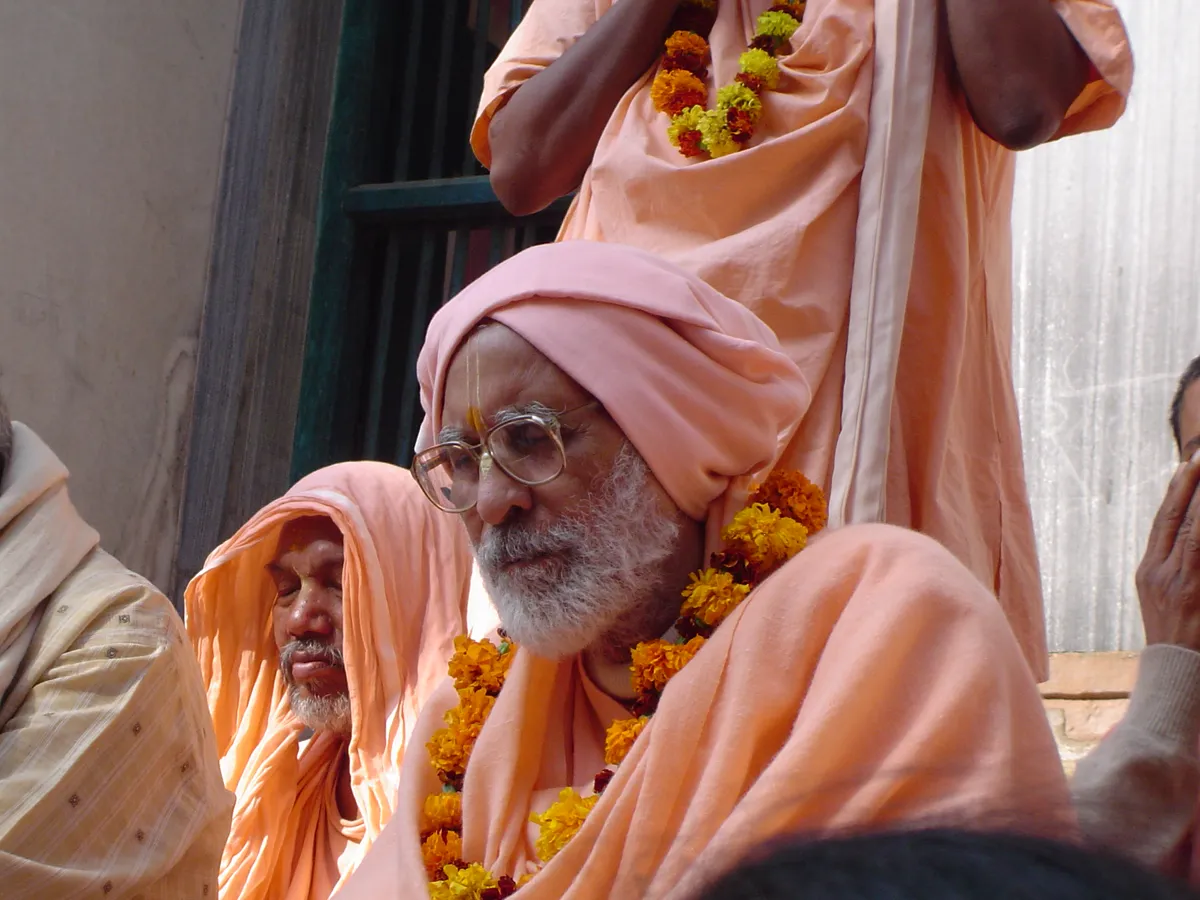
Śrīla Gurudeva: So, the Western countries had no background or even a smell of Kṛṣṇa consciousness. I know that is very hard to sow the seed of devotion in the Western countries. But, Svāmījī mercifully gave this seed of bhakti. If this seed is properly watered, tended to, and nourished, then leaves will gradually unfurl and this seed will take the form of a very, big tree. It may also take the form of a beautiful creeper. This tree or creeper will cross the heavenly realms and enter the spiritual sky. It will also cross the abodes of Vaikuṇṭha, Ayodhyā, Dvārakā, Mathurā and will finally find shelter at the lotus feet of Kṛṣṇa in Vṛndāvana. So, it is very difficult to sow this seed of devotion in anyone, especially in someone who has a dry heart. The vairāgyamāna-puruṣa, or the heart of he who has no attachment to worldly desires or anything is like a desert. No seed will germinate there. The heart of someone who is excessively attached to this world is also like a desert. The heart of someone who is excessively detached is also like a desert. The heart of an excessively attached person is like a cold desert where no seed can be sown, while the heart of an excessively detached person is like a hot desert filled with sand. Even a powerful seed sown here will not sprout.
So, Śrīla Svāmī Mahārāja miraculously made these two kinds of desert like hearts, very fertile. He made them fertile by his hari-kathā, by his exposition on the pastimes of Kṛṣṇa and by his own practice of bhakti. If you aren’t practicing bhakti and have not established yourself in the line of devotion, then you may chant harināma ten lakh times, but no change will manifest. Śrīla Bhaktivinoda Ṭhākura and all our ācāryas have practiced devotion to Kṛṣṇa themselves, and then they have preached what they have practiced. Śrī Caitanya Mahāprabhu has ordered His devotees to practice and then preach.
āmāra ājñāya guru hañā tāra’ ei deśa
Caitanya-caritāmṛta, Madhya-līlā 7.128
First, practice devotion in your lives. Your behavior must reflect your devotion. And then, if you have realized something; preach to others. They will also become devotees. Being trained by its master, a parrot repeats, “Hare Kṛṣṇa Hare Kṛṣṇa.” But, if a cat comes and attacks the parrot, the parrot forgets to repeat Hare Kṛṣṇa, and instead, shouts for its master. So, we should not be like a parrot that only repeats what it has been told. We just sang the bhajana, ‘śrī guru-caraṇa-padma kevala bhakati-sadma.’ In this song, we find the words, ‘divya-jñāna hṛde prakāśita.” What is the meaning of these words? We should realize the import of this bhajana. If you are chanting like a parrot, you will not have prema-bhakti. The chanting will create some good impressions, impressions that karmīs (materialists) and yogīs seek, acquiring which they will be very happy in this world. You can also get salvation by this nonchalant chanting, but you will not get vraja-prema for which Caitanya Mahāprabhu, our Guru-varga, and Svāmījī came to give to the conditioned souls of this world. You will not be able to attain this prema. ‘Divya-jñāna hṛde prakāśita.’ What is divya-jñāna? You will have to try to know what divya-jñāna is. ‘Cakṣu-dāna dilā jei janme janme prabhu sei divya-jñāna hṛde prakāśita.’ Chanting, chanting, and also engaging in kīrtana to the accompaniment of the playing of the harmonium, mṛdaṅgas, karatālas, and dancing; but not knowing anything of this divya-jñāna, transcendental knowledge, then what will be the effect? You should try to know the deep underlying moods of this kīrtana. ‘Cakṣu-dāna dilā jei.’ What is cakṣu-dāna? It is the vision by which you will realize that you are not this physical, mortal body. You may manage to have all worldly requirements and facilities like how Hiraṇyakaśipu did, he had many boons that made him nearly invincible or like Rāvaṇa, who ruled over the city of Laṅkā, which was made entirely of gold. He didn’t have only son. He had one lakh sons and one hundred, twenty-five thousand grandsons. Each son had a golden palace. Their kingdoms were far more advanced that any scientist could ever imagine. Scientists have made many countries like—England, France, Germany, and America very advanced, but yet, the citizens of these countries are not satisfied. Rāvaṇa could not be satisfied, he was killed with all his brothers, sons, and grandsons. The golden city of Laṅkā was burnt to ashes. Material facilities and advancements cannot help us. ‘Divya-jñāna hṛde prakāśita.’ We are all the servants of Kṛṣṇa, His part and parcels. We are not of this material world. We have come like refugees here for some days. We should realize this by divya-cakṣu, transcendental eyes. We should come to the conclusion that we cannot live in this world as refugees for more than hundred years. Out of those allotted hundred years, half of the time, is spent in sleeping. And those who are not jitendriya, who haven’t conquered their senses, they will sleep even more. They will sleep for more than twelve hours a day. So, one half of a person’s life is spent entirely in sleeping. And then, out of the remaining fifty years, twenty years or more will be spent during one’s childhood upbringing, and education, where the student wants to become a doctor, engineer, business man or a leader. By spending time in getting educated this way, they will be qualified to earn more and more, and thus, they will aim to fulfill their worldly requirements. So, a lot of time is spent in earning money. And in the age between eighty to hundred, you will become so old that you will not be able to move without the help of a stick. Your hair will become dry and your eyes will lose their power of sight. Your teeth will fall out. When the age of forty comes, your hair will start turning white, but being undeterred, you will have them removed. But after single strand of hair is removed, on the next day, you will see that many strands of hair have turned white. After some time, you will see that half the hair on your head has turned white. Then you will think, “What to do?” At that time, you will not be able to do anything, you cannot do anything. You will be old, and after that, you will die. Therefore, out of hundred years; fifty years is spent in sleeping; twenty years is spent in an upbringing and on one’s education. Old age will conquer twenty years. This way, ninety years is lost. For the remaining ten years, you will plan and think, “I have to marry. I have to raise children and make them qualified. I have to earn enough money to buy a television, car, and many other things.” Sitting within your living room, by the medium of the television, you will see all that is happening around the world. Sitting and lying down in your home, you especially want to see football and cricket. [Laughter] So, the remaining ten years will also pass this way. When will you realize, “I should serve Kṛṣṇa.” But, even if you desire to serve, you will have no time. You should try to serve Kṛṣṇa from your boyhood. And to aid you in your service to Kṛṣṇa, you must have the association of bona fide Guru and Vaiṣṇavas. If you don’t follow the instructions of Śrī Guru and Vaiṣṇavas, you will not be able to proceed an inch in the realm of bhakti. ‘Kṛṣṇa-bhakti janma mūla haya sādhu-saṅga.’ Sādhu-saṅga is the mother of kṛṣṇa-bhakti. If there is no sādhu-saṅga, there is no bhakti. But sādhu-saṅga is rarely found in this world. Sādhu-saṅga is very rare indeed. There are many people who don the guise of a sādhu, they will wear red cloth and claim that they are of the renounced order. But they have no divya-cakṣu, transcendental eyes. So, many problems come. Hence, it is stated here that a person should be in sādhu-saṅga from the beginning of his life and accept the shelter of a real guru. [CC-by-NDNC Bhakta Bandhav]15 May 1996 Radlett