When Every Action Becomes an Offering
How one week transformed our understanding of devotion, parenting, and the sacredness of everyday life.
Some journeys are delayed not because they are meant to be forgotten, but because they are quietly making their way toward us—patiently, invisibly, through doors we hadn't noticed were opening.
For years, we dreamed of visiting New Braj in Badger, California, and experiencing the Bhakti Kids Camp there. Each time we hoped to go, the pandemic or other circumstances placed another obstacle in our path. Although that journey never came to pass, Krishna had a different destination in mind—one we didn't know we were waiting for. He opened another door, leading us to Bhakti Kids Camp at Bhakta Bandhav Ashram in Ellenville, New York.
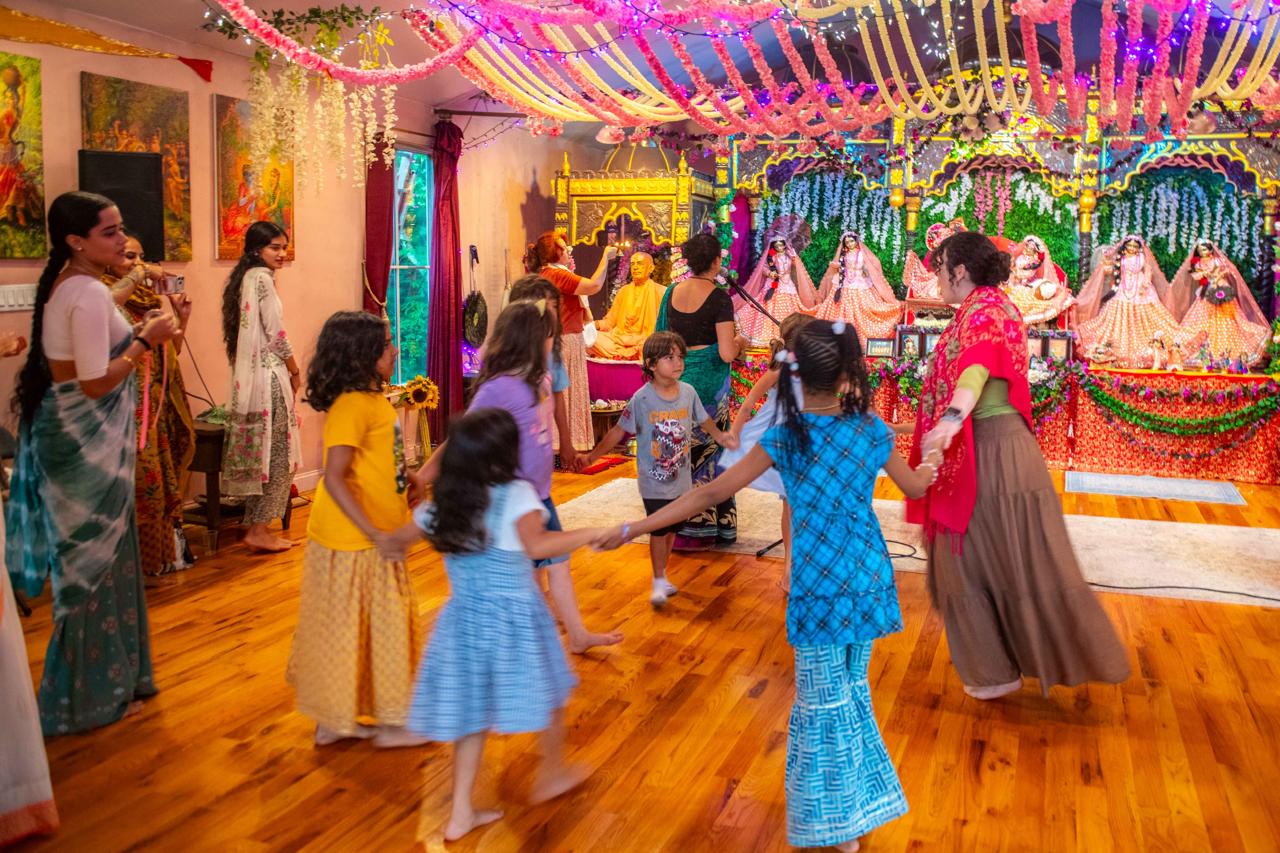
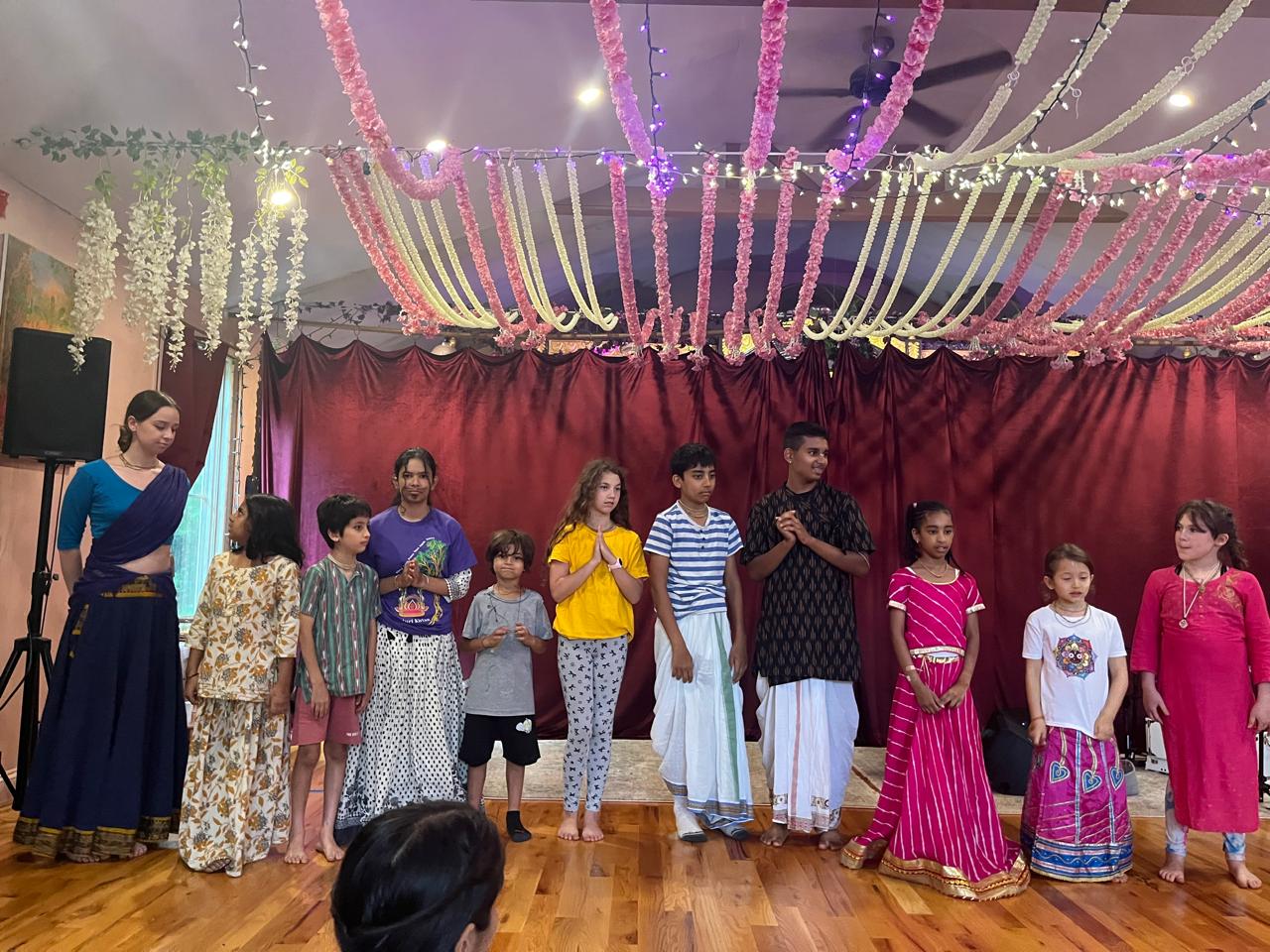
When Hari finally arrived at his first Bhakti Kids Camp, it felt as though a long-awaited prayer had finally found its answer—not in the place we had imagined, but in the one Krishna had been preparing all along.
This was more than a summer camp. It was his first taste of ashram life—where the day began and ended with chanting, where service was woven into every moment, and where friendships were forged not in competition, but in shared devotion.
The Why Behind the Ritual
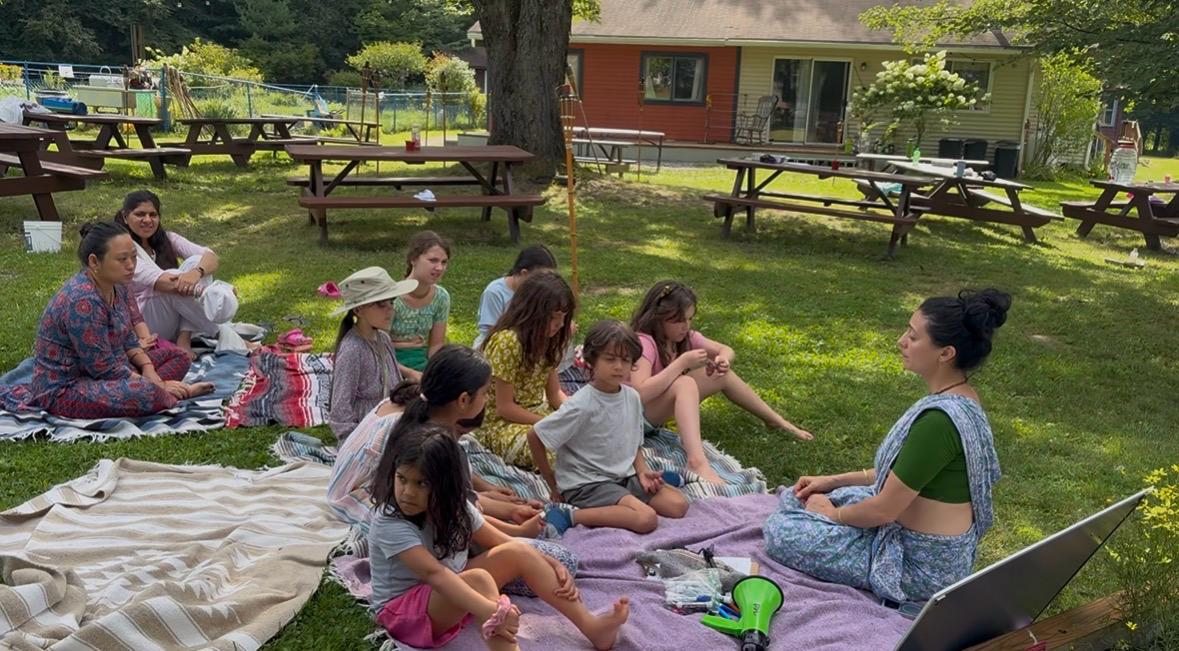
Many of us grew up in Vedic or Hindu families, learning to wear tilak, offer food, visit the temple, and participate in ceremonies—because these practices were simply part of life. At camp, however, the children were invited to look beneath the surface—to the meaning waiting there. They learned not only what we do, but why we do it—and how each small act can become a living expression of devotion.
As I watched him move through the days, I found myself drifting back to my own childhood—to the rituals we followed without ever being told why, to the traditions we honored but never truly felt. I had performed them, but I had not lived them. I wished, with a quiet ache, that someone had once explained them to me with the same warmth and tenderness these children were receiving.
When the children applied tilak each morning, they weren't just following a routine—they were marking themselves as Krishna's own, a quiet promise written not in words, but on their skin. They learned why bhoga is offered to Thakurji before we eat—and how that simple act transforms ordinary food into prasadam: love received, blessed, and returned.
These were not just lessons for children—they were reminders for the adults watching them.
They learned to chant japa on Tulasi beads, holding each bead between thumb and finger with care and reverence, as if touching something sacred. Through these gentle, practical lessons, familiar customs took on new life. What once seemed like ritual became personal, intimate, and alive.
The children didn't just learn bhakti—they caught it, like a smile or a yawn, from the people around them.
A Seed Planted
The children learned the Mahamantra and several sacred verses—including this timeless teaching from the Bhagavad-gita:
यत्तपस्यसि कौन्तेय तत्कुरुष्व मदर्पणम् ॥ ९.२७ ॥
yat tapasyasi kaunteya tat kuruṣva mad-arpaṇam
Most of the children already knew the Mahamantra:
Krishna Krishna Hare Hare
Hare Rama Hare Rama
Rama Rama Hare Hare
But at camp, they learned its meaning and purpose—not as words to recite, but as a call to connection, a rhythm of remembrance, a way to quiet the mind and open the heart. They discovered that the mantra is not a mechanical repetition but a living conversation with Krishna—a thread that ties every moment of the day to Him.
The Yat Karoshi verse (Bhagavad-gita 9.27) planted a seed in their young hearts: spiritual life is not confined to the temple or to formal prayer. A garland, a song, a helping hand, a meal—all could become seva when offered with love.
The children learned that Krishna is our protector, our dearest friend, and the ultimate goal of our journey—not a distant deity, but the closest companion. These teachings were not delivered as abstract philosophy but as living truths—woven into every game, every song, and every moment of their days.
Children absorb love when it is presented naturally. How much did I miss because I was taught with formality instead of joy?
The Fire That Carried Our Prayers
They also participated in a yajña, a fire sacrifice. For the children, this was not just a ritual to watch—it was an experience to enter.
As the sacred flames rose, they felt the warmth on their faces and heard the crackling fire mingle with the rhythmic chanting of mantras. Some leaned in, wide-eyed, watching the flames dance toward the sky. Others sat quietly, mesmerized by the glow, as if the fire itself was speaking to them.
They learned that the fire was Agni, the divine messenger, carrying their prayers upward—not into emptiness, but into loving hands. They learned why we offer: because everything comes from Krishna and nature—and we offer it back with gratitude.
The ghee they poured came from Mother Cow, who gives us her milk, her butter, her very life. Offering it back was a way of saying thank you—a small act of trust, a letting go placed into the flames, where it rose as something greater than itself.
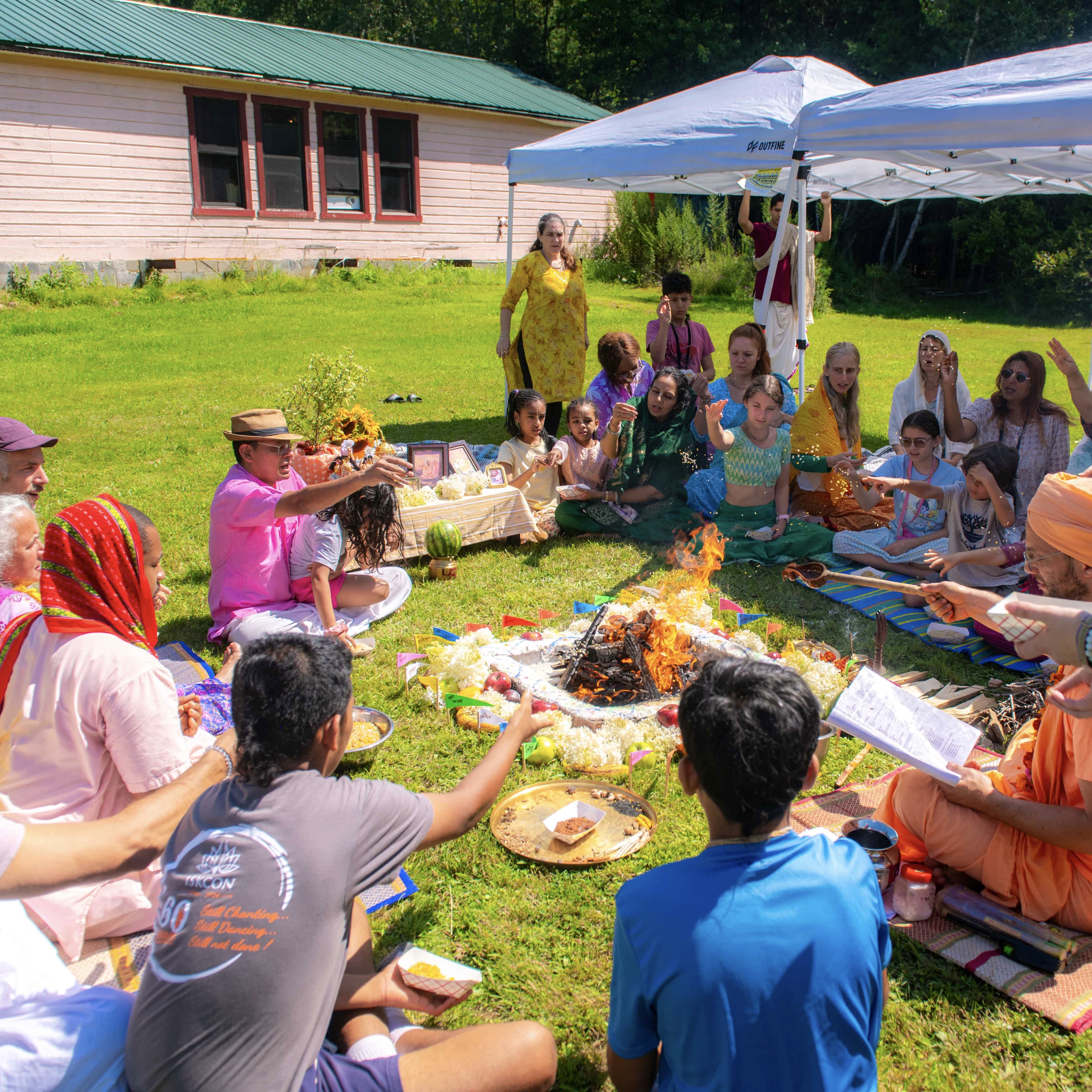
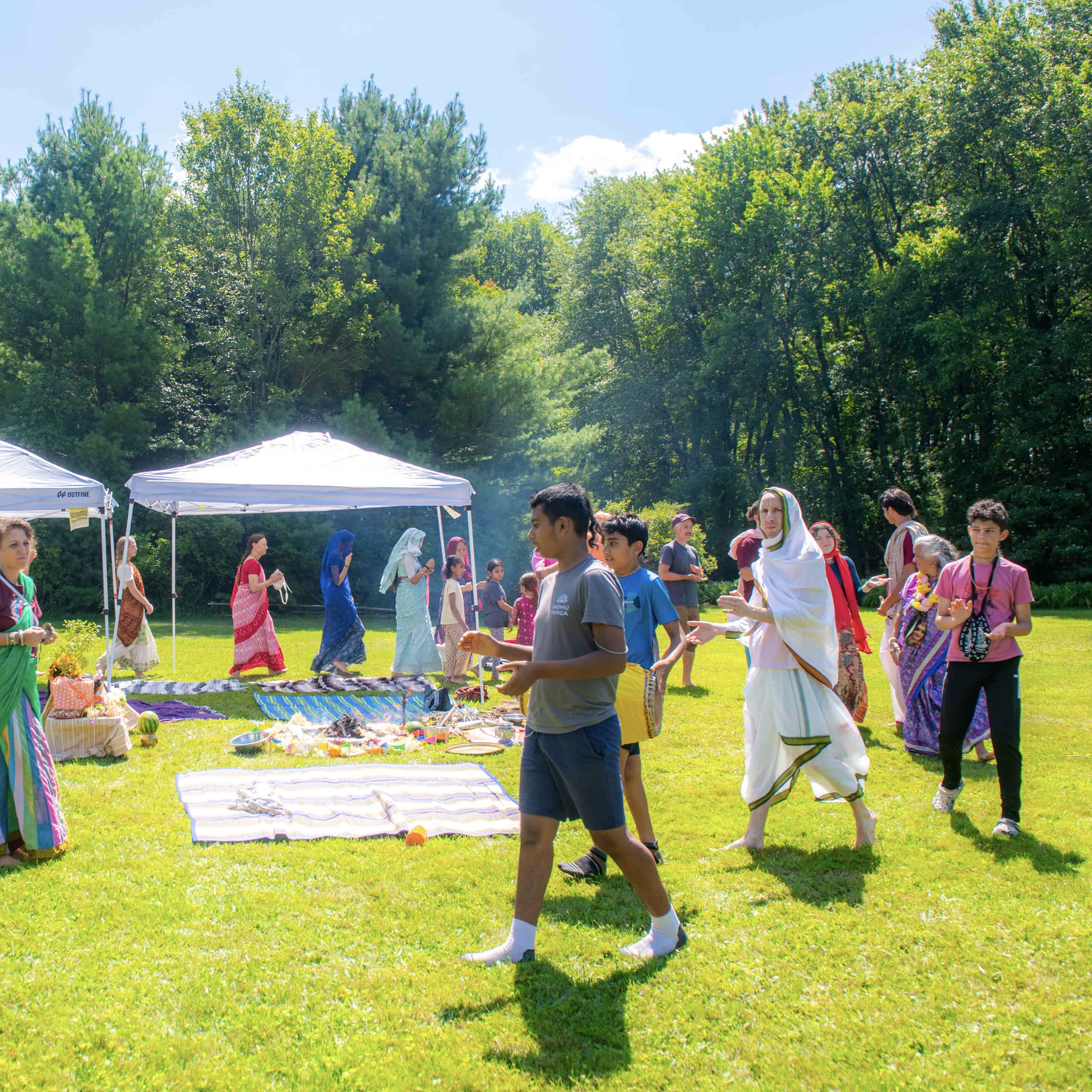
The scent of smoke and sandalwood, the sound of collective voices, the presence of community—it all created an atmosphere of reverence that reached beyond words. For the children, the yajña was not a lesson to memorize but a moment to feel—a quiet knowing that they were part of something ancient, sacred, and alive.
Stories That Came Alive
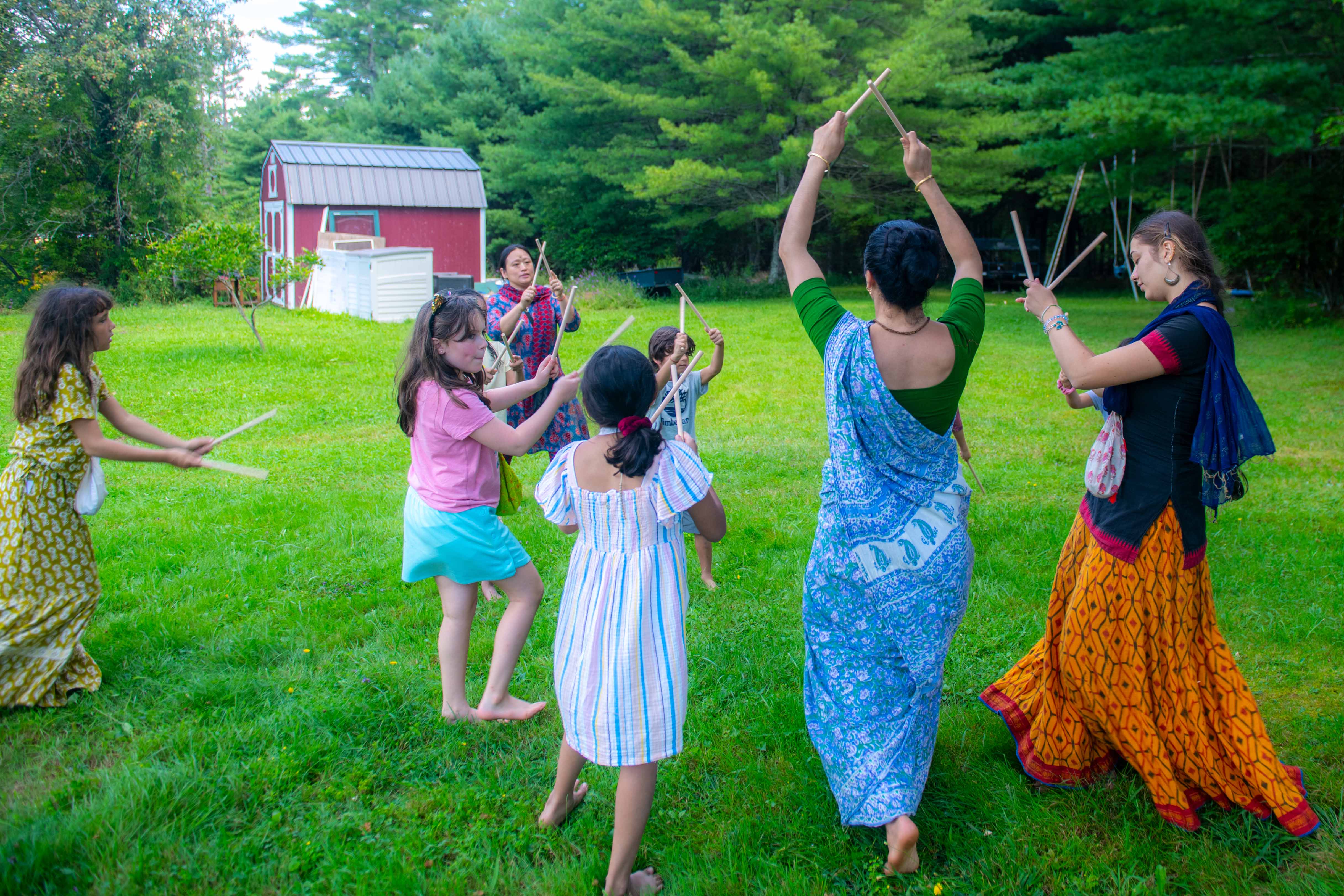
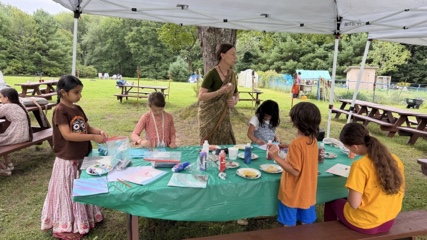
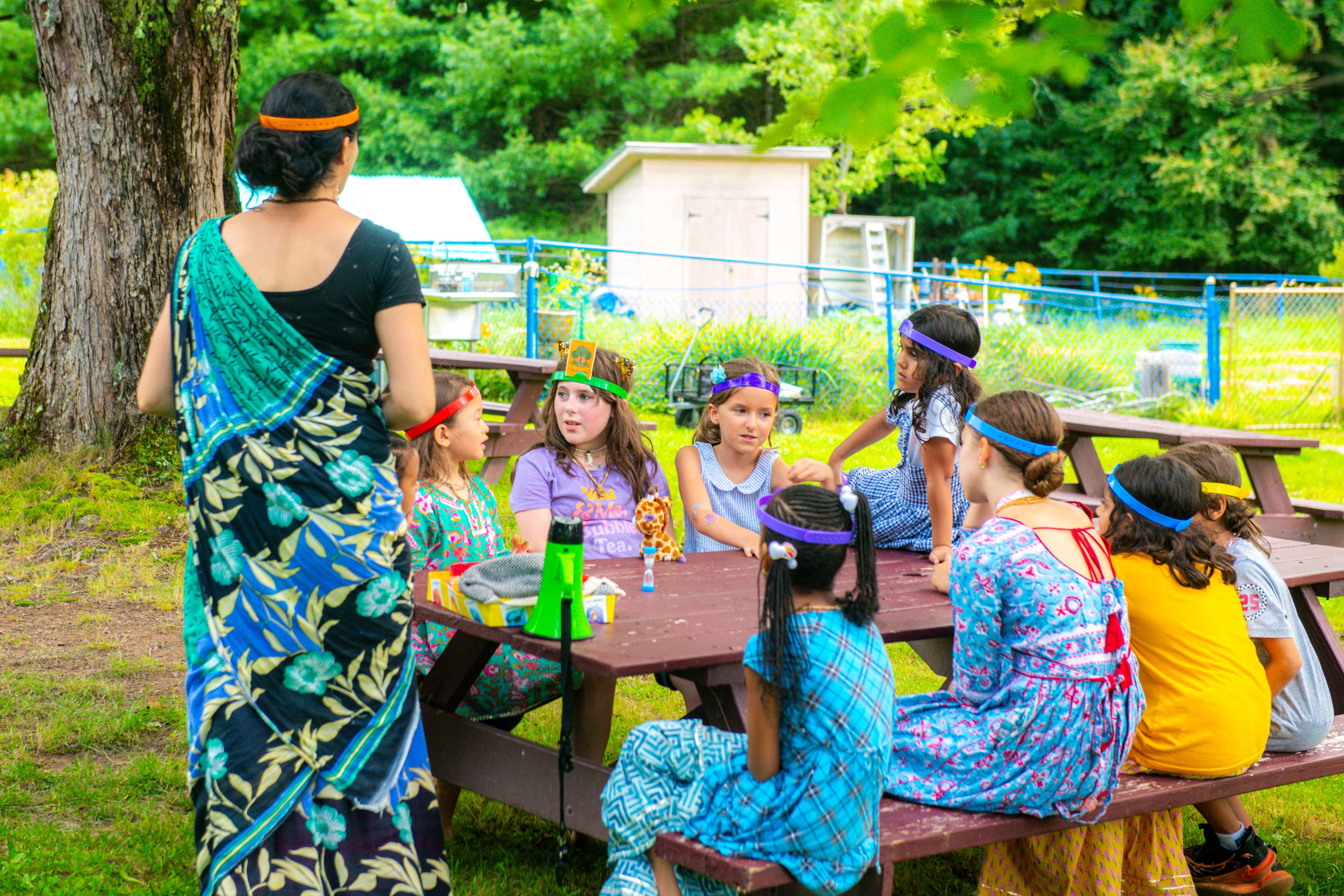
The camp blended these teachings with dancing, singing, painting, archery, and drama—each activity a doorway. The children performed two plays—one about Krishna lifting Govardhan Hill to humble the proud Indra, and another about the origins of the Kheturi festival. Through these performances, they brought sacred stories to life with their own voices and movements.
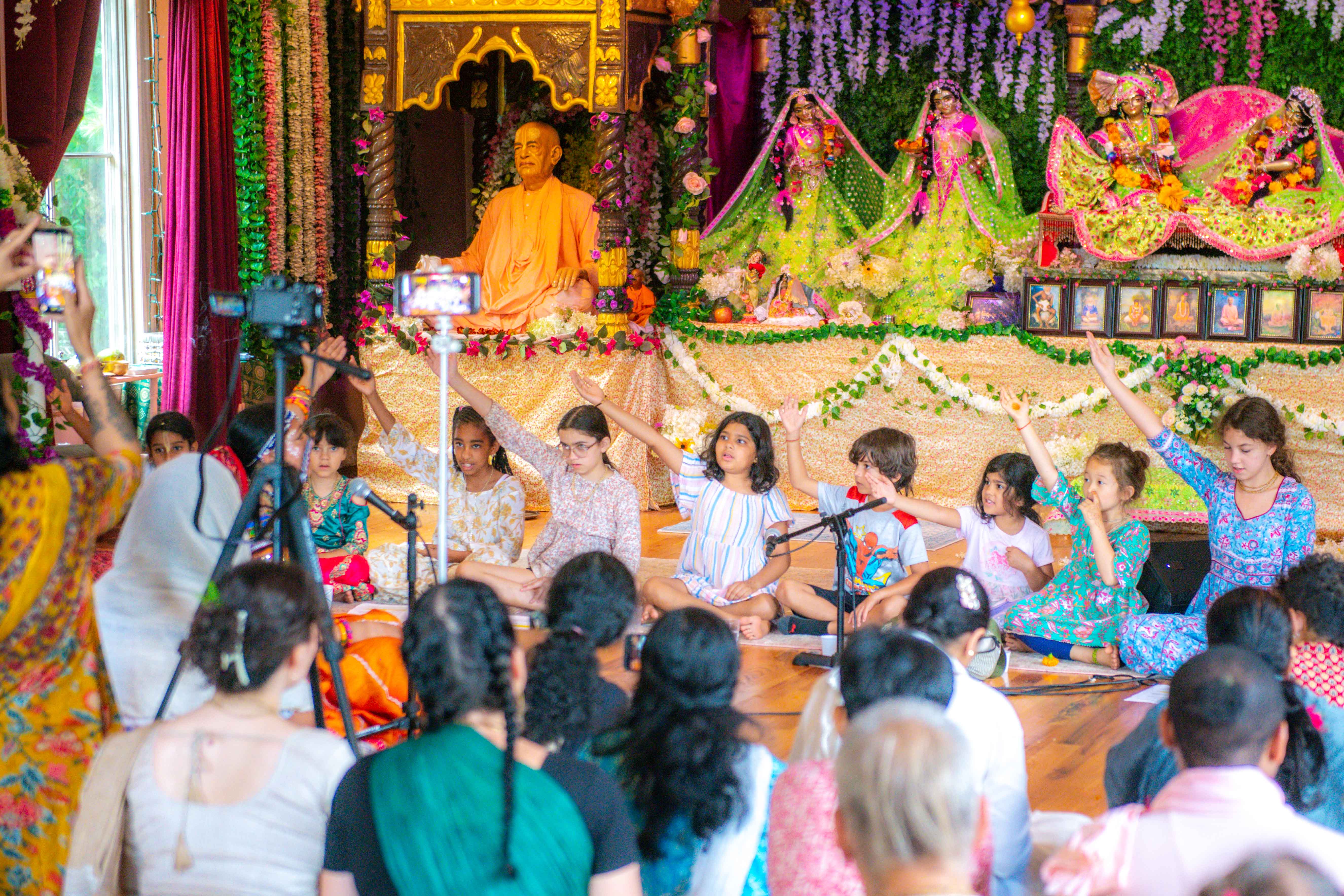
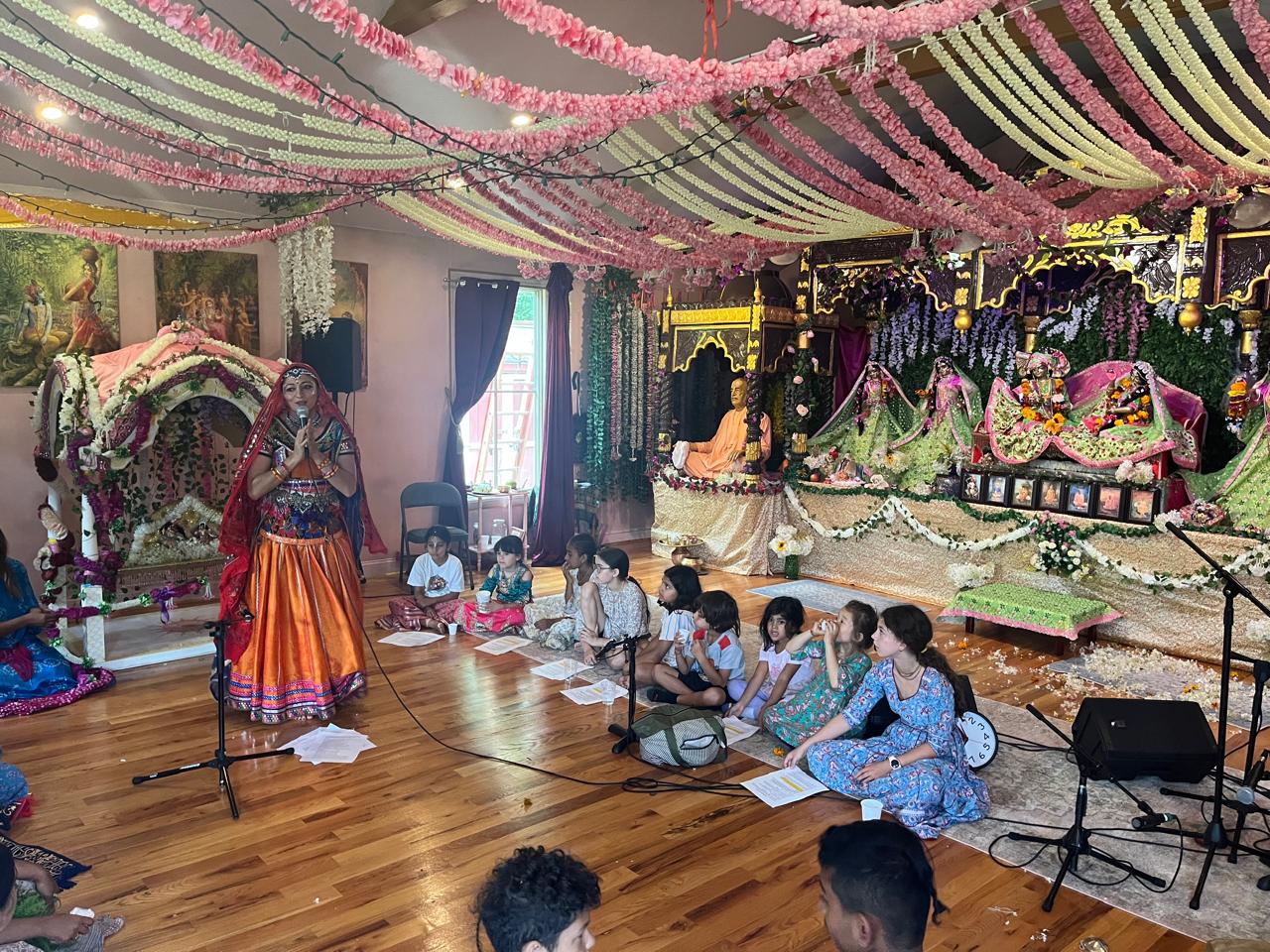
The lesson that stayed with them was clear: pride creates distance, while humility and surrender bring us closer to Krishna. They saw how Krishna protects those who trust Him, and how He gently breaks through arrogance to reveal the strength of faith.
Yet, as I watched Hari take part in these stories, I saw something in his eyes—a quiet wonder mixed with struggle.
He understood the lesson intellectually, but he kept asking me afterward: "How do you actually remove ego? How do you know if you're being proud?"
It is one thing to hear that pride is an obstacle; it is another to know how to let it go. That question stayed with him. And honestly, it stays with me too.
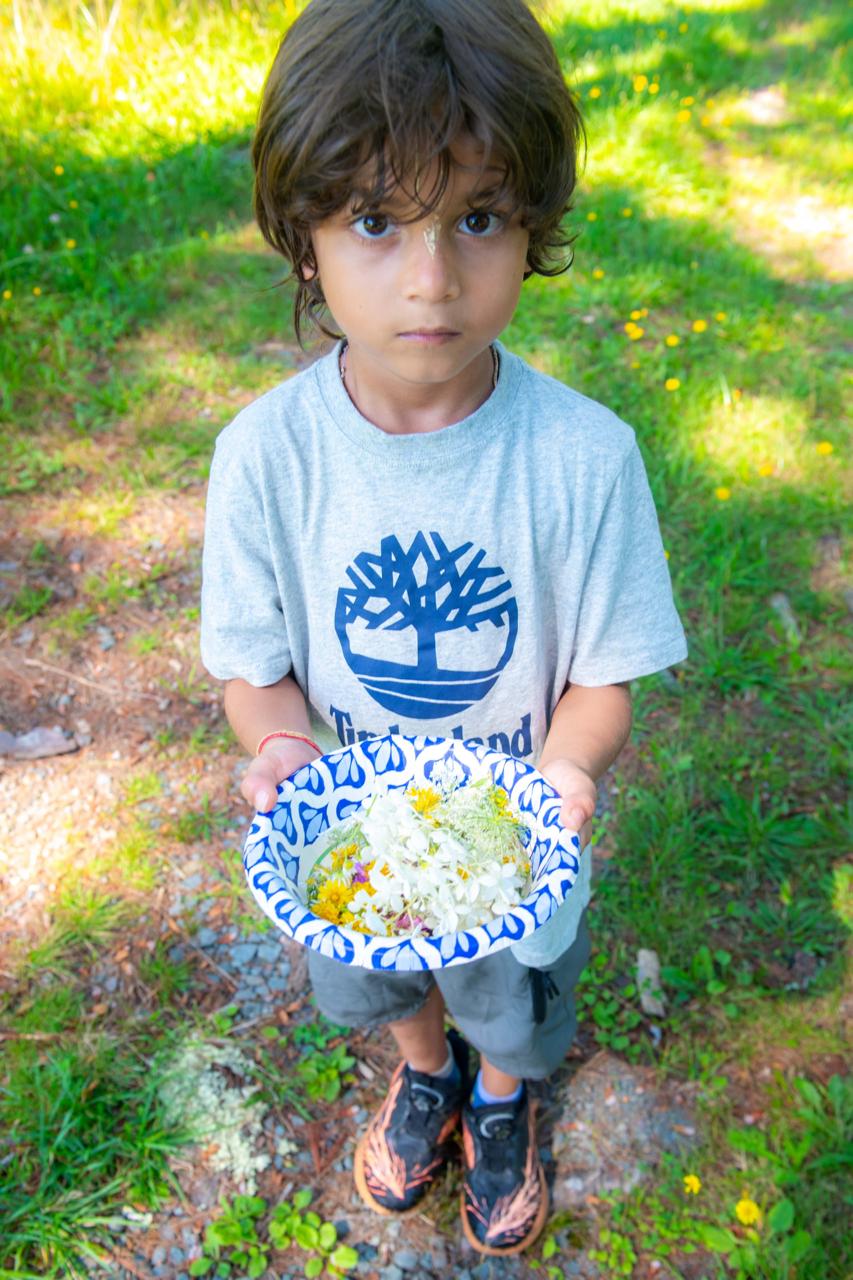
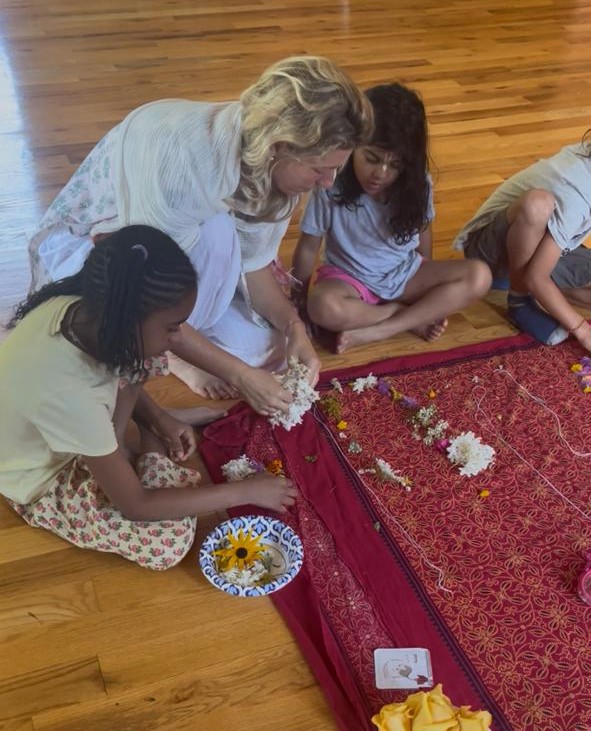
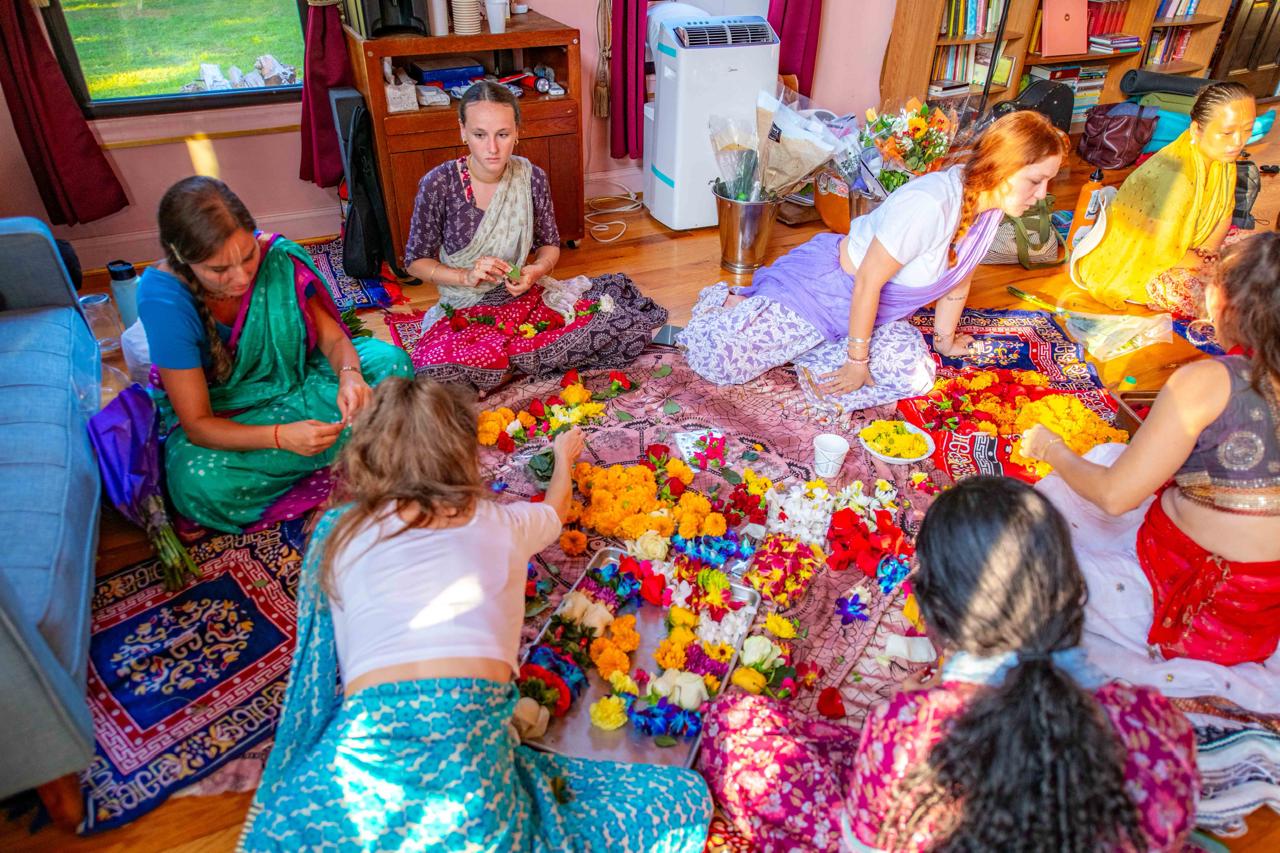
Weaving meadow flowers into garlands and offering them to Krishna taught the children to see nature not as a backdrop, but as part of their seva. Helping to decorate and gently swing the beautiful Deities of Radha and Krishna gave them another intimate experience of service—hands busy, hearts full. What might have appeared as simple crafts were, in truth, acts of love.
I came to the camp thinking I was giving my child an experience. I left realizing he had given me one instead.
What the Mountain Taught Us
The ashram itself was one of the children's greatest teachers—patient, unhurried, and vast.
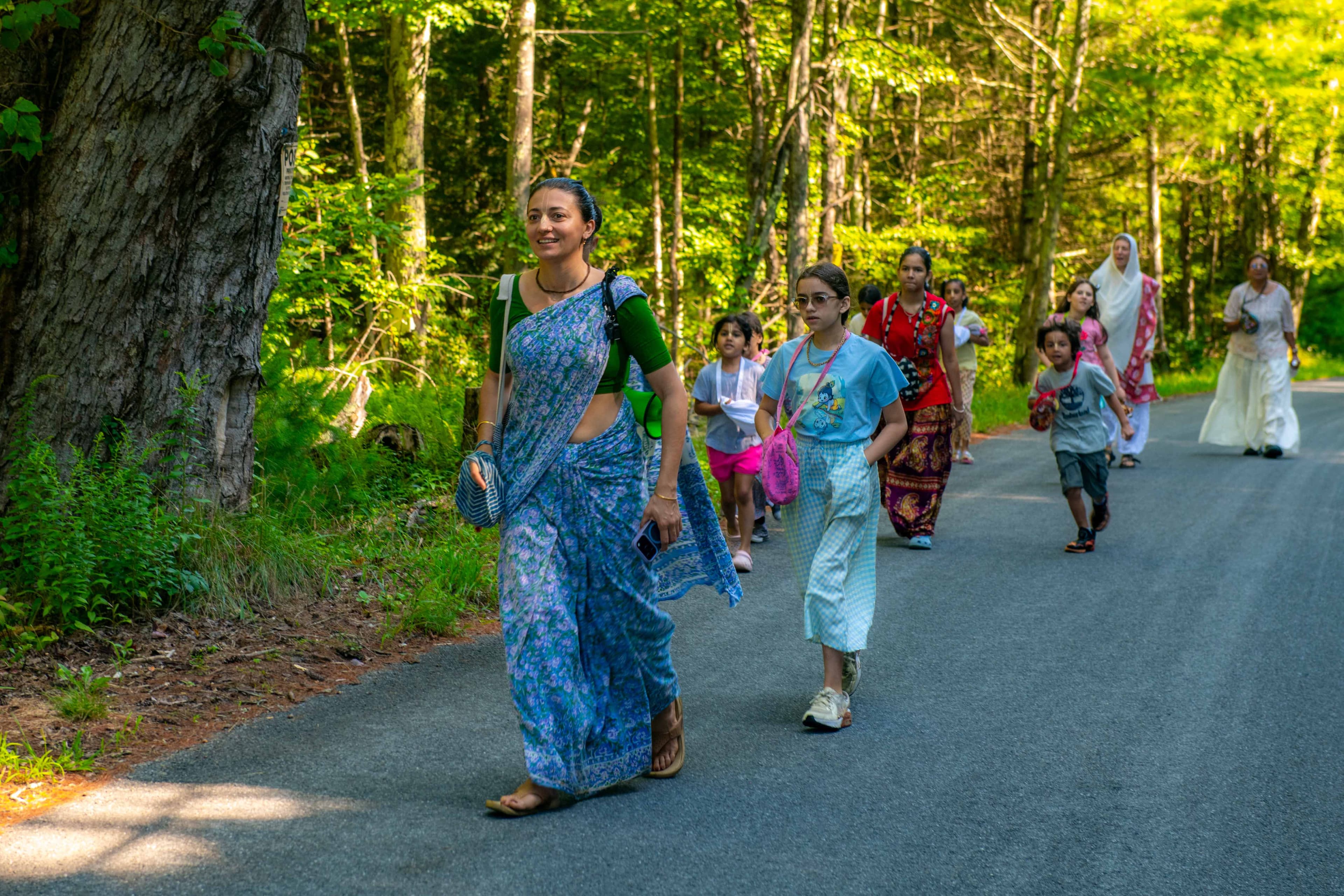
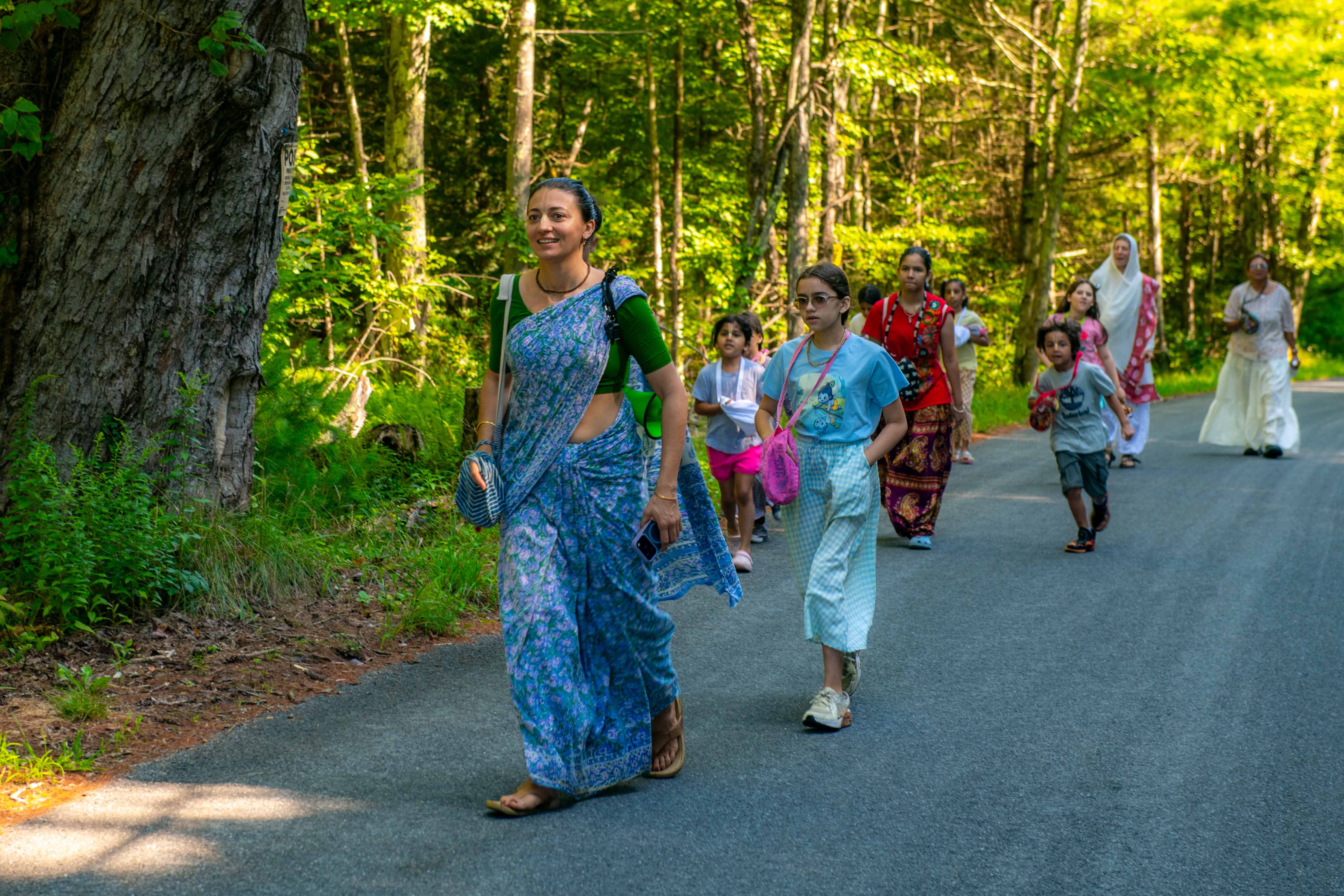
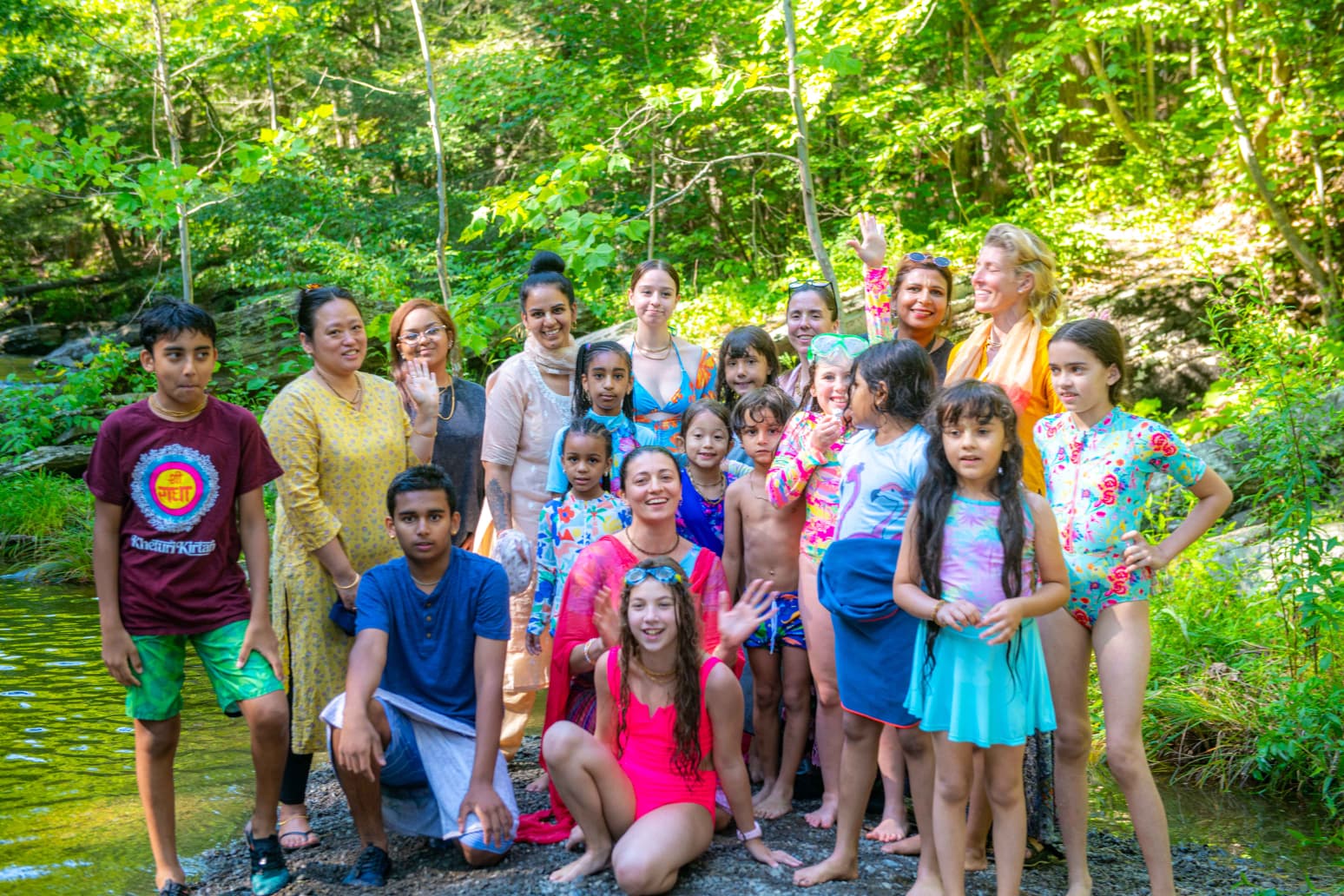
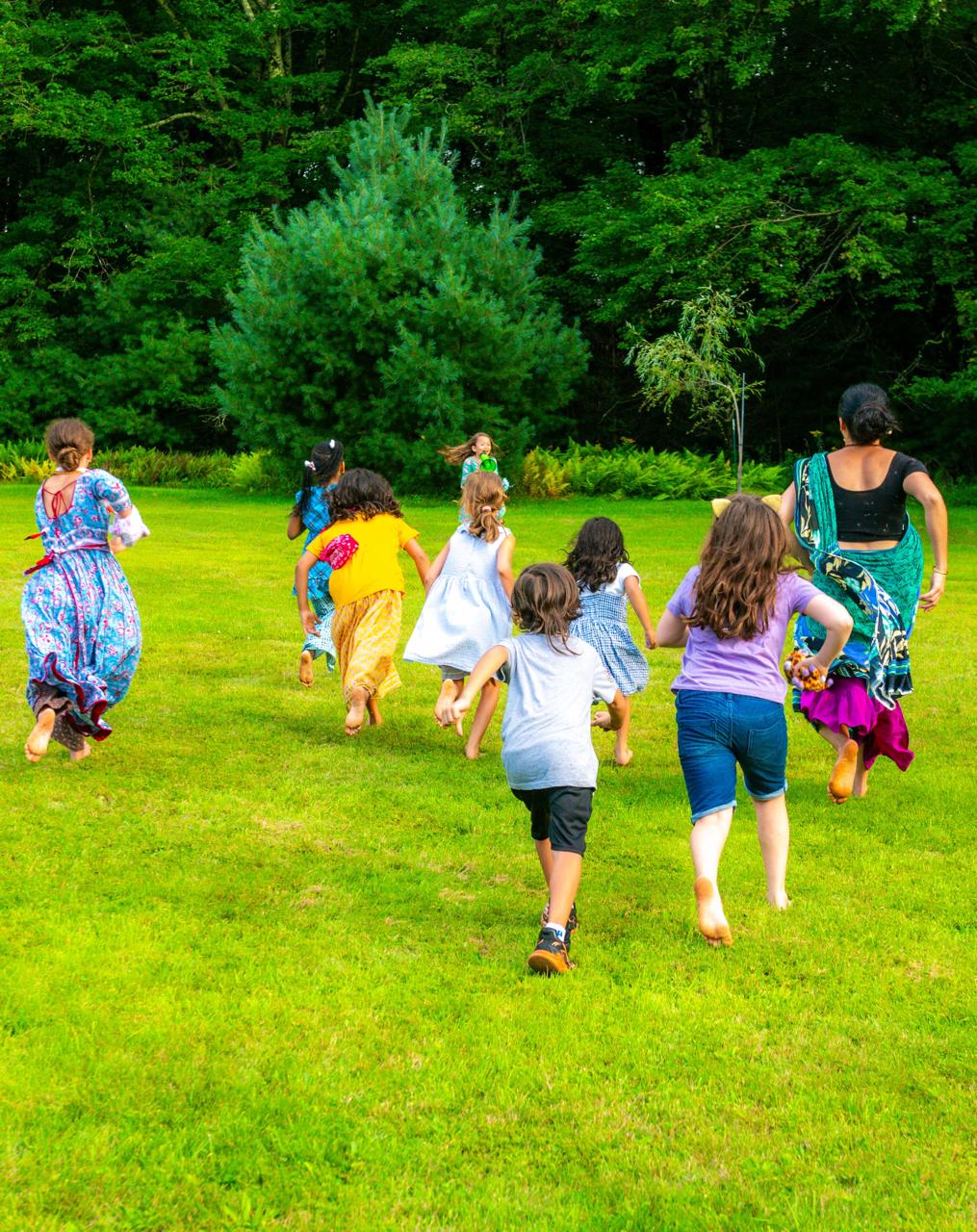
They crossed clear creeks, wandered through the forest, played near the river and cliffs, walked barefoot across the grass, and spent long hours gazing up at the stars. These experiences gave the children a sense of freedom while rooting them in the natural world—feet on the earth, eyes on the sky.
The ashram was not merely a place where they attended classes—it was a living landscape in which they could explore, learn, and experience wonder.
The forest taught them what no classroom could: that Krishna is not just in the temple—He is in the patience of a climbing trail and the generosity of a shared marshmallow.
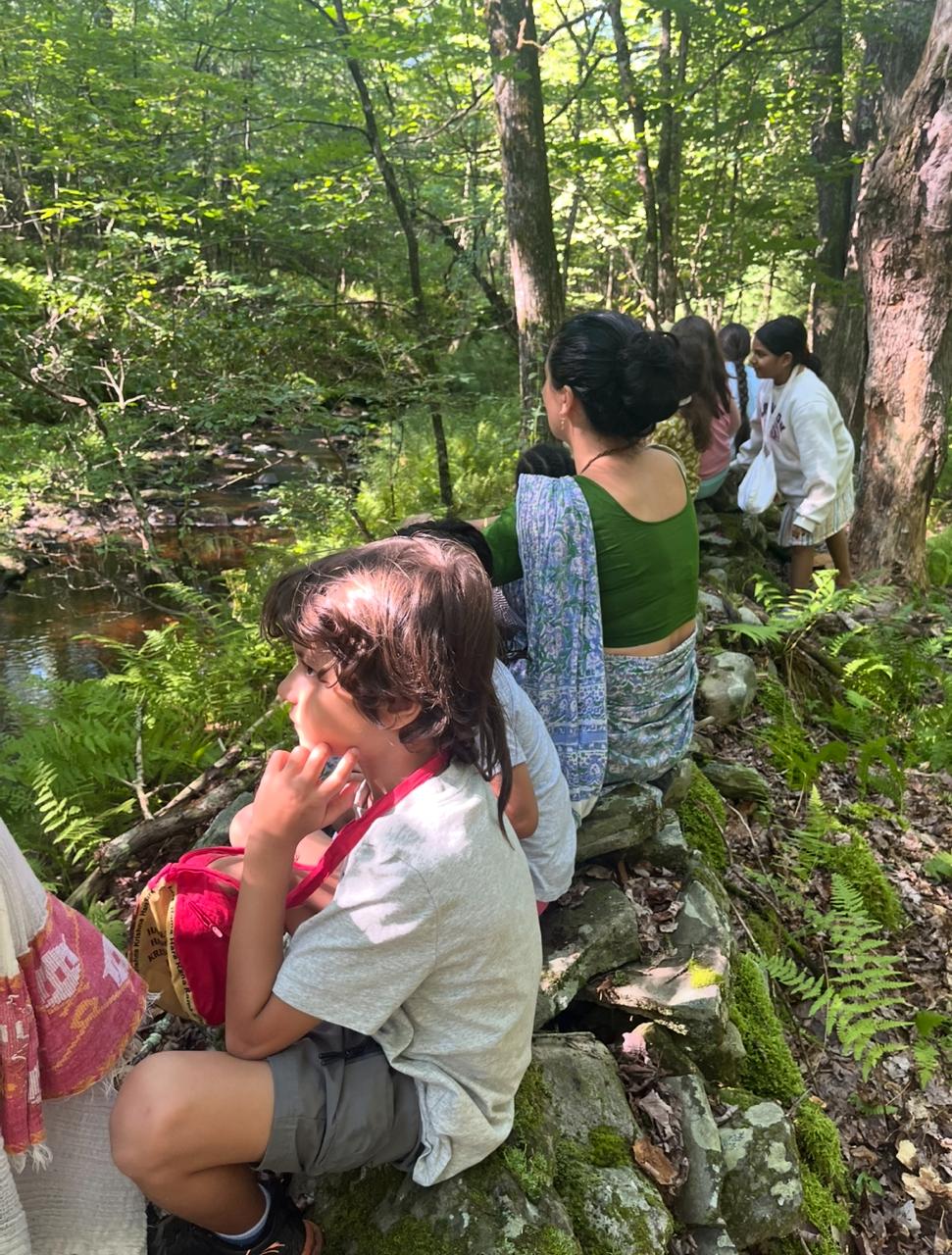
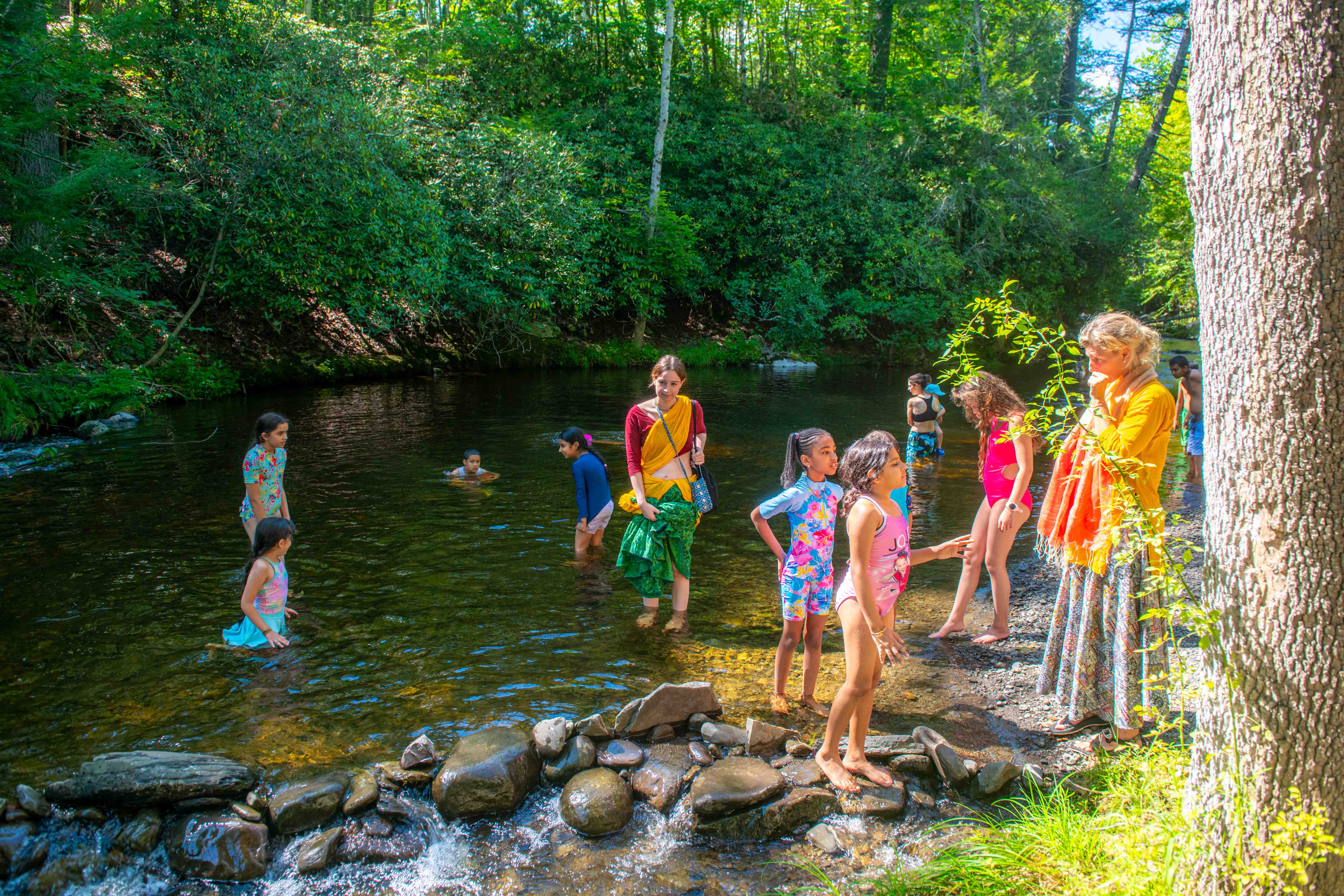
One of the most memorable adventures was the hike to the mountain overlook. From the cliff, broad valleys stretched into the distance beneath the vast sky. On a clear day, we were told, it was possible to see parts of three states.
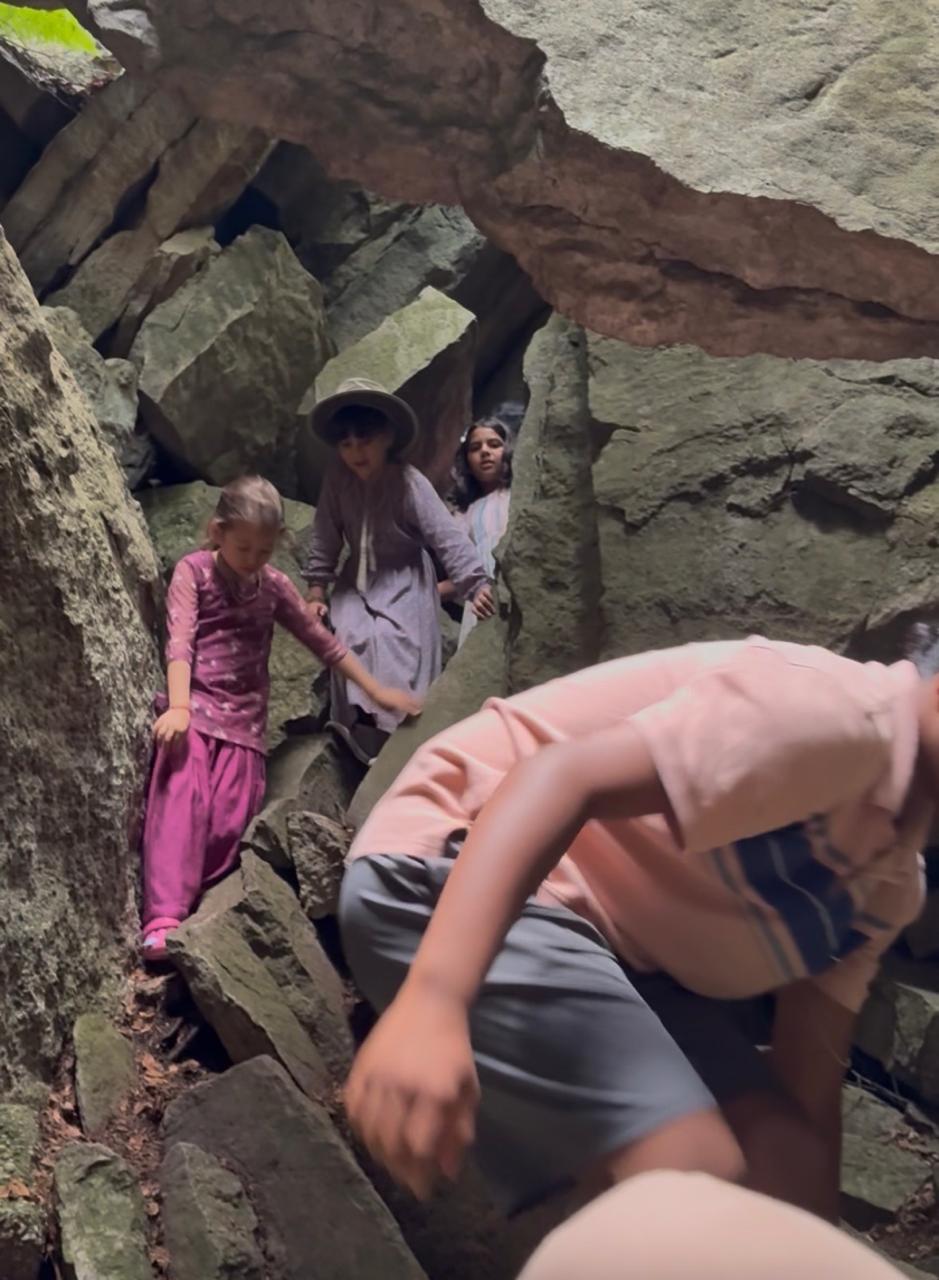
The hike to the cave—and the climb back along the narrow path—were challenging. There were moments when the trail felt steep and tiring, but the children encouraged one another and pressed onward. They discovered that difficulties become lighter when faced together—with patience, courage, and a shared sense of purpose.
How often do we carry our burdens alone? How much lighter might they feel if we let others walk beside us?
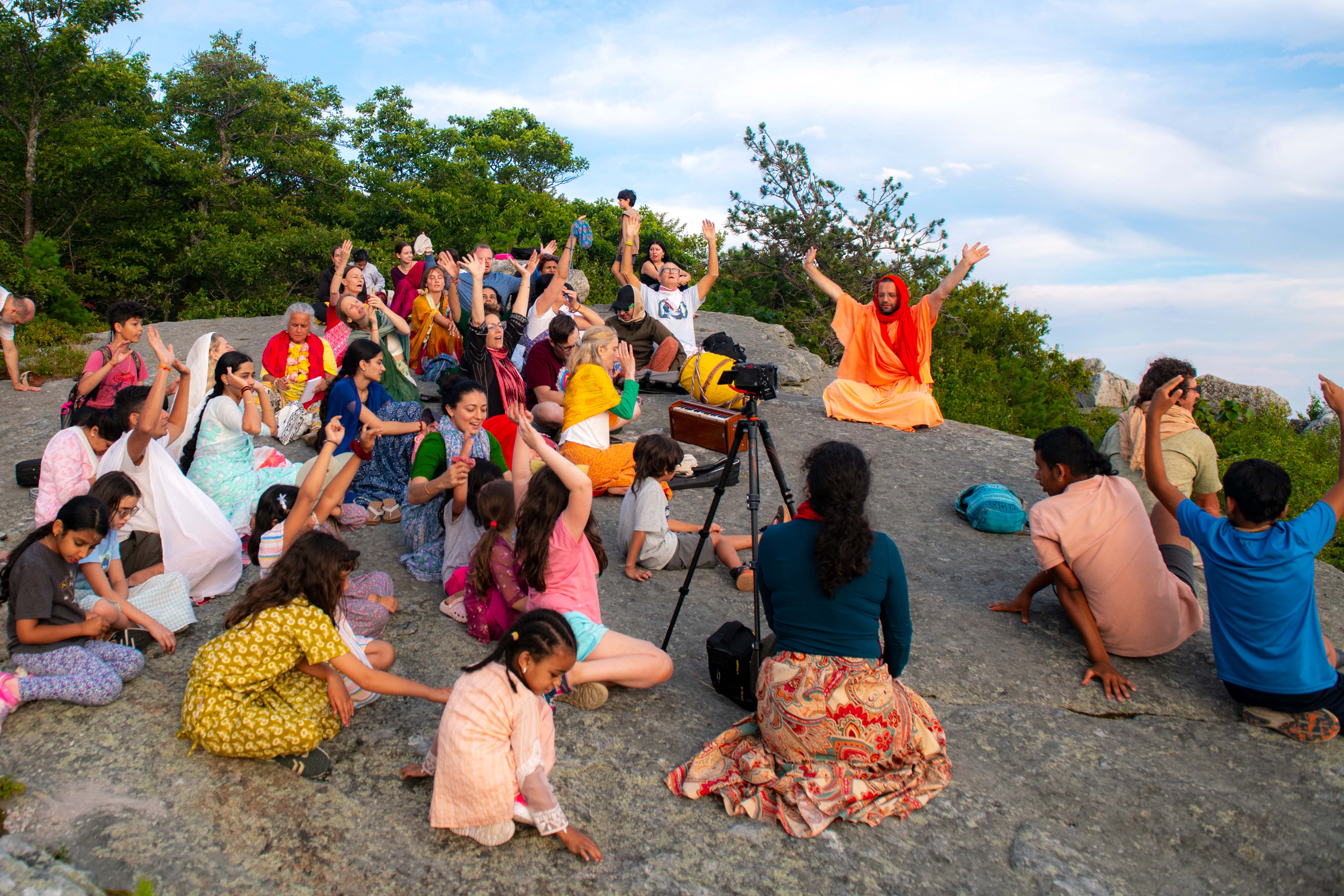
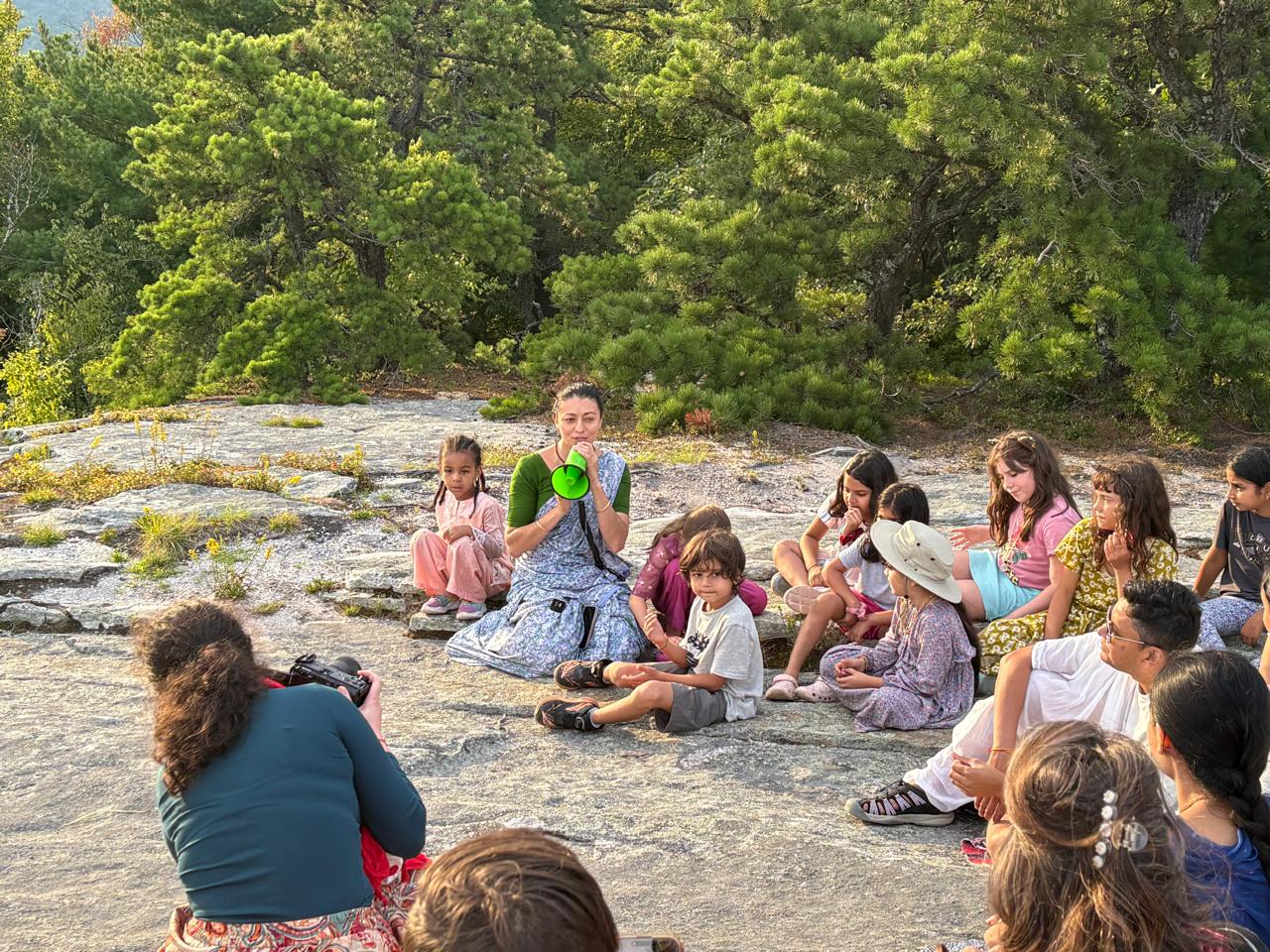
At the overlook, BB Rasikanand Maharaj and the devotees led sunset kirtan. The holy names rose into the evening air as the sun lowered itself behind the mountains—as if the earth itself was joining the prayer. Hearing Krishna's glories while surrounded by valleys, cliffs, and the changing colors of the sky—it was impossible not to feel small, and yet, impossibly held.
The hike became more than an outdoor excursion. It was an act of remembrance—an opportunity to appreciate Krishna's creation and offer gratitude for the divine source behind its beauty.
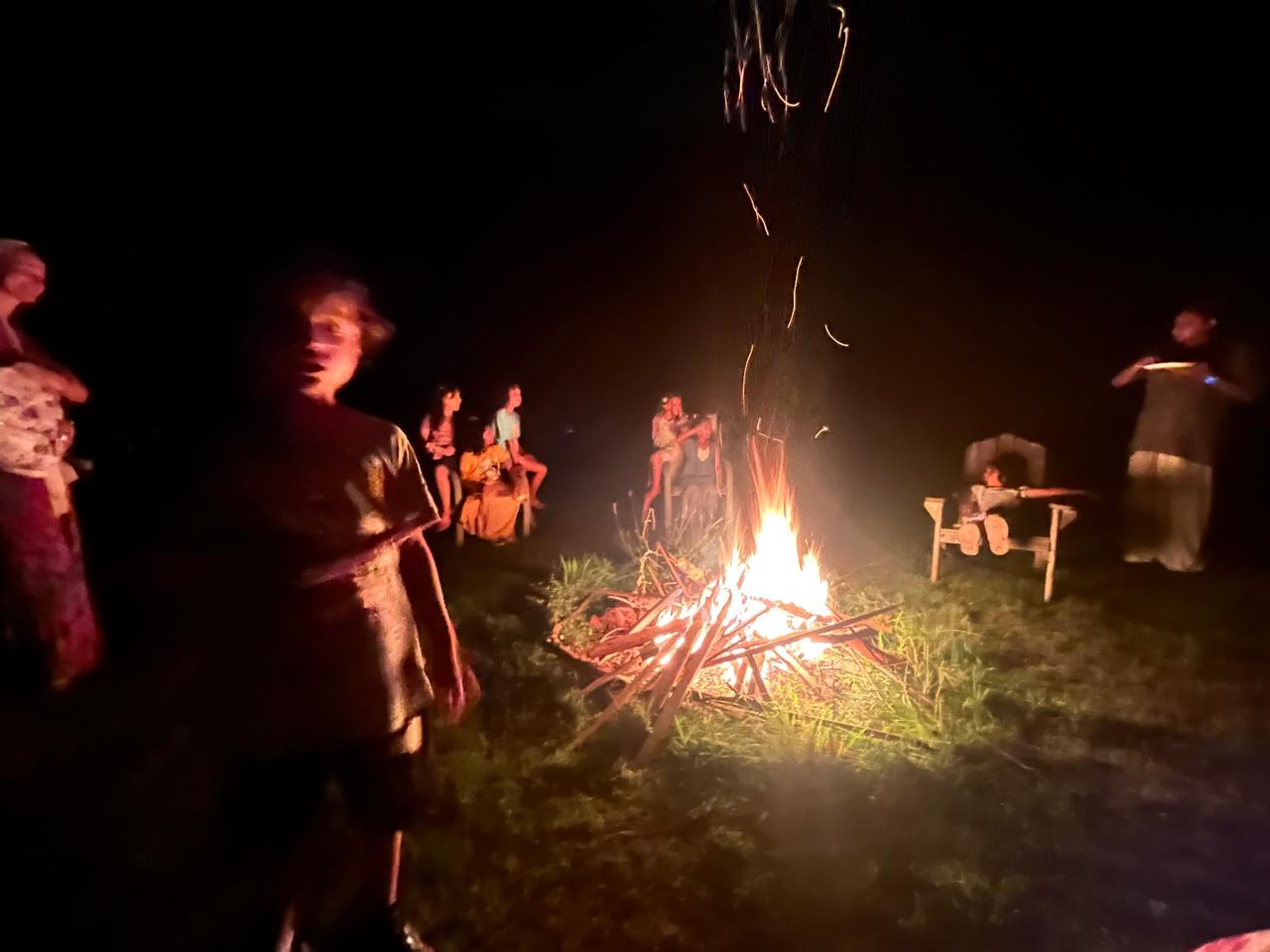
The campfires were especially memorable. The children gathered outdoors, watching the flames dance—each one a small sun in the dark. They learned to roast marshmallows—some were patient, others a little too eager, watching theirs catch fire with a burst of laughter. Their joy mingled with the crackling flames as they tried again. Afterward, they made s'mores and savored the simple happiness of being together beneath the open sky—no screens, no schedules, just presence. Maharaj and Malini Didi made these evenings even more special with treats and celebrations.
A Community That Felt Like Home
As a parent, I was especially grateful for the atmosphere of safety and trust at the camp—a place where I could breathe. I could attend temple programs, lectures, and seva without worry, knowing that Hari was cared for and surrounded by people who genuinely wanted the best for him.
Families had traveled from many cities and countries to attend the camp, yet the ashram quickly became a warm and welcoming community. People who arrived as strangers soon felt like old friends. When a child was hurt, everyone focused on helping rather than blaming. That compassionate response gave the parents a deep sense of reassurance—a quiet knowing that their children were in good hands.
How rare and precious it is to be in a place where people respond with care instead of judgment.
I am grateful to all the devotees who built and cared for Bhakta Bandhav Ashram. Every part of that place seemed to carry the imprint of the devotion, service, and sacrifice of those who had served there before us—their love lingering in the walls, the paths, the very soil. Their efforts created a sanctuary where children could learn about Krishna not only through formal instruction, but through the example of devoted lives—lived out loud.
Two Kinds of Service: Humility and Creativity
Gratitude to BB Rasikanand Maharaj
I am deeply grateful to BB Rasikanand Maharaj for his loving presence throughout the camp—a presence that felt less like instruction and more like love. He didn't just teach the children—he served them.
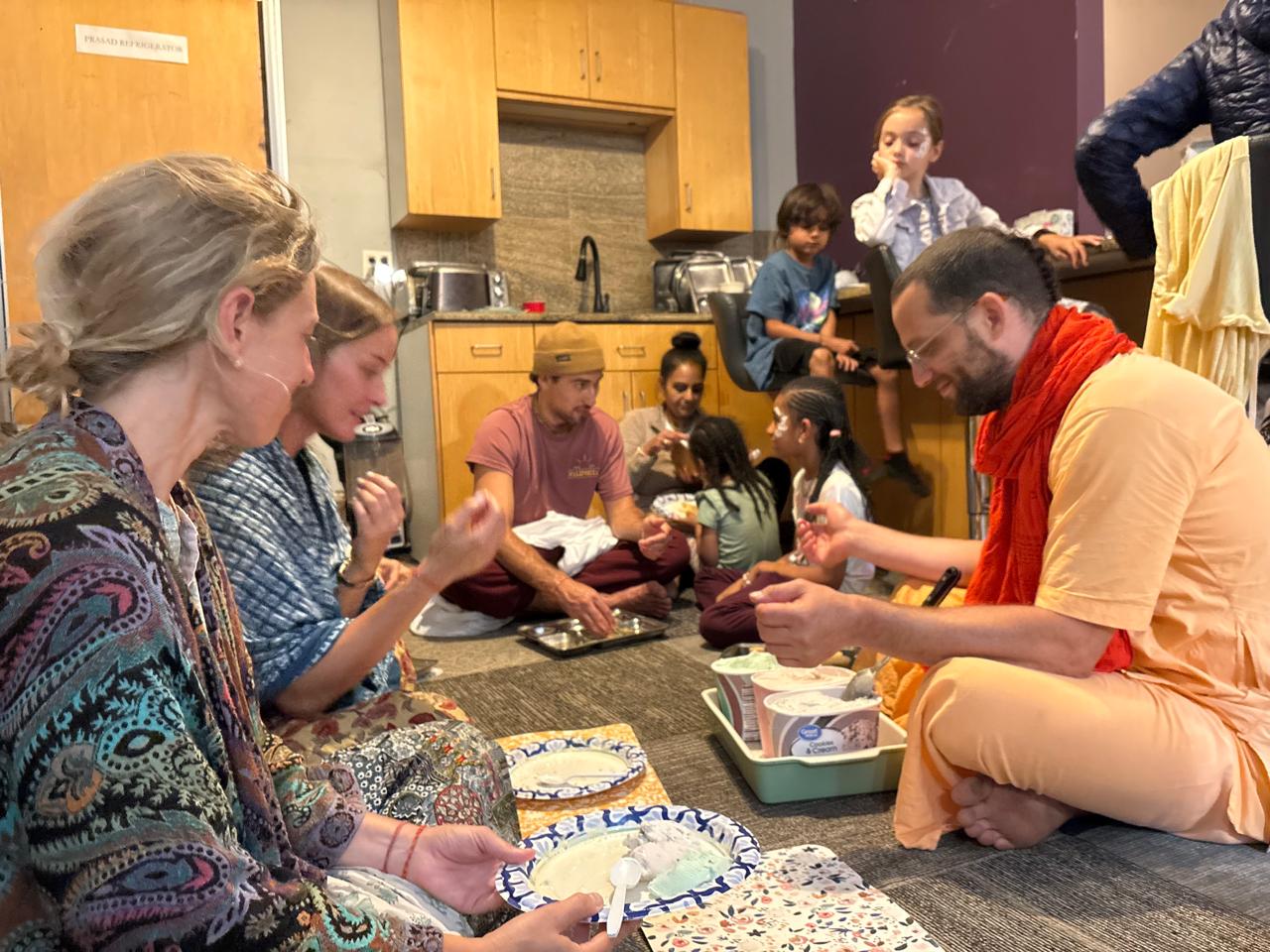
He showered his love on them with ice cream, cakes, and treats—making sure they felt cherished and celebrated, not just instructed. Even when evening programs ran late, he made sure the children were fed on time, after the offering—so they never had to wait hungry, never felt forgotten. He was always approachable, always kind, always present—never too busy for their small voices or their big questions.
Through his example, he showed us that bhakti is not stiff or distant—it is joyful, natural, and alive. It flows through service, through friendship, through the quiet act of making sure a child feels seen and cared for.
Maharaj's warmth gave the camp a special tenderness—the children felt valued, not just supervised. He is not just a teacher to them—he is a living reminder that a true guide does not merely instruct, but serves. And in his service, he makes the path not only visible, but possible.
Gratitude to Malini Didi and the Devotees
I am especially grateful to Malini Didi for inviting us and for organizing this camp year after year—a labor of love that bears fruit we may never fully see. She has created a beautiful space where children encounter bhakti naturally—through stories, chanting, music, art, seva, adventure, friendship, and community.
Her creativity, enthusiasm, and devotion shine through in every detail—from the activities to the atmosphere. Gifted in dance, drama, singing, and playing instruments, she brings warmth and energy to everything she does—as if her very presence is an offering. She planned a multi-cuisine menu and made sure the children ate plenty of vegetables and fruits—caring for their health as much as their hearts. From planning the program to caring for the children, she serves tirelessly and wholeheartedly.
Where Maharaj showed us the humility of service, Malini Didi showed us the joy of creative offering—two sides of the same radiant coin.
Malini Didi is truly a special child of Srila Gurudev—her life a living reflection of his teachings. She and her husband, Jagadish Prabhu, were among the first devotees we met—and Jagadish Prabhu quickly became one of the children's favorite friends.
Although we never had the opportunity to meet Gurudev personally, Malini Didi's loving and vibrant personality gave us a glimpse of his influence and spiritual legacy—a legacy carried forward in every smile she shares. Through her service, kindness, and dedication, she continues to create a nurturing space in which the next generation can grow—and in doing so, she plants seeds that will bloom long after we are gone.
A Question That Remains
As I watched Hari participate in the camp, I realized that he was receiving something rare and precious—something I could not give him, but could only watch him receive.
This was not simply a summer program—it was the beginning of a spiritual journey shaped by devotion, nature, service, friendship, and the guidance of devotees. The children practiced japa on Tulasi beads, heard the holy names, participated in yajña, tasted prasadam, learned sacred verses, and shared the joy of serving together. Through these experiences, they began to understand that ordinary activities can become offerings to Krishna when performed with love and devotion—not in spite of their ordinariness, but because of it.
The children discovered that bhakti is woven into every part of life—a song becomes kirtan, helping a friend becomes seva, a meal becomes prasadam. It flows through chanting, serving, learning, playing, and celebrating.
The natural setting of Bhakta Bandhav Ashram made this understanding especially profound. The forests, meadows, river, and starlit skies revealed Krishna's magnificence—while chanting, yajña, and sacred stories reminded us of the divine source behind it all.
Hari especially loved archery. He is already looking forward to next year's camp—just for that.
For our family, Bhakti Kids Camp was a dream fulfilled—and an unforgettable beginning. Although we never made it to New Braj, we found something equally precious at Bhakta Bandhav Ashram—a place where bhakti came alive in ways we never expected, in moments we couldn't have planned. It brought Hari closer to Krishna—through bhakti, kirtan, yajña, seva, nature, friendship, and the care of a devoted community.
We look forward to another year of camp—hopefully with two full weeks for the children to learn, serve, explore, and deepen their friendships. I earnestly pray to Krishna that, one day, a Gurukul may also be established there—where education, devotion, nature, service, and loving companionship are beautifully united.
The memories created at Bhakta Bandhav Ashram will remain with us—a lasting reminder of the teaching in the Yat Karoshi verse (Bhagavad-gita 9.27) and Hari keeps on singing this beautiful song "Govinda Govinda your mercy is sweet, let us take shelter in your lotus feet..." taught by Malini didi during the kid's camp.
When every action is offered with love, the whole of life becomes an offering to Him.
Not just the prayers. Not just the temple visits. But the cooking, the walking, the watching, the waiting.
Everything.
And maybe—just maybe—the offering is not what we give, but what we allow ourselves to become.