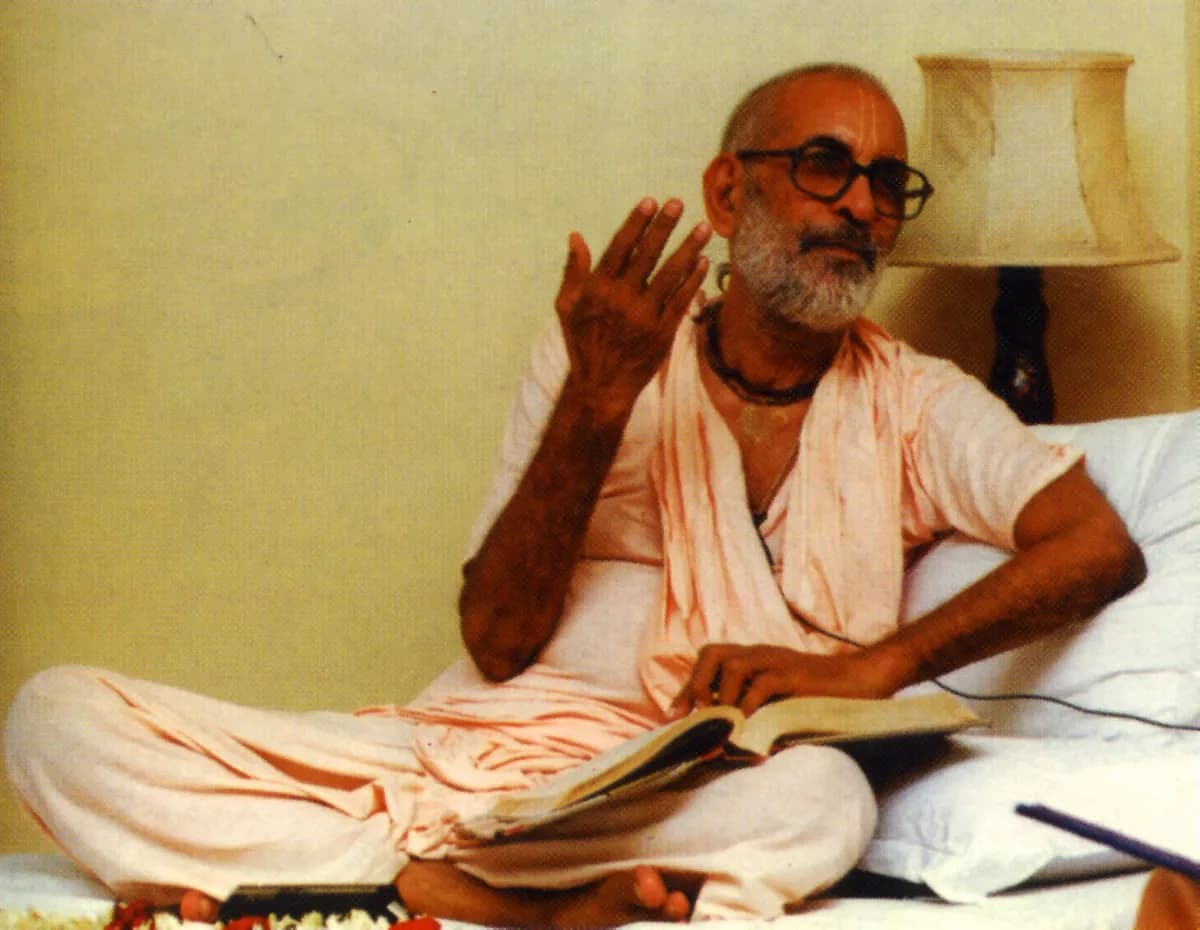
Śrīla Gurudeva: Sītā-devī was applying sindhur (vermilion) at the parting of the hair, according to Vedic custom. Do you know what sindhur is? Married Indian ladies apply this reddish vermilion at the parting of the hair. So, Sītā-devī was applying this sindhur.
Seeing this sight, Hanumān asked her, “Mother, what are you doing? What is this that you apply?”
Sītā-devī replied, “By applying this sindhur, Rāma will never die. He will always be in good health and He will be glad and satisfied. I will be a chaste lady who controls her husband.” Hanumān was satisfied by this answer. As soon as Sītā-devī went out of the room, Hanumān emptied the entire pot of sindhur and covered his entire body with this reddish powder. Entirely covered by this powder, Hanumān entered the royal assembly of Rāma. On seeing Hanumān, all the members of the assembly started laughing and told each other, “What has Hanumān done?” Mother Janaki was also laughing.
One of the members asked Hanumān, “What have you done? Have you manifested your monkey nature?”
Hanumān replied, “I saw Mother Janaki applying this powder on the parting of her hair, so that Rāma will have a long, happy life. So, mother applied this powder only on the parting of her hair, but I decided to cover my whole body with it, because Rāma will then always be happy and He will never die.”
So, Hanumān’s service to Rāma was incomparable, but he cannot go to Vṛndāvana. He cannot go. Why? If he sees Mother Yaśodā disciplining her son, Kṛṣṇa, Hanumān will think, “My Lord is being disciplined?” Thinking so, he will be upset. With his club, he might do something wrong. If he will see that in the groves of Vṛndāvana, Śrīmatī Rādhikā and the gopīs order Kṛṣṇa and tell Him, “Come on! Come on! The colors painted on our feet has been washed away, so You should paint our feet.” Hanumān will also see Kṛṣṇa praying to the gopīs. Hanumān will think, “What is my Prabhu doing?” And he will again be upset. So, Hanumān never goes to Vṛndāvana because he is of dāsya-rasa (the mood of being the servitor of the Lord). dāsya-rasa is not to be considered lowly, it is achieved only after liberation. dāsya-rasa is of two kinds. In the Vaikuṇṭha realm, there are four kinds of liberation—sārūpya (having bodily features that resemble the Lord’s), sāmīpya (equal association with the Lord), sārṣṭi (equal possession of opulence like that of the Lord), and sālokya (equal facility to live on the same planet of the Lord). sāyujya-mukti, to become one with the bodily effulgence of Kṛṣṇa must be discarded. This kind of impersonalistic liberation is a great curse. But the other four kinds of liberation may be accepted by the lower class of devotees. Being four handed like Lord Vishnu or Nārāyaṇa, and embellished with the conch, discus, club, and mace, they are situated in the lower half of Vaikuṇṭha. Residing there, they are liberated and experience some happiness.
But, those devotees who proceed to the higher regions of Vaikuṇṭha, can serve the Lord there like His associates—Jaya and Vijaya. This form of devotion is called prema-sevā-uttarā. But, the servants of Kṛṣṇa like Citraka and Patraka, whose mood of servitorship is mixed with the mood of friendliness; they are so much more superior and liberated.
Caitanya Mahāprabhu is asking Rāya Rāmānanda Prabhu questions, and He is gradually giving the devotees the culmination of the highest forms of love and affection to the Lord. After glorifying dāsya-rasa (the mood of servitorship), Rāya Rāmānanda Prabhu will speak on sakhya-rasa (the mood of friendship), and he will gradually speak on vātsalya-rasa (the mood of parenthood), and mādhurya-rasa (the mood of considering Kṛṣṇa as the beloved).
So, I want to stop here because I have been advised by the doctors to not speak for long. Now, harināma should be chanted and sung. You should try to have a very regular and good association of bona fide devotees. The seed of devotion has been planted in your hearts, but if you don’t water this seed of devotion with the water of hari-kathā; it may dry and be destroyed. You should carefully and diligently tend to this seed of devotion. You should always be in good association and you must also sincerely study scriptures like Śrīmad-Bhāgavatam, Śrīmad Bhagavad-gītā, and all other books of Śrīla Rūpa Gosvāmī, Śrīla Svāmījī, and our Guru-varga. Thus, we should gradually advance in our Kṛṣṇa consciousness.
Gaura Premānande! Hari Haribol!
[CC-by-NDNC Bhakta Bandhav]
Radlett 16 May 1996