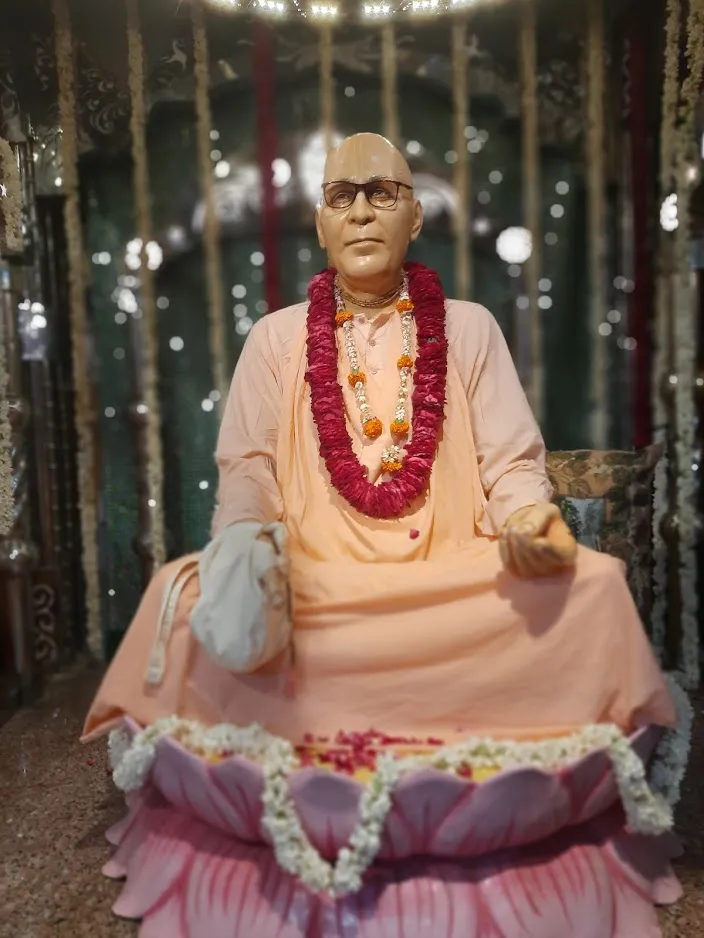
Śrīla Gurudeva and Kṛṣṇa Himself have given us this opportunity to observe Keśava-vrata. Before, many disturbances came when we followed Keśava-vrata. People would always say, “Why are you following this vrata?”
How will a sādhaka ever progress if he is not strong in his sādhana? What is the harm in following these vratas?
Kṛṣṇa kindly gives everyone an opportunity and chance to observe Keśava-vrata in this month of Vaiśākha. By following this vrata, you will get the result.
agre haya mukti, tabe sarva-bandha-nāśa
tabe se haite pāre śrī kṛṣṇera dāsa
Śrī Caitanya-bhāgavata, Madhya-līla 17.106
First, you should become free of all attachments; and then, you will become Kṛṣṇa’s servant. Otherwise, you will always be arrested and bound by attachments. How will you serve Kṛṣṇa when you are always anxious? How will you chant Hare Kṛṣṇa or Haribol? Although you remember many other names, you are not able to remember or chant the Lord’s names.
This Keśava-vrata is mentioned in all Gauḍīya-Vaiṣṇava calendars; still, most devotees do not follow this vrata and many even criticize those who do. The same occurs with Kātyāyanī-vrata. Those who follow are criticized. But why have they written the starting and ending days of this vrata in all the calendars? And why is Kātyāyanī-vrata mentioned in the Śrīmad-Bhāgavatam, followed by none less than the gopīs, who Mahāprabhu instructed His devotees to emulate—ramyā kācid upāsanā vrajavadhū-vargeṇa yā kalpitā.
“That is only for the gopīs,” some say. But whose followers are they? Are they in the Gauḍīya-sampradāya or not? People also question Keśava-vrata. “Where has this come from?” they ask. But before you ask this, please explain why you have written the dates of this vrata in the calendar you follow? No Gauḍīya Maṭha can follow these vratas of the gopīs. They are afraid. They think, “I will become a gopī? This is very hard.”
They cannot follow Kātyāyanī-vrata, they cannot follow Keśava-vrata. When they are asked, “Can you stand in front of Vṛndā-devī, and worship Vṛndāvana-dhāma and follow her?”
They say, “No!”
When they are asked, “What is the meaning of Keśava-vrata,” they reply that it is nothing. Then why has Keśava-vrata been stated in the calendars? The glories of Keśava-vrata have been stated in the scriptures.
When we started following Kātyāyanī-vrata, we saw how the glories of this vrata have been stated in all the scriptures. We collected the glories of this vrata from many scriptures.
Rūpa Gosvāmī has also given the glories of Keśava-vrata in Ujjvala-nīlamaṇi. Hari-bhakti-vilāsa also has much evidence. Śrīla Bhaktivinoda Ṭhākura has sung many kīrtanas in glorification of Keśavadeva.
He has sung, “Keśava tuya jagat vicitra.” He said, “Keśava, your world is very strange. People are running here and there; but they don’t come near You. Although You give the residents of this world everything, they don’t like You. Rather than liking You, they like everything else. The more You give, the more You receive. But, they don’t come near You. This is māyā.”
Keśavadeva gives everything. He enters all the species to help the conditioned souls. But no one likes Him. The conditioned souls like what He gives; but they don’t like Him.
Keśavadeva said, “Offer Tulasī, candana, and Gaṅgā water to Me. This is enough.”
When worshiping Śālagrāma however, one must carefully follow the rules and regulations for such worship as described in the scriptures. Be cautious and do your best not to commit offenses during the time of worship. Tulasī-devī must not be touched or disturbed on the day of Dvādaśī. She is busy serving her Lord on Dvādaśī. You can water her, or offer ārati, without touching her. Don’t touch her or pick her mañjarīs or leaves on Dvādaśī. Śāstra states this.
Where does Śālagrāma appear? Lord Hari appeared as a stone mountain next to the Gandaki River, which is the personification of Tulasī-devī. As described in the Brahma-vaivarta-purāṇa, millions of Vajrakīṭa-worms cut this mountain into small pieces of varying shapes and sizes and the stones that fall in the Gandaki River are accepted as śālagrāma-śīlas, with different names of the Lord according to their specifications. Brāhmaṇas and Vaiṣṇavas worship these śīlas as the self-same Lord.
Śrī Gopāla Bhaṭṭa Gosvāmī once prayed to Mahāprabhu, “You have given me many instructions, and told me to live in Vṛndāvana, but You are in Purī far away, so how can I remain connected to You? Who should I worship?”
On Mahāprabhu’s inspiration, Gopāla Bhaṭṭa Gosvāmī then went to the Gandaki River and prayed there, and a large Śālagrāma, twelve fingers long, called a Dāmodara-śīla, appeared to him. Those śālagrāma-śīlas that are big and circular, that have two rings, but no garland mark, are known as a Dāmodara Śālagrāma. This Dāmodara-śīla later manifested as Rādhā-ramaṇa. On the back of Rādhā-ramaṇa you can see the sign of the Śālagrāma. Rādhā-ramaṇa is non-different from Mahāprabhu, or Rādhā-Kṛṣṇa combined.
Śrīla Gurudeva speaks of an anecdote:
Once, a guru called his priest and said, “Oh pūjārī, why was there a sound coming from the Deity room? What were you doing inside?”
“Gurudeva, I wasn’t doing anything.”
“What were you doing behind the closed doors?”
What was the priest doing? He was using two śālagrāma-śīlas to break almond shells. He would place an almond on top of one Śālagrāma and he would break the shell by using another Śālagrāma. Later, the guru caught the priest in his offensive activity. This is the business of the people of Kali-yuga.
In this month of Keśava-vrata, the residents of Purī worship Tulasī-devī at the Jagannātha temple.
A daughter of a priest would go to the temple and worship Jagannātha and Tulasī-devī. When she matured, her parents arranged for her marriage. Their daughter said, “When I get married, I will also take Tulasī-devī to my in-laws home.”
She took Tulasī-devī with her and worshiped her as she would at home. Her in-laws became very angry with her. “Why are you bringing this plant here?” they asked her. They then threw Tulasī-devī away. But she brought Tulasī-devī back. The in-laws then broke the pot.
Undeterred, the daughter-in-law planted Tulasī-devī again. Her in-laws were cruel atheists. They would incessantly disturb their daughter-in-law.
They told their son, “You have not married a lady; you have married a rākṣasī demoness. She always worships these plants. We throw this plant away; yet, she brings another back. She wants to destroy our house with this plant.”
“What is the problem?” the daughter-in-law asked her husband, “I am not doing anything wrong.”
“No. You must follow my parents,” the husband replied.
“I will not.”
“Then we will have to beat some sense into you.”
“No problem.”
The father-in-law, mother-in-law, and the husband caught this devotee girl and beat her ruthlessly. Again they broke the Tulasī pot, desecrated Tulasī-devī, and threw her out of the house. The daughter-in-law began to fast and she brought a dry Tulasī plant and continued her worship. She would continuously worship Tulasī-devī despite the disturbance. Every morning she watered Tulasī. One morning she saw that two leaves had unfurled on the stem. When her mother and father-in-law tried throwing Tulasī-devī away again, a black snake appeared and bit both of them. They immediately died.
When the husband returned from his work, he saw his wife smiling and laughing. He angrily said, “You killed my parents! Now everyone is crying because of you. Why aren’t you crying as well?”
“Why should I cry?”
“My parents are dead. You are very wretched. Why are you smiling! Now all my relatives will cut you into many pieces.”
“No problem.”
“Why are you laughing?”
“They kicked Tulasī-devī; yet, when they left their body, a plane came and took them to Vaikuṇṭha-loka. They were always against the worship of Tulasī-devī. They tried disturbing her in so many ways. But by touching the body of Tulasī-devī, they have gone to Vaikuṇṭha.”
The jīvas make problems even when they come to the temple. They make problems anywhere they go. Śrīla Gurudeva told us the following pastime:
A dog came wailing to Śrī Rāmacandra’s assembly.
The Lord asked the dog, “Why are you crying?”
The dog replied, “A brāhmaṇa scholar beat me and broke my legs.”
Rāmacandra replied, “How can I pass a judgment on the brāhmaṇas?”
The Lord asked Vaśiṣṭha, “Guru Mahārāja, you should call the brāhmaṇa. You should ask him, ‘Why did you beat the dog? What was the dog’s mistake?’”
The dog was asked, “Did you do something wrong?”
“No.”
“Then why did the brāhmaṇa beat you?”
“I was sleeping on the side of the street. Yet, the brāhmaṇa took a stick and beat me severely. He broke my legs! Now I cannot even move. How will I maintain my body?”
Vaśiṣṭha Ṛṣi then had the brāhmaṇa called.
The brāhmaṇa was asked, “Why did you break the dog’s legs?”
The brāhmaṇa nonchalantly replied, “Oh the dog was sleeping on the street. He was blocking my path.”
Vaśiṣṭha asked the brāhmaṇa, “The road is wide. Why didn’t you go on another side? Why did you break the dog’s legs?”
The dog was asked, “What kind of punishment should be inflicted on the brāhmaṇa?”
The dog replied, “The brāhmaṇa should be made the ācārya of the Kaliṅga Temple.”
Rāmacandra and guru Vaśiṣṭha were greatly surprised. They asked the dog, “What are you saying?”
The brāhmaṇa became very happy. Ecstatically dancing, he said, “Today, my life is successful. I will be the ācārya of the temple. Just see how foolish this dog is. Now everything will be mine. Formerly, I was a very poor brāhmaṇa.”
Rāmacandra asked the dog, “Why do you want the brāhmaṇa ‘punished’ this way?”
The dog replied, “In my last life I was the ācārya of the Kaliṅga Temple. Although I was responsible for worshiping the Deities, my mind only thought of enjoying the bhoga. I only thought of my family’s enjoyment. I never properly worshiped or offered bhoga to the Deities. I only stole everything. And now, my tongue is always hanging out. So, the brāhmaṇa will also become a dog in turn. Then he will understand my position.”
So, although you have come to the temple and have approached the lotus feet of the Guru-varga, have you purified and changed yourself? Therefore, we should try to seriously follow this vrata under guidance of the Guru-varga and bhaktas.
[CC-by-NDNC Bhakta Bandhav]