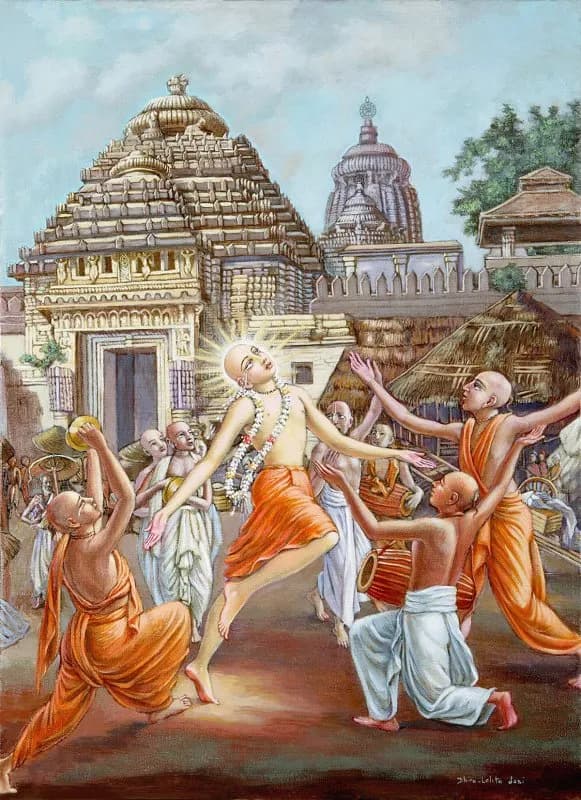
In the fifth verse of Śikṣāṣṭakam, Mahāprabhu prayed:
ayi nanda-tanuja kiṅkaraṁ
patitaṁ māṁ viṣame bhavāmbudhau
kṛpayā tava pāda-paṅkaja-
sthita-dhūli-sadṛśaṁ vicintaya
O Nanda-nandana, as a result of my fruitive activities, I have fallen into this fearful ocean of material existence. Please bestow Your mercy upon this eternal servant of Yours. Consider me to be just like a speck of dust at Your lotus feet and always accept me as Your servant.
The aspiration here is to become a speck of dust at the lotus feet of Kṛṣṇa. Brahmā and Uddhava have prayed like this. We want to become very small, like a particle of dust in the midst of the Vrajavāsīs. Being close to them, their mercy will purify us.
The Śrīmad-Bhāgavatam (1.8.26) states:
janmaiśvarya-śruta-śrībhir
edhamāna-madaḥ pumān
naivārhaty abhidhātuṁ vai
tvām akiñcana-gocaram
O Lord, You can easily be approached, but only by those who are materially exhausted. One who is on the path of material progress, trying to improve himself with respectable parentage, great opulence, high education and bodily beauty, cannot approach You with sincere feeling.
Taking birth in a rich family that possesses so much opulence, being very learned, possessing great strength, and having a fair and beautiful body causes pride to arise in the heart of the jīva, and thus he finds it very difficult to be akiñcana.
The sādhaka should pray to become the foot dust of those who are the nearest and dearest servants of the Lord. But do not think that this is ordinary dust. This means to be very close with those intimate servants of the Lord, under their shelter, and feeling very insignificant.
One time, a king had a very intelligent, young son. This prince asked his mother and father, the ministers, and other persons, “How can I please everyone? I will be pleased if I can do this.” The king, as well as the ministers and the boy’s tutors gave some advice to the boy. The prince followed all their advice and thus everyone was very pleased with him.
However, there was one person who was not happy. There was an elder female servant of the prince who was like an aunt for the prince and served him in so many ways since the time of his birth. She used to wash his cloth, massage him, feed him, and fan him while he slept. For some reason however, she would cry every time she saw the prince.
The prince asked her, “Why are you crying whenever I am present? Everybody else becomes happy as soon as they see me, but you start to cry. Please tell me why.”
She would not answer his question, and silently continued doing her services. After asking again and again, the prince began a hunger strike. He said, “As long as you do not tell me why you cry every time you look at me, I will not eat. I will not go to school or anywhere else. Please, tell me.”
Since the maid remained silent, the king and queen themselves came to her and said, “Please, tell us why you are crying.”
The lady said, “But if I tell you, I will die immediately.”
The king said, “But if you don’t say anything, our son will fast to death.”
Then she said, “Okay, I will tell it to your son in secret, but not to anyone else.” The king agreed, and the maid then told the following to the prince.
She was serving in the house of the king at the time the boy took birth. The mother could not take care of her baby for the first six days, so the sister and aunt, which happened to be this maid, took care of the boy during this time. Six days after the baby’s birth, Lord Brahmā comes and writes the baby’s karma on its forehead.
On the night of the sixth day, the maid recited mantras for the child’s protection and put him to sleep. She herself slept at the gate which led to the prince’s quarter. There, Lord Brahmā appeared in the middle of the night and said, “Give me way. I have to go inside and write the boy’s karma on his forehead.”
The maid replied, “I will only let you go inside if you tell me what you’re going to write.”
Lord Brahmā knew that he could not cross over her body. If he did so, he would lose all his sukṛti. He requested the maid again and again to let him pass by until she finally let him go. Upon seeing that Brahmā would never cross her body, she got the idea to lay there and force him to tell her what he wrote on his way back. Brahmā went inside, did his job, and came back.
Then she said, “Now I will not give way until you tell me what you wrote.” Brahmā finally agreed to tell her everything. But at the same time, he warned her that she would die instantly if she told this information to anybody else. Brahmā told her, “This boy will be a beloved prince until he dies suddenly at the age of sixteen. Then the king and queen will become blind with grief and the whole country will go to ruin.”
Since the maid knew this, she was always suffering and crying when she saw the boy. She watched him growing up into such a brilliant and intelligent boy imbued with all good qualities. Now, the last year of the fifteen-year-old prince had come and he was told his unfortunate destiny. After revealing this misfortune, the maid died immediately.
For the prince’s sixteenth birthday, everybody was invited to the palace for the celebrations. The prince thought, “I shall not leave my body in front of my parents and everybody else.” With this in mind, he went to the horse shed on the night before his birthday, where he took a good horse and rode it off into the jungle. He went to the far away āśrama of Kana Muni. The ṛṣi was in samādhi and the prince offered praṇāma, performed parikramā, and waited for the ṛṣi. In the evening, the ṛṣi came out of his samādhi and looked at the prince.
“What led you to me, dear prince?”
The prince replied, “You know that I am the prince, so you must also know why I have come. Please give me shelter.”
The ṛṣi said, “Yes, I know about you and your future. You can stay here and take my shelter. I will give you mantra-dīkṣā. Then you will be safe.”
Although the following night was clear and calm, suddenly thunderbolts started appearing in the sky. The thunderbolts were sent by Indra in order to kill the boy. This was what Brahmā wrote on the prince’s forehead.
Kana Muni sat on a raised platform and had told the prince to sit underneath the platform, taking full shelter of the muni. Indra destroyed all trees and creepers in the forest and all the animals ran away in fear. But he could not touch the prince, who was being protected by the sādhu.
Many demigods came, including Lord Brahmā and Yama Mahārāja, and the muni addressed all of them, “If you want to kill the boy, you will have to kill me first.”
Brahmā said, “Give him up. I will give him another birth.”
But the muni refused. Indra said, “You cannot change the boy’s karma.”
The muni fearlessly replied, “No problem, you can kill me then.” But Indra could not kill him, because he knew that he would be cursed for killing such a great muni. Finally Lord Viṣṇu appeared and said, “I have a solution that will make it so the boy does not have to die, but at the same time Brahmā will not be a liar and his karma will become true.
Indra should throw a thunderbolt striking the boy’s fingernail and a strand of his hair. When they become separated from his body, they will be considered dead.” Indra followed Viṣṇu’s instruction, and everybody was appeased and left. The boy went back to the kingdom and everybody rejoiced upon his return.
āśraya laiya bhaje tare kṛṣṇa nahi tyaje āra saba mare akarana
It is necessary to take shelter. We should realize that we have fallen in the very dangerous ocean of saṁsāra, or material family life. Wherever the soul goes and takes birth, it gets a new family. These so-called family members all arrest the jīva. Therefore it is necessary to take shelter of those who are near and dear to God. They may treat us as they like, as everything they do is for our protection and purification.
Mahāprabhu prayed:
maj-janmanaḥ phalam idaṁ madhu-kaiṭabhāre
mat prārthanīya mad-anugraha eṣa eva
tvad bhṛtya-bhṛtya-paricāraka-bhṛtya-bhṛtya
bhṛtyasya-bhṛtyam iti māṁ smara lokanātha
Mukunda-mālā-stotra 25
O Supreme Lord of all, slayer of the demons Madhu and Kaitabha! Please be merciful to me and grant my prayer that You may remember me as a servant of Your servant’s servant, a servant of such a servant of Your servant’s servant, a servant of a servant of Your servant’s servant, and a servant of Your servant’s servant servant.
When we take shelter of the servants of the Lord, they will take care of us as our guardians. Without this relationship, svarūpa-siddhi can never be attained.
Param Gurudeva was very close to Prabhupāda Sarasvatī Ṭhākura. When my Guru Mahārāja came, Prabhupāda told Param Gurudeva, “Vinoda, you take care of this boy.” In the same way Prabhupāda put Siddha-svarūpa Brahmacārī in the care of Bhāratī Mahārāja, and he put Bhakti Dayitā Mādhava Mahārāja, whose name was Hayagrīva Brahmacārī, in the care of Bhaktivilasa Tīrtha Mahārāja.
During his lifetime, Prabhupāda Sarasvatī Ṭhākura demonstrated a perfect example on how to follow Vaiṣṇavism. Once a brahmacārī, who had grown up in a rich family in Calcutta, joined the maṭha. When he joined, the temple facilities where very simple and there was no good water and food available. In time, the brahmacārī became ill with typhoid and was suffering for a long time, and it looked like he was going to die.
There were also no doctors in Māyāpura in those days and the only treatment they could provide consisted of some herbs from the jungle. One day, the boy’s father came to the maṭha and offered his son some medicine. The brahmacārī said, “I will only take the medicine if you ask my Guru Mahārāja for permission.” The father then asked Prabhupāda if he could provide medicine and the proper diet for the boy and Prabhupāda agreed.
The parents stayed in Māyāpura for one month and spent a lot of money on doctors and medicine. When the boy got some relief from his illness, his parents asked him to go back to their house in Calcutta and to stay there until he was completely cured, after which they said he could go back to his guru. The brahmacārī again told them to ask Prabhupāda, who again agreed to their suggestion.
When they arrived in Calcutta, the brahmacārī said that he wanted to stay in a room outside rather than in the house. But the mother said, “I was in Māyāpura for one month looking after you, and now I will have to continue my service to you and at the same time serve the rest of the family and look after the house. I can only do this if you stay inside the house.” He submitted to his mother’s request and stayed inside the house.
Sometime later the mother said, “The doctor ordered you to eat fish and meat in order to gain strength, but if you don’t want to you don’t have to. But, please, at least accept some of my cooking that contains fish or meat stock, and some dishes that contain eggs. In this way you will become healthy. You don’t have to eat any fish, just take the juice from the soup, and this will make you healthy.”
Like this, māyā slowly captured the boy and when Param Gurudeva went to his house to check if his health was back, the boy was indeed healthy, but his intelligence and taste for bhakti was lost. The boy was so embarrassed that he did not even come out of the house to meet parama Gurudeva. parama Gurudeva was kept waiting, and then after a long time the boy’s mother gave him some dakṣiṇā for Prabhupāda and said that her son was still not well enough to go back to the maṭha.
Since Param Gurudeva promised Prabhupāda to bring the brahmacārī back to the maṭha, he was determined, and thus tried again and again to bring him back, even though it appeared to be hopeless. After quite some time, Param Gurudeva again met the brahmacārī. He now had a successful business, but he wept when he met with Param Gurudeva and asked him how he could go back to the maṭha.
Shortly later he had an accident and completely disabled, the boy had to stop his business and went to meet Prabhupāda, who told him to offer whatever little he had left for Kṛṣṇa. In this way, Kṛṣṇa’s punishment turned out to be His blessings, and allowed the boy to come back to Prabhupāda.
Āśraya, taking shelter, is necessary. Otherwise nobody will take care of us and think about us. Without shelter, we are hopeless in this world and we will never attain svarūpa-siddhi. This verse teaches us that in order to attain svarūpa-siddhi, we have to take shelter; not directly of the Divine Couple, but of their nearest and dearest servants.
[CC-by-NDNC Bhakta Bandhav]