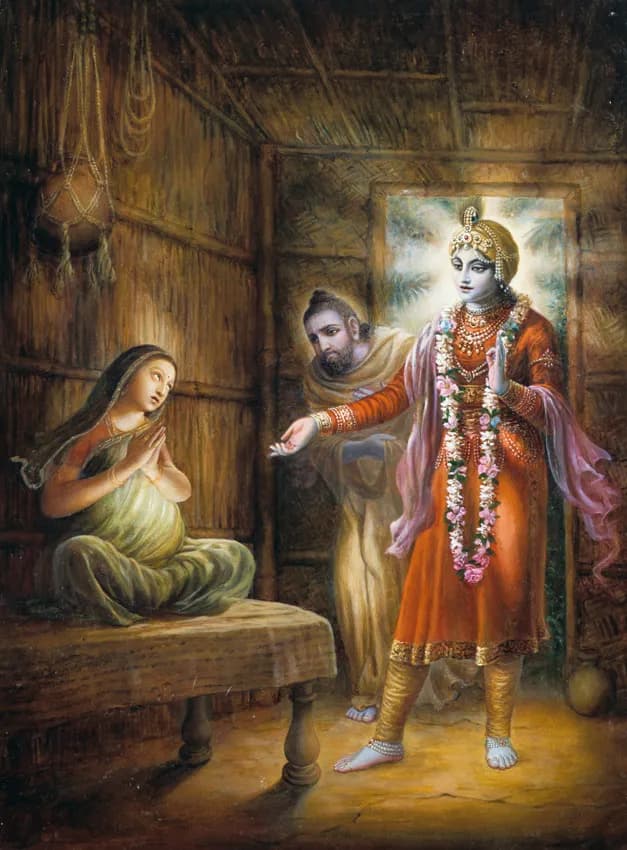
When Śiva Ṭhākura is in Kailāśa-dhāma, he externally covers himself by smearing the ashes of dead bodies all over himself. He shows by this that everything in this world is temporary and we should learn detachment. He resides with ghosts, witches, goblins, and brahma-rākṣasas. He doesn’t meet with anyone. When he does kīrtana, all the spirits ecstatically dance with him. Those who dance with him have many physical deformities; yet, they dance without any reservations.
Śiva Ṭhākura is very kind; he helps the helpless, like the ghosts and spirits. A poverty-stricken, lame, and blind orphan is rejected by everyone in this world. People declare him to be useless and reject him. But Śiva Ṭhākura never kicks anyone away. He engages even the destitute and helpless in nāma-saṅkīrtana. During kīrtana, the spirits quarrel and dance. Śiva Ṭhākura is not disturbed by their unusual kīrtana. He is very happy by kīrtana. He only speaks hari-kathā and does kīrtana for the pleasure and happiness of Śrī Hari. He also knows the rules and regulations of every vrata.
The associates of Śiva Ṭhākura are mostly comprised of witches, ghosts, goblins, and other fearful creatures. They are always intoxicated. They become happy by drinking cauldrons of alcohol. But Śiva Ṭhākura told his followers, “Don’t drink alcohol anymore. I will give you an inconceivably greater drink. This drink is far greater than the sura elixir of the demigods.”
The demigods tried luring the associates of Śiva Ṭhākura with this sura. Śiva Ṭhākura sternly told them, “Don’t ever accept the sura. I will give you the unending nectar of Śrīmad-Bhāgavatam.”
This month of Vaiśākha is very auspicious. Therefore, many people continuously organize the complete recitation of the Śrīmad-Bhāgavatam. Or else they engage continuously in nāma-saṅkīrtana. By remembering even half a syllable of the Śrīmad-Bhāgavatam in this month, all forms of auspiciousness will be gained. This also holds true for a person who bathes in the Gaṅgā, and worships Śālagrāma-śilā and Tulasī-devī.
Lord Śiva began speaking the Bhāgavatam during this month of Vaiśākha. Śiva Ṭhākura told his associates, “Don’t ever take anything from the demigods. They will cheat you and steal all your sukṛti away. Then all of you will be orphans. Don’t go here and there; just listen to the Śrīmad-Bhāgavatam.”
When Śiva Ṭhākura started speaking the Śrīmad-Bhāgavatam, his associates fell fast asleep. They slept soundly. Śiva Ṭhākura thought, “Bābā! Everyone is so happy because they have fallen fast asleep.”
Śiva would then start saṅkīrtana and everyone would dance to Śiva Ṭhākura’s kīrtana. But they would fall asleep when he would begin speaking on the Bhāgavatam. Although Satī was sitting on Śiva Ṭhākura’s lap, she also fell asleep listening to the Śrīmad-Bhāgavatam. Yet, Śiva Ṭhākura spoke hari-kathā continuously, in deep absorption, because someone would say at regular intervals, “Go on. Go on.” After three hours had passed, Satī awoke and said, “What have you been saying all this while?”
“Haven’t you been listening?” asked Śiva Ṭhākura.
“No.”
“Why not?”
“I was sleeping.”
“You were sleeping?”
“I was sleeping on your lap. So, didn’t you see me sleeping?”
“No.”
“Why?”
“I am absorbed in the eternal līlā. When I speak, I am present in those pastimes. Therefore, I cannot see anybody.”
“Then I have missed the opportunity to listen to the Śrīmad-Bhāgavatam,” Satī said.
“But who has been listening all this while? Who has been nodding and saying, ‘Go on?’ He has been drinking all this nectar without permission.”
Śiva Ṭhākura looked around and saw a parrot hiding among the leaves of a mango tree. This parrot had been listening to the Bhāgavatam. The parrot would nod and sound its consent and inspire Śiva Ṭhākura to speak more.
The parrot would sweetly say, “Yes. Go on. Go on.”
Śiva Ṭhākura became very angry with the parrot. He said, “Hey parrot! Why have you been listening without my permission? You were cheating me!”
Greatly angered, Śiva Ṭhākura took his trident and ran to kill the parrot. The parrot flew swiftly in fear. It flew from Kailāśa and took shelter in Vyāsadeva’s āśrama in Badrinatha.
Vyāsadeva was speaking from the Purāṇas while his wife Vīṭikā-devī was listening. But just as Vīṭikā was yawning, the parrot swooped down and entered her mouth, hiding in her stomach.
When Śiva Ṭhākura reached Badrīkāśrama, he was received by Vyāsadeva.
Vyāsadeva greeted Lord Śiva, “Namaste! What happened Bholanātha?”
Śiva Ṭhākura looked very angry and the trident in his hands only added to his furious demeanor. Śiva Ṭhākura said, “I was speaking the Śrīmad-Bhāgavatam in Kailāśa.”
“So, what happened? Was everyone sleeping?” inquired Vyāsadeva.
“No! A parrot heard me intently without asking my permission. He has drank this nectar and fled for his life. He is now in your āśrama. He should be punished by death for such an offense.”
Vyāsadeva asked, “May I ask what is the result of hearing the nectar of the Śrīmad-Bhāgavatam?”
“One becomes immortal,” replied Śiva.
“Immortal! This is indeed a grave offense. But may I ask further, if the parrot has now become immortal, then how do you plan to kill it?”
Śiva Ṭhākura paused and replied, “This is true. It cannot be killed.”
He offered obeisance to Vyāsadeva and returned to his abode.
So, this parrot actually belonged to Śrīmatī Rādhārānī. The parrot was previously residing in Varsānā. The parrot, or Śuka, would always stay with Śrīmatī Rādhārānī. She would feed Śuka pomegranate seeds, grapes, and other fruits. She would also feed him rice and milk. And sometimes, Śrīmatī Rādhārānī would feed Śuka seeds of red chillies. Parrots like the seeds of chillies very much.
Śrīla Jīva Gosvāmī Prabhu has explained how this parrot serves Śrīmatī Rādhārānī in his Gopāla-campū. When Śrīmatī Rādhārānī feels viraha (separation) from Kṛṣṇa, Śuka sings many names of Kṛṣṇa.
śrī kṛṣṇa-gopāla hare mukunda
govinda he nanda kiśora kṛṣṇa
Śrīmatī Rādhārānī Herself taught these names of Kṛṣṇa to the parrot. The parrot would then sweetly sing these names and make the nectar of Kṛṣṇa’s names enter the ears of Śrīmatī Rādhārānī. The parrot would bring so much joy to Śrīmatī Rādhārānī. Rādhārānī would caress the parrot as he sweetly sung Kṛṣṇa’s names.
At the time of Kṛṣṇa’s disappearance, Kṛṣṇa requested Śuka to stay in this world, to help people develop bhakti. Śuka flew all around the world; but he didn’t come across anyone glorifying Kṛṣṇa, the Vraja-devīs, and the Vrajavāsīs.
Finally, when he came to Kailāśa, he heard the glories of the Vrajavāsīs as stated in the Śrīmad-Bhāgavatam, being spoken by Śiva Ṭhākura. So, he became very happy. Then he flew from Kailāśa and entered the mouth of the wife of Vyāsadeva. Upon Śuka entering her womb, she became pregnant.
On the advice of Nārada Ṛṣi, Vyāsadeva had previously established himself in bhakti-yoga. Vyāsadeva had darśana of kṛṣṇa-līlā by Nārada Ṛṣi’s grace. But many questions came to his mind, “Who will distribute these glories and pastimes? Who will be the follower of the Vrajavāsīs? Who has this greed? Who will be a pure brahmacārī, always absorbed in transcendentalism? Who has this power? Who doesn’t have any desire for respect, name, and fame? I will speak the Bhāgavatam to that person. He will then distribute what he has heard. His heart will not have space for anything else. He will only have a desire to drink Kṛṣṇa’s glories.”
In the meantime, Vyāsadeva waited for many years; yet still, the personality in his wife’s stomach did not come out.
He inquired, “Who are you? Oh great personality! Why don’t you come out?”
“I will never come out.”
“Why?”
“Māyā-devī is very strong. Everyone will contaminate me as soon as I come out. I will then forget everything. My love and affection will be divided among many. I will be shared. Consequently, I will be a vyabhicārī. It will not be possible for me to remain a brahmacārī. Everyone will try stealing me away. I will then lose my beloved Lord in the heart.”
“But when will you come out?”
“Only if Māyā-devī is removed and will not disturb me.”
Vyāsadeva prayed to Kṛṣṇa and said, “Oh dear Kṛṣṇa! This baby has been in his mother’s womb for sixteen years now. He refuses to come out. Please withdraw the influence of Your māyā.”
Kṛṣṇa agreed and said, “I will remove the influence of māyā—but just for the time a mustard seed will sit on the edge of a blade.”
Hence, Māyā-devī was removed for a fraction of a second. Śukadeva Gosvāmī then immediately emerged from his mother’s womb and ran in full pace. Otherwise, attachments would grab hold of him. Vyāsadeva followed his son from behind.
He thought, “Oh this mahā-puruṣa is leaving!”
Running after Śukadeva Gosvāmī, he cried out, “My dear son!”
But only the trees echoed in response, “Who is a son? Who is a father? All relationships in this world are illusory.”
Vyāsadeva thought, “What can I do? Now there is no one qualified to listen to the Śrīmad-Bhāgavatam. I should have the boy return to me by any means.”
Vyāsadeva went to the forest and taught the hunters some mantras.
He told them, “I have lost my parrot. By reciting these mantras, you will catch many animals. You should play on the flute and sing these mantras. If any animal or person even falls into your trap, then bring them to me. Please don’t kill them. I will reward all of you with many gifts. You need only play the flute and sing the mantras.”
Thus, Vyāsadeva taught the hunters some ślokas from the Śrīmad-Bhāgavatam that describe Kṛṣṇa’s name, form, qualities, and pastimes. After being thus taught, the hunters played on their flutes and sang those verses in the forest. Śukadeva Gosvāmī heard the sound of the flute after a long time. He was entranced by the flute song, combined with the sweet glories of Kṛṣṇa in the verses the hunters sang.
Śukadeva Gosvāmī came and asked the hunters, “Who taught you these glories of Kṛṣṇa? You play the flute so nicely. Who taught you?”
“We have a guru in Badrīkāśrama; will you come with us to see him?”
When Śukadeva Gosvāmī came in front of Vyāsadeva, Vyāsadeva didn’t say anything. He didn’t cry in lamentation for his son.
He didn’t say, “Oh my son! You have returned after a long time!”
Vyāsadeva then started explaining the tenth canto of the Śrīmad-Bhāgavatam to Śukadeva Gosvāmī. He only spoke Kṛṣṇa’s pastimes. He especially spoke on Rāsa-pañcādhyāyī, the five chapters of Gopī-gīta, Yugala-gīta, Bhramara-gīta, Praṇaya-gīta, and Veṇu-gīta. These chapters are the five life airs of the Śrīmad-Bhāgavatam.
Śukadeva Gosvāmī is always ātmārāma (self-satisfied) and āptakāma (all his desires have been fulfilled). But he became ecstatic by drinking the nectar of the Vraja-devīs’ glories. He then stayed near Vyāsadeva and heard the entire Bhāgavatam from him. He became very pleased by this inconceivable nectar.
He thought, “I will explain and distribute these pastimes of Kṛṣṇa and Vraja. I have this desire.”
Śukadeva Gosvāmī never desired name and fame. He would wander around naked, with no attachments, possessions, or worries.
Śukadeva Gosvāmī thought, “I must glorify the Vraja-devīs, then they will be pleased. Their glories are the glories of Kṛṣṇa. This is the only way to please them.”
As Śukadeva Gosvāmī pondered on a suitable recipient for his katha, in the meantime, Parīkṣit Mahārāja was cursed by a brāhmaṇa sage’s son to die in seven days by the poison of a snake. He then came to the bank of the Gaṅgā. Gaṅgā-devī invited everyone there by her heart. Therefore, all the ṛṣis came. Śukadeva Gosvāmī also came. How did he come? People were following him and throwing dust and stones at his naked body. But he was completely detached. Therefore we pray to Śukadeva Gosvāmī:
yaḥ svānubhāvam akhila-śruti-sāram ekam
adhyātma-dīpam atititīrṣatāṁ tamo ‘ndham
saṁsāriṇāṁ karuṇayāha purāṇa-guhyaṁ
taṁ vyāsa-sūnum upayāmi guruṁ munīnām
Śrīmad-Bhāgavatam 1.2.3
Let me offer my respectful obeisances unto him Śuka, the spiritual master of all sages, the son of Vyāsadeva, who, out of his great compassion for those gross materialists who struggle to cross over the darkest regions of material existence, spoke this most confidential supplement to the cream of Vedic knowledge, after having personally assimilated it by experience.
He was only absorbed in chanting and praying to his Lord. All the sages headed by Nārada, Parāśara, Vyāsadeva, Yājñavalkya, Asita, and the rest of the ṛṣis gave him a seat. When he sat on the vyāsāsana, Parīkṣit Mahārāja asked him two questions, then Śukadeva Gosvāmī started his recitation of the Śrīmad-Bhāgavatam.
The Śrīmad-Bhāgavatam is glorified in the Padma-Purāṇa as follows:
tam ādidevaṁ karuṇā-nidhānaṁ
tamāla-varṇaṁ su-hitāvatāram
apāra-saṁsāra samudra-setuṁ
bhajāmahe bhāgavata-svarūpam
Padma-Purāṇa
I pay my salutations to that Supreme Personality of Godhead, Lord Śrī Kṛṣṇa, who has appeared in the form of Śrīmad-Bhāgavatam, who is the original personality, who is the ocean of mercy, who is dark in color like a Tamāla tree, who is all auspicious, who is the most pure, who is the source of all incarnations, and who is the bridge to cross the immeasurable material ocean of birth and death.
As everyone heard Śukadeva Gosvāmī speak, they enriched themselves with the nectar of Kṛṣṇa’s pastimes. Therefore, everyone became renounced. They no longer divided their love and affection among others.
When a lucky person will hear the Śrīmad-Bhāgavatam from the mahā-bhāgavata Vrajavāsīs, he will have the nectar of Kṛṣṇa’s pastimes immediately enter his heart. This is the paramparā. Everyone should respect this paramparā and pray for this nectar to enter their hearts.
Śukadeva Gosvāmī glorified Lord Keśava by every syllable. He explained how Keśavadeva is the heart of all the Vrajavāsīs and how all the Vrajavāsīs are His heart.
After describing the first nine cantos, Śukadeva Gosvāmī said, “By listening to these nine cantos, you will obtain some spiritual welfare. This is an important platform. But the tenth canto is everything.”
The tenth canto is divided into two parts—vraja-līlā and dvārakā-līlā. Vraja-līlā consists primarily of sakhya-rasa (the mood of friendship), vātsalya-rasa (the mood of parental love), and mādhurya-rasa (conjugal love). Ultimately, śṛṅgāra-rasa or mādhurya-rasa, amorous love, is the original mellow (ādi-rasa). Mahāprabhu and His followers like the Gosvāmīs primarily spoke and focused on śṛṅgāra-rasa. They have written about śṛṅgāra-rasa. In their purports, Śrīla Rūpa Gosvāmī, Sanātana Gosvāmī, Jīva Gosvāmī, and Kavi Karṇapura Gosvāmī have described vraja-līlā, because this was Mahāprabhu’s desire.
Yaḥ svānubhāvam akhila-śruti-sāram ekam––Śukadeva Gosvāmī collected the essence of all the Śrutis, Smṛtis, and Purāṇas. Then he spoke this essence to Parīkṣit Mahārāja for his benefit, and for the rest of the world. Therefore, lucky people will start reading the Śrīmad-Bhāgavatam from this month, during this vrata, to herald the appearance of this spotless scripture.
Everyone should worship the Śrīmad-Bhāgavatam. By listening to the Bhāgavatam from the mahā-bhāgavatas especially during this month, a pure relation with the Vraja-devīs, Vrajavāsīs, and Vraja-bhūmi will manifest.
Bhāgavata-kathā starts in this month of Vaiśākha. As the Gītā is especially regarded in the month of January on the day of Mokṣada Ekādaśī; similarly, people arrange large-scale programs in this month for the recital of the Śrīmad-Bhāgavatam. Saṅkīrtana, fire-sacrifices, bathing in the water of the Gaṅgā, and many other services also accompany the recital of the Bhāgavatam.
The Bhāgavatam is Kṛṣṇa’s svarūpa.
pādau yadīyau prathama-dvitīyau
tṛtīya-turyau kathitau yad-ūrū
nābhis tathā pañcama eva ṣaṣṭhau
bhūjāntaraṁ dor-yugalaṁ tathānyau
kaṇṭhas tu rājan navamo yadīyo
mukhāravindaṁ daśamaṁ praphullam
ekādaśo yasya lalāṭa-paṭṭaṁ
śiro’pi tu dvādaśa eva bhāti
Padma-Purāṇa
Śrīmad-Bhāgavatam is the literary incarnation of Lord Kṛṣṇa, in the form of Twelve Cantos. The First and Second Cantos are the lotus feet of the Lord, the Third and Fourth Cantos are His thighs, the Fifth Canto is His navel, the Sixth Canto is His chest, the Seventh and Eighth Cantos are His two arms, the Ninth Canto is His neck, the Tenth Canto is His smiling face, the Eleventh Canto is His forehead, and the Twelfth Canto is His head.
You should read the Bhāgavatam at least once in your life. If this is not possible, then read at least half a verse. Your life will then be successful. By reading the Śrīmad-Bhāgavatam, you will become a bhakta-bhāgavata.
Śrīla Prabhupāda Sarasvatī Ṭhākura would chant three lakh harināma and then read the Bhāgavatam. When Śrīla Gurudeva was residing on the bank of Govardhana, he would do parikramā everyday and after chanting one lakh harināma, he would read one canto of the Bhāgavatam. Govardhana would hear Śrīla Gurudeva speaking the Bhāgavatam. Śrīla Gurudeva said that peacocks, monkeys, mongooses, parrots, and other birds and animals would come to hear him speak the Bhāgavatam. During those days, there were no roads, buildings, or people. There was only a dense forest then. All the birds and animals would listen to Śrīla Gurudeva speak with rapt attention.
Śrīla Gurudeva stayed near Govardhana for a few months that year. Śrīla Bhakti Dayitā Mādhava Gosvāmī Mahārāja’s disciple, Pūjyapāda Bhakti Prasāda Purī Mahārāja, was one of Śrīla Gurudeva’s close friends. He would do parikramā with Śrīla Gurudeva. He would also listen to Śrīla Gurudeva speak and both of them would sit and chant together. He had so much respect for Śrīla Gurudeva.
Śrīla Gurudeva would bathe in Mānasī-gaṅgā, Rādhā-kuṇḍa, Govinda-kuṇḍa, Surabhi-kuṇḍa, Kusuma-sarovara, Nārada-kuṇḍa, and Gulāla-kuṇḍa. He would do mādhukarī from the homes of different Vrajavāsīs. Our Giridhārī paṇḍā was a baby then. His father would also give mādhukarī to Śrīla Gurudeva. Śrīla Gurudeva would only take a little buttermilk. On some days, he would eat a little sabjī and rotis, and on some days, he would simply fast.
Śiva Ṭhākura taught the Śrīmad-Bhāgavatam in this month in the hills of Kailāśa. Śiva Ṭhākura prays to the 1,008 names of Śrīmatī Rādhārānī and Śrī Caitanya Mahāprabhu. He chants Viṣṇu-sahasranāma and Gopāla-sahasranāma. He always chants the Lord’s names and glories.
While observing Keśava-vrata, one should not waste time. One should always chant and serve with vraja-bhāva. Don’t be arrested by any other mood. You should think, “I will not cook, clean, or perform other services without possessing vraja-bhāva.” Then the very special mood of the Vrajavāsīs will enter your heart. Thus, it will be very easy to achieve vraja-sevā. You will gain entrance into Vraja-bhūmi.
Śrīla Gurudeva is watching over us. He sees our services. By his mercy, his services in the spiritual world will manifest in your heart. Gurudeva may be in a far away land, we may have no physical connection, but his kathā will automatically manifest in our hearts. After listening to his class, we realize how intimate a heart to heart connection is and how we are connected. By following in his footsteps, whatever Śrīla Gurudeva is doing in another brahmāṇḍa (universe) will reflect in our hearts. His activities in Goloka Vṛndāvana will also manifest in our hearts. We will then realize the Absolute Truth in our hearts.
[CC-by-NDNC Bhakta Bandhav]