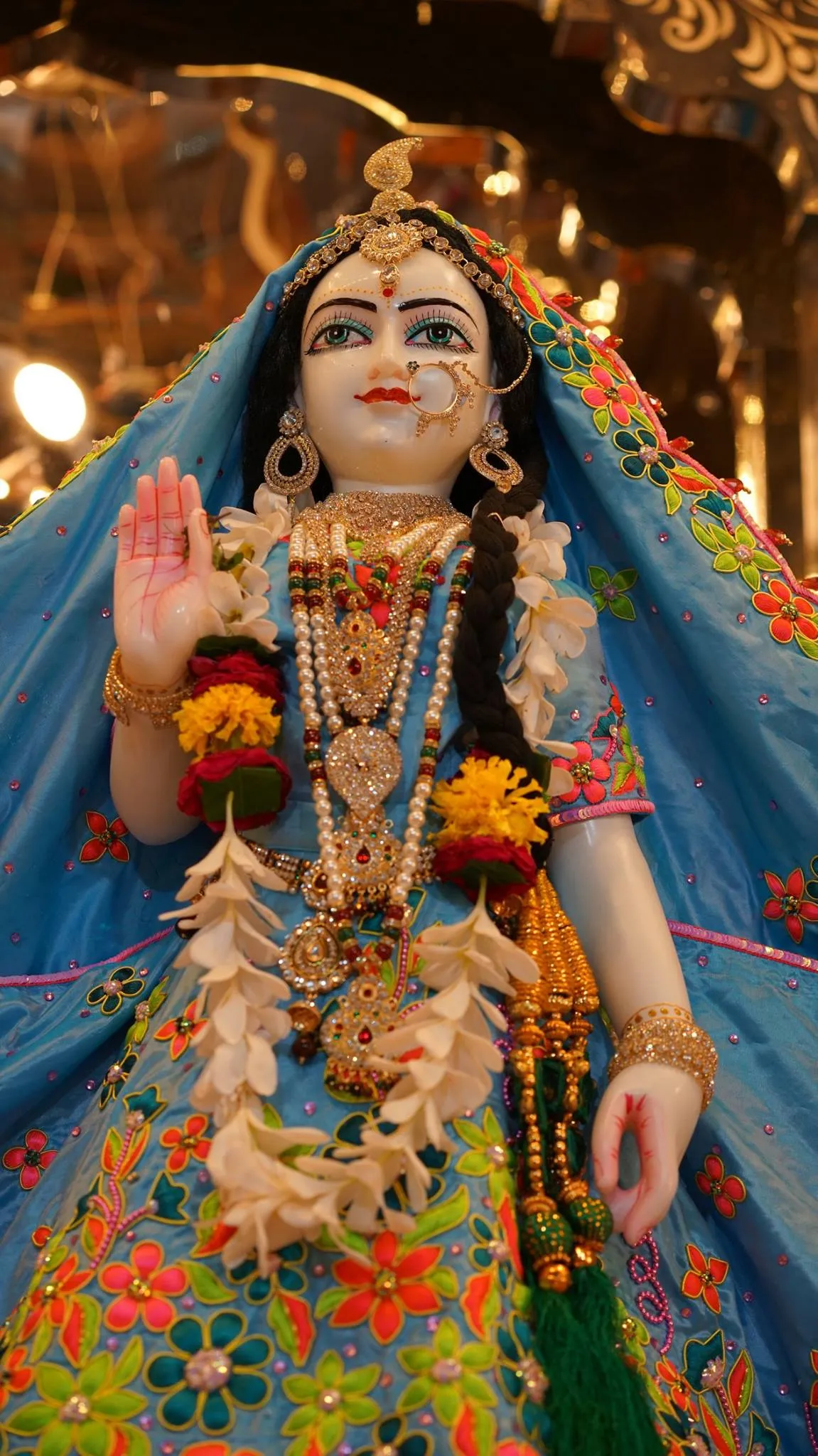
HOW TO RECEIVE MERCY
Some people, despite having come to Vṛndāvana, do not have relationship with Rādhā and Kṛṣṇa and the Vrajavāsīs and instead worship Durgā, Śiva, Gaṇeśa, Hanumān, Nārāyaṇa, Dvarakadisa, Lakṣmī, and other gods and goddesses. They miss the golden chance one achieves by coming to Vṛndāvana. These people will become gradually disturbed and will feel always anxious in Vṛndāvana. Vṛndāvana-dhāma is the place of Rādhā-Kṛṣṇa and the vraja-anurāgī-bhaktas. We must understand the exalted position of Vṛndāvana. Even Lord Brahmā, the creator of the universe, prays to take birth in an insignificant position in Vṛndāvana and have some service to the Vrajavāsīs. He prays:tad bhūri-bhāgyam iha janma kim apy aṭavyāṁ yad gokule ’pi katamāṅghri-rajo-’bhiṣekam yaj-jīvitaṁ tu nikhilaṁ bhagavān mukundas tv adyāpi yat-pada-rajaḥ śruti-mṛgyam eva Śrīmad-Bhāgavatam 10.14.34
The greatest of good-fortunes would be the chance to take birth in any form whatsoever in this forest of Gokula which would allow my head to be bathed by the dust from the lotus-like feet of the Vrajavāsīs, whose entire life and soul is Mukunda—the Supreme Lord—and the dust of whose feet are ever-eagerly sought by the Vedic mantras personified.
Brahmā prays, “May I take birth in Vṛndāvana as a piece of stone which the sweepers of the dhāma use to scrape the dirt from their feet at the end of the day. In this way, I will happily receive the Vrajavāsīs’ foot-dust. I would gladly take birth as a snake, insect, or wild animal in Vraja, for in that position, I can achieve the Vraja-devī’s mercy. This type of birth would be far superior than taking birth even as a demigod or master of anyone.” The Vraja-devīs will give mercy to even the scorpions and snakes. Therefore, if you follow even the animals of Vraja, they will give you bhakti. If you cannot follow the sakhās, sakhīs, or Yaśodā Mātā, then you can just follow the creepers, birds, and other animals. By this you will make gradual progress. Rādhārānī can enter a state of māna with cause or without cause. She then leaves the kuñja in a huff. Sometimes, in order to break Her māna, Kṛṣṇa takes the help of the snakes. On Kṛṣṇa’s indication, the snakes make groups of 20 or 30 and approach Rādhārānī. Rādhārānī becomes frightened and loudly shouts, “Kṛṣṇa! Kanhaiyā! Śyāma!” Kṛṣṇa suddenly appears and embraces Rādhārānī. She wraps Her arm around Him and says, “Oh, this path is very dangerous! Help Me! There are so many big cobras here.” “Where are the cobras?” Kṛṣṇa asks, looking around. By that time, the snakes have already hidden themselves. Now Kṛṣṇa says, “The only cobra here was Your māna.”WHO TO WORSHIP
All the residents of Vraja assist Rādhā and Kṛṣṇa’s prema-keli, loving pastimes. Nārāyaṇa, Vāmana, Kalki, Vairabhā, Śivānī, Rudrānī, Candrānī, Pārvatī—if you follow and worship them, you will not be able to achieve the mood of Vraja. Even if you worship the different incarnations of Viṣṇu, you will not get the priceless gem of vraja-bhāva. An example is given. If you are a citizen in a kingdom and you give great respect to the guards and other representatives of the king without showing any honor to the king himself, then you are viable to be punished. Also, if you enter a company but do not respect the owner, and instead offer respect to the employees only, what will be the result of this? The demigods are like the gatekeepers—the servants—of Kṛṣṇa. If you say, “Oh the king is one small man who governs,” and then you worship his servant in front of him, ignoring him completely, what result will come to you? Vṛndāvana is the home of Rādhā and Kṛṣṇa. They are far beyond any incarnation of Viṣṇu or any god or goddess. You must also never respect anyone in front of Śrī Guru. Śrī Guru is the prime object of your worship and respect. Do not respect any ordinary person in front of him. So, in the presence of Rādhārānī and Kṛṣṇa, and while residing Vṛndāvana, if you glorify the demigods or hear their glories, vraja-bhakti will go very far away from you. You will never be able to attain it in thousands of lives. In Vraja, many people arrange festivals and feasts. However, if it is not done for the pleasure of Rādhā and Kṛṣṇa, no positive result is attained. People do this for their own name and fame and respect. Even though they spend so much money, they get no real benefit. Kṛṣṇa is raso-vai-sah. He has everything and is indeed the source of everything. What does He need from us? He is happy if we offer Him our love and if we serve under the guidance of Rādhārānī. He accepts our loving mood, but when we are under guidance only.BEYOND SURRENDER
People think that śaraṇāgati is very important. This is true, but it is only the A-B-Cs of bhakti. It is only the doorway to the realm of bhakti. It is not even inside bhakti. In Bhagavad-gītā, Kṛṣṇa says:brahma-bhūta prasannātmā na ṣocati na kāṅkṣati samaḥ sarveṣu bhūteṣu mad-bhaktiṁ labhate param Bhagavad-gītā 18.54
A person thus situated in Brahma becomes fully joyful. He never laments or desires anything. Being equally disposed to all beings, he attains bhakti to Me, which is blessed with the symptoms of love.
By becoming brahma-bhūta, always absorbed in transcendence, we are freed of material distress, gain and loss, victory and defeat, and are no longer the ghosts of māyā. This, however, does not mean that we have experienced kṛṣṇa-prema. That is only the doorway. Then we can taste mad-bhaktiṁ labhate param. We can then taste this transcendental bhakti. So this is like the entrance into bhakti. After some time we can get bhakti. It is not that we achieve parama-bhakti at once.ānukūlyasya saṅkalpaḥ prātikūlyasya varjanam rakṣiṣyatīti viśvāso goptṛtve varaṇaṁ tathā ātmā-nikṣepa-kārpaṇ ye ṣaḍ-vidhā śaraṇāgatiḥ Caitanya-caritāmṛta, Madhya-līlā 22.100
The six divisions of śaraṇāgati are (1) accepting those things that are favorable for bhakti, (2) rejecting those things that are unfavorable for bhakti, (3) considering Kṛṣṇa to be one’s protector in all circumstances, (4) accepting Kṛṣṇa as one’s sole maintainer, (5) completely submitting oneself to Kṛṣṇa, and (6) cultivating an attitude of genuine humility.
People understand these six limbs of surrender and try to follow them, but after surrendering what will we do? Renouncing everything including ourselves to God is necessary and very good, but that it not bhakti in and of itself. We can offer ourselves to Kṛṣṇa, but this is actually like giving Him work or a problem that we do not want. We are being a burden to Him. So surrendering does not mean that we just renounce everything and just expect Kṛṣṇa to take care of us. This is not positive or dynamic. Beyond śaraṇāgati is the mood of Yaśodā Mātā or Śrīmatī Rādhikā. At every moment, they serve Kṛṣṇa and they do not want to give Him any burden such as their own maintenance. A disciple should be like this in relation to Śrī Guru. He should always try to serve Śrī Guru without giving him or Kṛṣṇa any burden for his maintenance. The disciple shouldn’t accept service from Śrī Guru. The gopīs are aśulka-dāsikā—they serve without desiring or expecting anything in return. They serve Kṛṣṇa saying, “We don’t want anything. We want no fruit of our actions. The fruit is Yours. We will collect the fruits and give them to You.” After śaraṇāgati, if some heavy reaction to previous karma or a test comes to a devotee, oftentimes he will think, “God does not like me. Why am I receiving punishment? Why am I suffering so much?” If someone speaks like this, then how can it be said that they are surrendered? How can it be said that they are within the realm of bhakti.REAL SANNYASA
Kṛṣṇa is pleased if we are strong and can care for ourselves, remaining clean, decorated, and always ready to offer service. We must be like a ripe fruit for Kṛṣṇa’s happiness. When parents see that their children are qualified and popular, they become happy. Governments also become happy when their citizens are famous and successful. Even ordinary people have this natural feeling. In Vraja-maṇḍala, Kṛṣṇa relishes priya-utsava. Kṛṣṇa’s beloved Vrajavāsīs are always clean and qualified in all kinds of activates, and can immediately do any service that is required perfectly. Kṛṣṇa does not demand renunciation. Yaśodā Mātā and Nanda Bābā did not receive sannyāsa, take up daṇḍas, or give up their homes. They are already Kṛṣṇa’s family members. The gopīs also all have their own homes and rooms, but they are always serving. Everything they have is for Kṛṣṇa. This is kṛṣṇa-bhakti-rasa-bhāvitā-matiḥ. The Vrajavāsīs are always surcharged with kṛṣṇa-rasa and their minds are always absorbed in Kṛṣṇa. For a person thus absorbed what is the necessity of taking sannyāsa? Mahāprabhu said:prabhu kahe, sādhu eī bhikṣura vacana mukunda-sevana vrata kaila nirdhāraṅa parātma-niṣṭhā-mātra veṣa-dhāraṅa mukunda-sevāya haya saṁsāra-tāraṅa seī veṣa kaila, ebe vṛndāvana giyā kṛṣṇa-niṣevana kari nibhṛte basiyā Caitanya-caritāmṛta, Madhya-līlā 3.7-9
The determination of a true renunciant is to devotedly serve Mukunda. This is the only purpose of accepting sannyāsa. Service to Mukunda can grant freedom from bondage in material existence. After accepting sannyāsa, I will go to Vṛndāvana to achieve the service of Mukunda. There, I will take shelter of the Vraja-devīs.
SPIRITUAL HUNGER
In Vraja-maṇḍala, all the Vrajavāsīs take part in the celebration of divine love. When we engage in a festival of saṅkīrtana and everyone participates, enthusiastically dancing, singing, and playing musical instruments—this is saṅkīrtana-rasa. If only one person is singing and everyone else is silent or neglectful, that is not sankīrtana-rasa. In Vraja, everyone is enthusiastic and participates in the continuous festival of love. Kṛṣṇa says that a feast is proper when everyone is ready to accept and participate and has a favorable mood. A person who is famished can take any dry chapatti and find it very tasty, but a person whose belly is full, will not be attracted any type of food. We must be spiritually hungry for this festival—this feast of prema—and we must rid ourselves of all other desires. In Vraja, even the crickets, snakes, and scorpions can help us. They also have kṛṣṇa-bhakti-rasa-bhāvitā-matiḥ and are Vrajavāsīs who can give you a share in the feast of love. You will not need austerity, japa, and tapa. The cost is your hunger, or your greed. Vraja-bhūmi will give you the special love that is found there if you have greed and a respectful mood toward the Vrajavāsīs. You must understand, however, that if you worship the demigods or any incarnations of Viṣṇu, Vṛndāvana-dhāma will not bestow upon you this prema. The Vrajavāsīs are Kṛṣṇa’s family members. Those who may be living in Vraja but are worshiping gods and goddesses are not actually Vrajavāsīs.THE REAL ORNAMENT
Kṛṣṇa’s sakhās and sakhīs wear beautiful ornaments. These ornaments are made from pieces of stone or gems. They are not pearls or diamonds. The Vrajavāsīs wear anklets, bracelets, and garlands—all of flowers. Their most special ornament, however, is their ekādaśa-bhāva. Their methods and moods in regard to their service to Kṛṣṇa are their ornaments. A brahmacārī may say, “I will daily offer praṇāma to all Vaiṣṇavas.” If he follows through with his vow, then that becomes his ornament. When a devotee says, “I vow to daily wear tilaka,” and follows this vow, that tilaka is then his ornament. Tilaka is not only a symbol of God. To apply tilaka on the body is to create a room or a place for God to situate Himself. People make buildings and temples out of bricks, stone, wood, and marble, but we make our bodies temples of God. The Lord resides in the marks of tilaka on our body. That is our ornament. The following of vows and execution of daily fixed services in the temple and to the bhaktas and the dhāma are a brahmacārī’s ornaments. The Vraja-devīs have so many ornaments that enchant Kṛṣṇa. Their ornaments are not just their necklaces and ankle-bells, but their moods and methods of sevā. We hear in Caitanya-caritāmṛta how Rādhārānī is bathed and dressed with Her different moods for Kṛṣṇa. The gopīs do not want to be famous or receive respect. We see that people of this world will dress very nicely and appear polished and dignified, but inside they are burning with the desire for name and fame. That is not an ornament. The gopīs’ behavior is like an ornament because it is freed from any ulterior motive. They only want to serve and please Kṛṣṇa. That is the purpose of all their activities. The desire for prestige is a poison that destroys spiritual life, but in Vṛndāvana, Kṛṣṇa sees that the gopīs have only true beautiful ornaments. Because of their true beauty that is within, the gopīs have so much beauty externally. Their attire and fragrance is all wonderful. They themselves are like flowers, so it is natural that flower ornaments decorate their bodies. They have good relation with the flowers of Vraja-maṇḍala. Their beautiful natures are represented by their dancing, laughing, smiling, and playing. People weighed down by thoughts of politics, envy towards other, and duplicity will not be light-hearted or joyful. Treacherous scorpions and snakes will hide in caves, while peacocks dance and sing with one another. The peacocks are like this because they have happy light moods. Their mood brings great pleasure to Kṛṣṇa. Owls and other predators are always hiding and waiting for a chance to snatch their prey. Mahāprabhu instructs:amānī mānada hañā kṛṣṇa-nāma sadā la’be vraje rādhā-kṛṣṇa-sevā mānase karibe
Respect others and do not yearn for personal respect. Chant the holy name always, and render service to Rādhā and Kṛṣṇa in Vṛndāvana within your mind.
Śrīla Bhaktivinoda Ṭhākura prays in a mood of longing for the strength to follow Mahāprabhu’s instruction:amānī mānada hoile kīrtane adhikāra dibe tumi tomāra caraṇe niṣkapaṭe āmi kāṅdiyā luṭibo bhūmi
Dear Lord, please give me the ability to always offer respect to others and never want respect myself, thereby granting me the qualification to properly perform kīrtana. Weeping and rolling on the ground, I sincerely submit myself at Your lotus feet.
“When will I be free from the desire for respect? When will I honor all others and thus naturally be engaged in sankīrtana-rasa?”