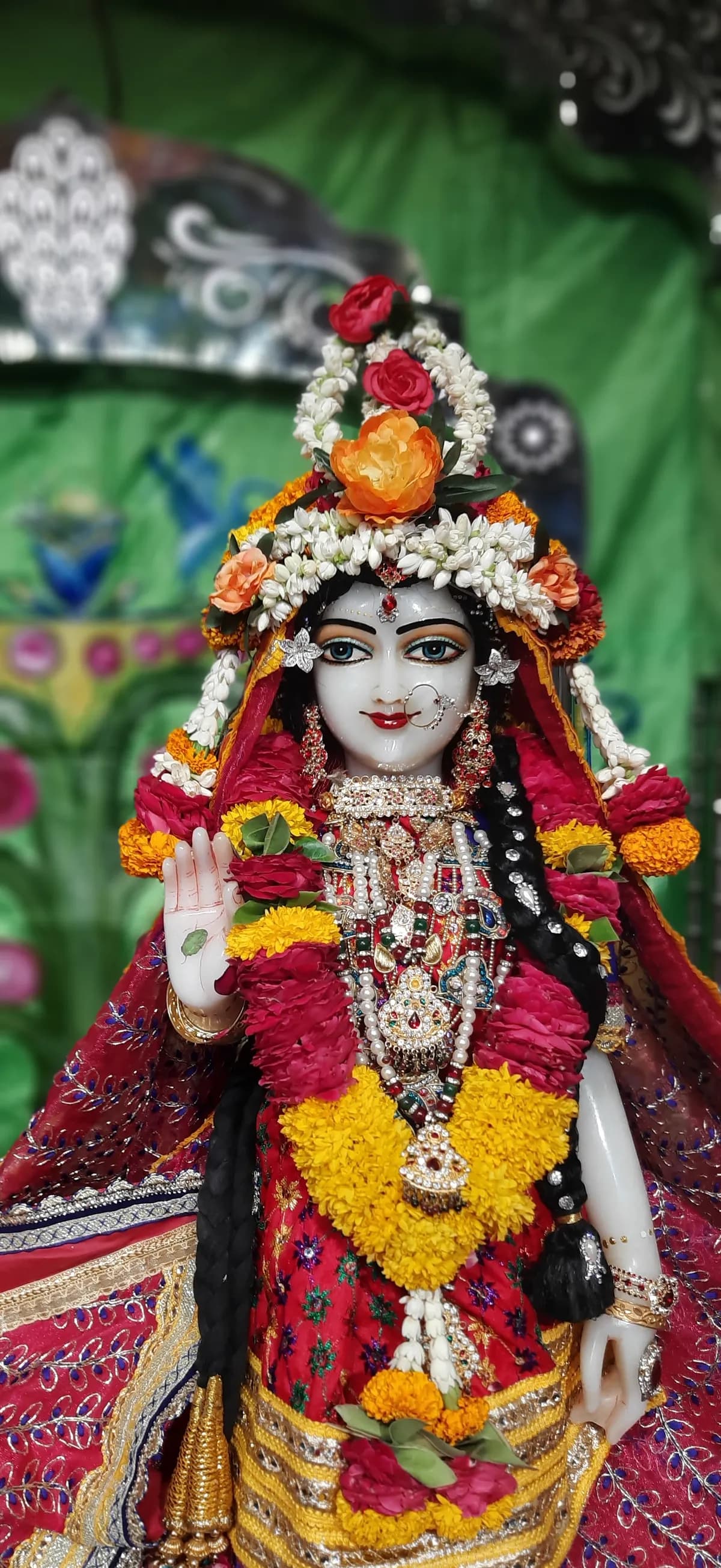
Śrīmatī Rādhārānī’s maidservants are like kāmadhenus. Her maidservants are also likened to the dust of Śrīmatī Rādhārānī’s lotus feet. The kāmadhenu cows give not only milk; they fulfill all desires. They have this transcendental power.
A kāmadhenu cow once lived in the āśrama of Vaśiṣṭha Ṛṣi. Passing through the forest with his army, King Viśvāmitra came to that āśrāma to rest a while. Vaśiṣṭha Ṛṣi welcomed the king and said, “Please rest here for some time. I will arrange refreshments for you as well as all your soldiers and animals.”
“How can you possibly feed all of us?” Viśvāmitra said. “We are so many, and you are a simple sage here in the forest with meager possessions.”
“Don’t worry. I will provide for you and your army. Please take bath and I will arrange everything.”
In a short while, Vaśiṣṭha Ṛṣi astounded Viśvāmitra by providing for his whole army without difficulty. Viśvāmitra ate and then rested. In the evening, he asked Vaśiṣṭha how he had accomplished such a feat.
“In my āśrama I serve a kāmadhenu, wish-fulfilling cow,” Vaśiṣṭha Ṛṣi said. “She provides whatever is necessary.”
“Any valuable property in a kingdom should be offered to the king,” Viśvāmitra said. “Why have you hidden this treasure from me?”
Vaśiṣṭha Ṛṣi was a brahmaṛṣi, a highly elevated sage, and had no attachment to anything. He therefore said, “Mahārāja, you may take her if you like.”
Brahmarṣis, who are highly elevated sages, are not miserly. Viśvāmitra tried to lead away the cow with him. He said, “O mother, come with me.” But the kāmadhenu looked to Vaśiṣṭha Ṛṣi with pleading eyes. She thought, “Here I live with a great sage, but this king wants to take me and engage me in fulfilling all his nonsense ideas. I won’t serve him!”
She silently asked Vaśiṣṭha Ṛṣi, “Why are you giving me to him?”
“I didn’t give you,” he replied. “The king asked, so I said he could do as he liked. I am a brāhmaṇa, so it is not in my nature to deny someone.”
“He is trying to take me by force,” kāmadhenu said. “Can I
protect myself?”
“Do as you see fit,” Vaśiṣṭha Ṛṣi replied.
Kāmadhenu then loudly mooed and thousands of soldiers appeared and quickly routed the entire army of Viśvāmitra. Viśvāmitra became envious of the power of Vaśiṣṭha Ṛṣi and thought, “I will also perform strong austerity and become a brahmarṣi, then I will defeat Vaśiṣṭha Ṛṣi and acquire the kāmadhenu.”
The mañjarīs have deep rati, attachment to the lotus feet of Śrīmatī Rādhikā, and are always endeavoring to satisfy Her. The mañjarīs are like kāmadhenus, endowed with all spiritual power. They are always absorbed in serving Śrīmatī Rādhikā and according to Her desires they can manifest anything they like at once. They can even manifest worlds in a moment simply by desiring for it to be so. However, they never misuse their power or show it openly. They keep it hidden. They know that when someone shows his or her powers externally then many people will come and try to steal and acquire it, like we see in the exchange over the kāmadhenu cow between Vaśiṣṭha Ṛṣi and King Viśvāmitra. Therefore the mañjarīs and gopīs hide their powers and appear like ordinary village girls, milking cows, cooking, making sweets, picking flowers, and moving from forest to forest.
The Vraja-devīs are never divided in their love. When they see a dark tamāla tree, they run and embrace it, feeling it to be non-different from Kṛṣṇa. When they see a dark raincloud then they feel uddīpana of Kṛṣṇa, and when they see peacocks dancing, they remember Kṛṣṇa and respect those peacocks.
Uddhava looks just like Krsna. However when he came to Vraja, the Vraja-devīs were very careful in their etiquette. They ran to embrace the tamāla trees but they did not embrace Uddhava. They are always one-pointedly attached to Śrī Kṛṣṇa and faithful to Him.
The mañjarīs are like kāmadhenus in the sense that if a sādhaka has respect for them and takes shelter of them, then they will give a chance to serve Śrī Śrī Rādhā-Kṛṣṇa. They can fulfill all our spiritual aspirations, therefore the Guru-varga—Rūpa Gosvāmī, Viśvanātha Cakravartī Ṭhākura, Bhaktivinoda Ṭhākura, and so forth teach us how to follow mañjarī-bhāva-upāsana, and they advise us to always remember and pray to the mañjarīs.
The mañjarīs possess bhāva-ullāsa-rati, which is unique only to them. Therefore we directly follow and pray to the mañjarīs, the maidservants of Śrīmatī Rādhārānī, who have more attachment to Her than to Kṛṣṇa Himself.
Śrīla Gurudeva describes bhāva-ullāsa-rati in his commentary on Veṇu-gīta, Verse 7:
Generally, devotees of the same mood and who are enriched with similar desires naturally share suhṛd-bhāva intimate friendship, with each other. That is why the love and affection that Lalitā and the other sakhīs have for Śrīmatī Rādhikā is called suhṛd-rati. When their suhṛd-rati is the same as or slightly less than their kṛṣṇa-rati (affection towards Śrī Kṛṣṇa), this is called sancārī-bhāva (a temporary emotion that is compared to the waves that swell and then return to the ocean of their permanent emotion of the mood of Kṛṣṇa's beloveds). In other words, this suhṛd-rati becomes like the waves in the ocean of their prominent affection for Kṛṣṇa; it is a sancārī-bhāva.
In the case of the mañjarī-sakhīs, their suhṛd-rati (for Śrī Rādhā and everything connected with Her), which abundantly exceeds their kṛṣṇa-rati and which constantly increases by the moment due to their full absorption in it, is called bhāva-ullāsa-rati. This is a special feature of madhura-rasa. Of the five types of sakhīs, only the nitya-sakhīs and prāṇa-sakhīs, who are known as mañjarīs, have this bhāva-ullāsa-rati as their permanent emotions (sthāyī-rati). It is no longer just a sancārī-bhāva. These mañjarīs nurture an abundance of sneha, tender affection, for Rādhājī.
It is seen that creepers are always endeavoring to embrace trees, but the leaves, flowers, and buds (mañjarīs) of the creepers do not even slightly try to embrace the trees directly. When a creeper embraces a tree, the joy of those flowers, leaves, and mañjarīs automatically increases. In Śrī Vṛndāvana, Śrīmatī Rādhikā stands supreme among all gopīs. She is famous as the kalpa-latā (the creeper that fulfills every desire) of love for Śrī Kṛṣṇa. Some of Her sakhīs have the nature of leaves, some are like flowers, and some are like mañjarīs. That is why they are always eager for Śrīmatī Rādhikā to meet with Kṛṣṇa, and are carried away by the bliss of Their union. (CC-BY-ND, Gauḍīya Vedānta Publications).
The mañjarīs have bhāva-ullāsa-rati. Their loving attachment for Śrīmatī Rādhikā causes them to feel a constant state of ullāsa, joy, and utsāha, enthusiasm, to serve. Without enthusiasm and a joyful mood, it is difficult to progress in bhakti. By the mercy of the mañjarīs, we can develop bhajana-utsāha and bhakti-ullāsa, enthusiasm in our spiritual practices and joy in our devotional services. How long can we chant without taste or realization? And how long can we serve without any enthusiasm? How long can we listen to hari-kathā without any taste for hearing Kṛṣṇa’s glories? We will think that it is only a waste of time. We therefore need this ullāsa and utsāha, happiness and enthusiasm. This can come to those who follow the footsteps of the mañjarīs. They can achieve bhāva-ullāsa-rati.
Those who follow karma, jñāna, or yoga, cannot achieve even a particle of bhāva, ullāsa, or rati. Aside from the followers of vraja-bhakti, those who follow other spiritual paths find it difficult to maintain their enthusiasm over a long course of time. However, those who follow mañjarī-bhāva-upāsana under the guidance of vraja-rasa-rasika Vaiṣṇavas are always experiencing more and more enthusiasm and bliss. Therefore, we must always remember and pray to those mañjarīs who are like kāmadhenus. The mañjarīs are able to fulfill all of our spiritual aspirations. Like a kāmadhenu, they give us all nourishment. The glories of these mañjarīs are unsurpassed.
We therefore pray to be able to take the dust from their feet on our heads. Kṛṣṇa says, “I am the follower of that person who follows the maidservants of Śrīmatī Rādhikā and I take the dust of that person on My head and smear it on My body.”
In the Bhagavad-gītā, (2.65) Kṛṣṇa says:
prasāde sarva-duhkhanam hanir asyopajayate prasanna-cetaso hy asu buddhih paryavatisthate
By taking prasāda, one feels the mitigation of all suffering and experiences supreme joy. The highest type of prasāda is the bhāva-utsava, festival of bliss, which is coming from the foot dust of the Vraja-devīs. By following the footsteps of the mañjarīs, one can take the dust from their feet and this will awaken bhāva-ullāsa-rati. Then our spiritual love, attachment, and joy will never cease.
In this world, we may meet with friends and become happy for a while, but if, a little bit later, those friends stop talking to us or reject us, we become sad and depressed. However the maidservants of Śrīmatī Rādhikā will never reject us. Our ācāryas are followers of the footsteps of the mañjarīs; they have this bhāva-ullāsa-rati and they distribute this mahā-prasāda to qualified sādhakas. The Guru-varga will never forsake someone who has come to their shelter.
The foot-dust of the gopīs is the most relishable prasāda for Kṛṣṇa, and if anyone follows the gopīs footsteps and takes the dust of their feet, then that is even more relishable for Kṛṣṇa. By following their footsteps and moods, one naturally receives the dust of their feet. This is the greatest feast. Kṛṣṇa does not have so much taste for other feasts. Also, wherever the mañjarīs’ followers start any program, Kṛṣṇa will immediately run to that place. He will Himself roll in the dust of that place, smear the dust on His body, and never leave that place.
Śrīla Gurudeva manifested the Sevā-kuñja painting. On either side of the Divine Couple there are two mañjarīs. He thus indicated that we must take shelter of the mañjarīs if we want to serve Rādhā and Kṛṣṇa.
Excerpted from the Bhakta Bandhav “Radha-Rasa-Sudha-Nidhi”, Commentary on verse 5 [CC-by-NDNC Bhakta Bandhav]