THE BUILDING OF PREMA
To make a building, not only are ingredients like stone, bricks, and wood required, but also a qualified worker. Someone who can combine all these ingredients and construct the building is needed. Rādhārāni’s servants are expert in building the temple of prema in the hearts of jīvas. They know which rasa each jīva possesses, and they know how to prepare that soul and help him progress. This rasa is like the water in the list of construction materials. Without water, a building cannot be constructed. Water must be mixed with the cement and utilized to keep everything together. Also, when you mix cement with water, it is not immediately ready to support the weight of people or a building. In the same way, we cannot immediately achieve rādhā-dāsyam or kṛṣṇa-prema, we have to first be prepared. The Vrajavāsīs prepare us. When we associate with Guru and Vaiṣṇavas we are being made ready. When we are fully prepared, we will realize everything and achieve our svarūpa-siddhi. Some people say, “I have come and taken shelter of Guru and Vaiṣṇavas, but my heart has not changed. I don’t taste any bliss or feel praṇaya-rasa. How can these persons be bona fide?” In reality, some time is needed. The rasa is working, but time is needed. We do not want any quick fix that will not last. Many gurus display mystic powers and quick results to their followers but this is material, not spiritual. For a spiritual result, time is required. First, our heart must be cleansed of all dirt, or the unwanted desires and obstacles on our path of progress and development toward kṛṣṇa-prema. Once the platform is clear and the foundation is set, then the Vrajavāsīs can construct the building of prema. We can understand that the building of prema is developing within us, and that our heart is being cleansed, when we have no other desire—no interest in accepting anything other than vraja-bhakti, finding no attraction for mukti or residence in Svarga. By worshiping the demigods or Nārāyaṇa, mystic siddhīs will come to us. We will become popular and famous. We will have many temples and followers and we will become divided and our mood will be spoiled. All desire for Rādhārānī’s service as a mañjarī will be lost. This is not praṇaya-rasa. We must be very careful and try to develop a laser-focus on our desired goal.VRAJA GURU-NIṢṬHA
If we once approach and surrender to a sad-guru who is in fact Rādhārānī’s kiṅkarī, then the great love of that sad-guru will make us unable to ever leave him. If we are apart we will cry. We saw that when Śrīla Gurudeva would depart from any location, the devotees would weep bitterly, thinking, “When will I see Śrīla Gurudeva again?” Why is this? This is because Śrīla Gurudeva has this love. He is Rādhārānī’s kiṅkarī, Her mañjarī. He does not come here for fame, followers, and temples, nor does he come to give these things. His purpose is to give us sva-bhakti-śrīyam—the chance to be Rādhārānī’s maidservant. A loyal and chaste disciple will never try to replace his guru once his guru has departed from his external vision, just as a chaste wife will not look for another husband if her husband passes away. A disciple's connection to sad-guru is eternal. The Vraja-devīs did not approach any other man once Kṛṣṇa left Vṛndāvana. They only cried and waited for Him to return, feeling the bitter pangs of separation from Him. Worshippers of the demigods will offer something to Durgā one day and then something to Hanumān the next day. Another day, they will worship Gaṇeśa. They have no loyalty for any specific god or goddess and therefore receive no blessings from anyone. They worship the Sun, the Moon, the other planets, and the different demigods. However, those who are the maidservants of Rādhārānī will not do this. They will not worship the planets and astrological devatās. They are beyond all this. “I desire unswerving devotion for the lotus feet of Rādhārānī.” When Mohan, Śrī Kṛṣṇa, sees this mood appear in a person’s heart He becomes overjoyed and ready to do anything for that person. He will come running to embrace that person, saying, “Oh, you are the follower of Rādhārānī! Please give Me something. Give Me some tāmbūla. I want to taste something from your hand. Give me a flower or a garland. What can I give you? I will give you Myself.” Aside from the lotus feet of Śrīmatī Rādhārānī, what else is worth thinking about? Why worship anyone else? We do not need to worship Kṛṣṇa. We do not need to worship any demigod or goddess. By one-pointed worship of Rādhārānī, everything will be gained. There is no need of anything else. This is the mood of Mahāprabhu and our ācāryas. The Gauḍīya-sampradāya specially gives this one-pointed attachment to Rādhārānī. Those who do not understand the true conception of this line, do not know the real meaning of Gauḍīya. They do not know the object of worship in this line. Such people say, “Mahāprabhu chanted ‘Hare Kṛṣṇa’ and preached the yuga-dharma,” but this is not everything. When we have strong faith and are one-pointed in focus to Rādhārānī, Kṛṣṇa will come and say, “What can I give you? I am giving you Myself, but what else can I give you? I am completely indebted to you. How can I serve you?” So what is the need to directly worship Kṛṣṇa? By worshiping Rādhārānī, everything is attained. Mohan Kṛṣṇa is vanamālī and is always eager to give some special gift or service to the followers of Śrīmatī Rādhārānī. Rādhārānī sees Kṛṣṇa’s mood and becomes very happy. She thinks, “Oh, He has so much affection for My mañjarīs and sakhīs.” Kṛṣṇa gives this, not only to the mañjarīs and sakhīs, but to anyone who is a follower of Rādhārānī—anyone who chants Her names. Prabhupāda Sarasvatī Ṭhākura would tell the devotees in Māyāpura Caitanya-matha that they should honor and serve any living entity that came there, whether they were a cat, dog, mouse, beggar, or anyone. He told them that if someone hears the names of Gaurahari and offers praṇāma, touching his body to the dust of the dhāma, that person or living entity is worthy of our greatest respect. It is our good fortune to serve a soul who desires the mahā-prasāda of Śrī Gaurahari, and any chance to do such service should be immediately taken. Kṛṣṇa has a similar mood toward anyone who chants Śrīmatī’s holy names and desires to serve Her. Kṛṣṇa’s love and affection flows to such a person like a river. Observing this, Rādhārānī becomes pleased and says, “Kṛṣṇa has respect and love for My followers.”THE HIGHEST UNIVERSITY
A person who chants ‘Rādhe Rādhe’ receives all spiritual potency. As a plant receives all energy and nourishment from the Sun, in the same way, when we chant the names of Rādhārānī—She who is the transcendental Sun of pure love—Her energy will completely envelop us. All Her beauty and qualities will also be revealed to us. All Her hladinī-śakti will come to us. At that time, our physical body, mind, and senses, as well as the soul-body and its senses will become parama-adbhuta, very wonderful and beautiful. We will find ourselves very close to Rādhārānī and Her associates. At that time we can understand who are our sajātiya, like-minded friends, and we wont be cheated by others who dress themselves as great Vaiṣṇavas but in reality are deceitful and devoid of love for Rādhārānī or our Gurudeva. Rādhārānī’s svarūpa-śakti empowers all the gopīs and therefore they are always dancing, singing, playing, cooking, picking flowers, making garlands, and otherwise joyously engaged. Moreover, whatever they do becomes very wonderful. In this world, we find different cooks who can make nice cakes. The smell and look of each cook’s cake will be somewhat different. Some cooks have less or more experience and different styles. But the followers of Rādhārānī will have the most excellent skill in whatever they do, and all that they do will be perfect. Whenever the followers of Śrīmatī Rādhārānī do anything, that action and its result is glorious. Rādhārānī’s followers are eternally glorified for their excellence in service. If one wants to enter one of the top universities of the world, he has to score very high marks in his preliminary studies and must pass the entry examinations. Only then can they enter. Similarly, the followers of Rādhārānī are like the students of the most exalted university. They are the topmost devotees of Kṛṣṇa. Kṛṣṇa and Vṛndā-devī test the devotees who desire to be Rādhārānī’s servants. Vṛndā-devī will train them, Yogamāyā will connect them, and Paurnamasi-devi will allow them entrance. Once allowed entrance, they will become connected to the flow of līlā-śakti or hladinī-śakti, and whatever they do will be perfect. Śrīmatī Rādhārānī’s followers will also be careful in anything they do because they know Śrīmatī Rādhārānī will not tolerate any shortcoming or mistake. She expects excellence and perfection. Therefore, everything the gopīs do is an art. Whether they are smiling, walking, or engaged in any activity—it is all supremely graceful. We pray, “When will Rādhārānī give me the chance to serve Her. My life will be useless without Her mercy and acceptance. All austerity or sādhana is useless unless I get Rādhārānī’s mercy and service.”BOYCOTTING KRSNA
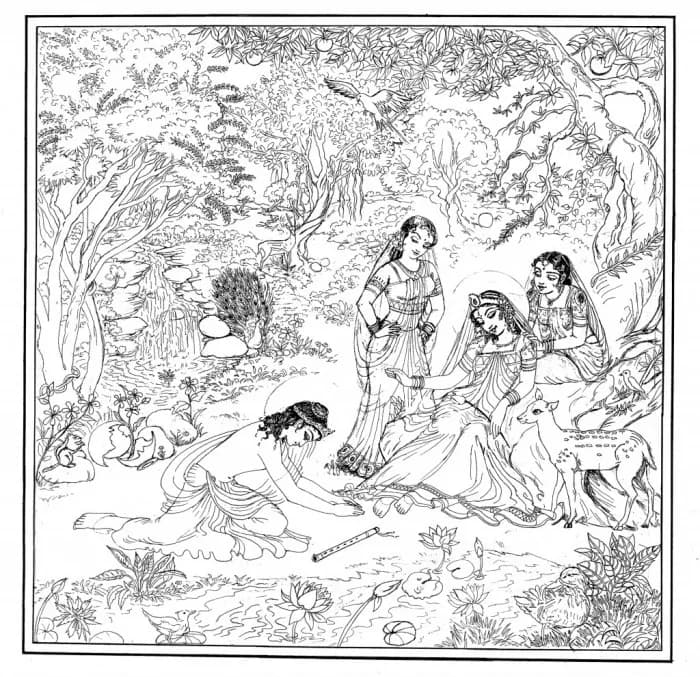
“O Rādhārānī, Your eyebrows are so beautiful. Your cheeks are reddish from Your anurāga for Kṛṣṇa. You become angry when You see someone has done something wrong in Vraja.” If Kṛṣṇa visits Candrāvalī, Rādhārānī will punish Him. She, however, does not harm or banish wrongdoers. Her punishment is Her māna. This is anger born out of Her love. Sometimes, Her māna becomes very deep and strong and Kṛṣṇa can only pacify Her with great difficulty. Śrīmatī Rādhārānī sometimes feels māna toward different mañjarīs or gopīs. Rūpa Mañjarī serves, performing some activity on Rādhārānī’s instruction, and then Kṛṣṇa comes and looks at her. He thinks she is Śrīmatī Rādhārānī because she looks so similar to Her. Because Rūpa Mañjarī is always thinking of Rādhārānī and has the same moods, she becomes rādhā-maya. Then Kṛṣṇa runs, embraces Rūpa Mañjarī, kisses her lips and runs off. Śrīmatī Rādhārānī sees Rūpa Mañjarī returning to the kuñja later and notices that her lip is cut. She says, “Oh, why is your lip cut? Were you bitten by a parrot, or perhaps a snake? Did a black snake bite you?” She sees that Rūpa Mañjarī’s face has become red, the color of anurāga. Rūpa is very young and her face is so sweet and attractive. Rādhārānī becomes angry and says, “Who attacked you like this?” She inquires from the different gopīs and finally learns what happened. “That black boy, Śyāma, attacked her,” one gopī says, “He came, kissed Rūpa, and ran away.” Rādhārānī becomes furious. “How could He attack my Rūpa? I will not let Him enter My kuñja ever again.” All the gopīs start a strike against Kṛṣṇa. None of them look toward Him and they also cover everything that is black in the kuñja with white cloth. They understand Rādhārānī’s mood and start a boycott against Kṛṣṇa. Kṛṣṇa suffers so much under this punishment and thinks, “Oh, why have I displeased Rādhārānī? Without Her permission, I kissed one of Her mañjarīs.” Kṛṣṇa goes to the gopīs and says, “What have I done wrong? Please ask Rādhārānī to forgive Me.” They said, “Why did you independently touch one of Her mañjarīs? For this offense, You will never again be allowed into the company of our Svāminī.” Seeing that they cannot find any solution, Madhumaṅgala and other sakhās go to Vṛndā-devī and say, “Kṛṣṇa is not eating. He is sick now and suffering so much. Please come help. Find some means to pacify Rādhārānī.” “No,” Vṛndā-devī says. “We have no more relation with Him.” The sakhās report this to Kṛṣṇa, who then becomes more depressed. He is rasika-mauli. He makes a plan. He arranges a meeting and makes a deity of the Vana-devī, the forest goddess, and they worship the deity. They offer that deity many songs. Which songs? The sakhās and Kṛṣṇa, playing on instruments, sing in sweet voices:rādhe! jaya jaya mādhava-dayite gokula-taruṇī-maṇḍala mahite
O Rādhā! All glories to You, all glories to You, the beloved of Mādhava. You are the most qualified of Gokula's damsels.
dāmodara-rati-vardhana-veśe hari niṣkuṭa-vṛndā-vipineśe
The beautiful way You dress causes Śrī Dāmodara’s attachment to You to swell. You are the presiding Goddess of Hari’s home—the forests of Vṛndāvana.
Kṛṣṇa commited an offense toward Rūpa Mañjarī by approaching her independently of Rādhārānī, so to pacify Her, He sings prayers like these. He sings:
rati-sukha-sāre gatam abhisāre madana-manohara-veśam na kuru nitambini gamana-vilambanam anusara taṁ hṛdayeśam
The sound of Kṛṣṇa’s singing goes into the kuñjas where the gopīs are present. Kṛṣṇa sings and then prays on His flute and this song pervades Vraja-maṇḍala with the sound, “Rādhe Rādhe!” All the kiśorīs, mañjarīs, and sakhīs hear this singing. The flute carries the names of Rādhārānī. They hear this singing and then Rādhārānī’s māna is washed away. Kṛṣṇa worships Śrīmatī Rādhārānī through kīrtana and by worshipping Her Deity and then Rādhārānī becomes pleased with Him. Rādhārānī’s Deity, Her name, and Herself are not separate. They are connected. If someone is worshiping Rādhārānī’s Deity, or chanting Rādhārānī’s names, She is aware of this. The sakhīs say, “O Rādhe, do you know? Kṛṣṇa has started a program with the sakhā-maṇḍalī. They are worshiping You and doing kīrtana of Your names.” Rādhārānī goes with Her sakhīs and from a distant hill looks down at Kṛṣṇa’s performance. She and Her friends see that all the sakhās are dancing and singing. All the parrots, cuckoos, peacocks, deer, and all the different animals have also joined Kṛṣṇa and His friends. They are all dancing joyously together. The cows, calves, and even the trees and creepers are also dancing. The trees sway as they hear the singing of, “Rādhe Rādhe!” Śrīla Gaura-kiśora dāsa Bābājī Mahārāja would sing:koṭhāya go premamayī rādhe! rādhe! rādhe rādhe go, jaya rādhe rādhe
Kṛṣṇa is crying and praying like this.dekhā diye prāṇa rākha rādhe rādhe tomār kāṅgāl tomāy ḍāke rādhe rādhe
“O Rādhe, you are Karuṇa-mayī, the ocean of mercy. Please forgive Me. I know You cannot remain angry at Me for long.”
Kṛṣṇa’s mood was very innocent. He sees the love and affection of the mañjarīs and how much they serve Śrīmatī Rādhārānī. His heart becomes overwhelmed with sweet affection for them because of this. He wants to embrace them. He thinks, “How can I show them My affection? What can I give them?” But the mañjarīs do not want any connection with Kṛṣṇa. They are solely dedicated to Rādhārānī.