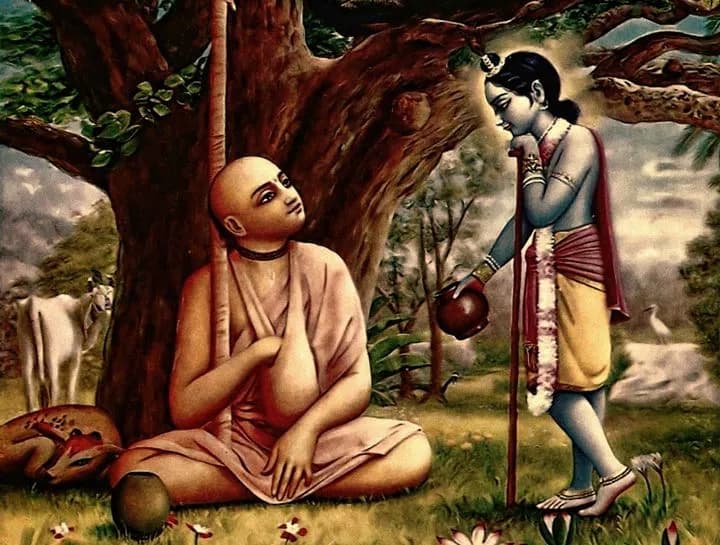
Mādhavendra Purī is the root of the tree of divine love. Our sampradāya of prema-bhakti stems from this root and is flourishing even now. Mādhavendra Purīpāda first gave mañjarī-bhāva, gopī-bhāva, and vraja-bhāva to the people of Kali-yuga.
Mādhavendra Purī had a desire to turn everyone into a pure devotee. But not everyone followed his instructions. He tried again and again—but not everyone heard him. And those who heard him would not follow his instructions; they would not practice what they had heard.
Mādhavendra Purī thought, “I want to give these moods of spontaneous love. But who will accept them?”
After Mādhavendra Purīpāda came to Navadvīpa-dhāma, he went to Śāntipura and met Kuvera Paṇḍita. Kuvera Paṇḍita had a son called Kamalākṣa. When he saw Kamalākṣa (Advaita Ācārya), he thought, “Oh this boy is very qualified.”
It is not possible to make advancement without the grace of Śrī Guru. Also, Śrī Guru should be a vraja-anurāgi; he should be a Vrajavāsī. Then it is possible for the disciple to be showered by spontaneous love. But if the guru has no love and if he doesn’t practice what he preaches, then how will he give this transcendental love? How can he shower others with vraja-rasa if he is not near svarūpa-śakti Śrīmatī Rādhārānī? It is not possible to control someone without love; it is impossible. Everything is possible by love. Yet, the conditioned soul divides whatever meager love he has among others. Therefore, he becomes completely dry. God and His devotees possess spontaneous, continuous love.
When Kamalākṣa met Mādhavendra Purīpāda, he saw that the divine body of Mādhavendra Purī embodied all the aṣṭa-sāttvika-bhāvas (eight types of transcendental bodily transformations). He then took initiation from him.
After he had taken initiation, Kamalākṣa thought, “The process of bhakti is so easy now. The flow of vraja-rasa is very strong and relishable. Many hindrances may come, but this mood is never disturbed. I always feel connected to the flow of vraja-rasa.”
Kamalākṣa asked Mādhavendra Purī, “Gurudeva, the atmosphere of Kali-yuga is very strange. The nature, culture, behavior, and desires of all the people are in the mode of ignorance. People are more degraded than animals. It is very difficult to inspire people to do bhajana. Śrī Hari has the world destroyed many times through universal devastations. Although the soul continuously suffers, he cannot purify himself. How can the conditioned souls of Kali-yuga secure their welfare? Their lives are short-lived; yet, they have bad mentalities. They are only engaged in sense gratification. How can they change? Punishment is not an appropriate solution. Many animals and human beings are dying everyday, but they do not change. They have still not entered this transcendental path of bhakti, therefore how can they change?”
Mādhavendra Purīpāda replied, “The embodiment of Kṛṣṇa’s compassion has appeared in this world. Karuṇā-sakti is giving God’s mercy and blessings everywhere unconditionally. Anyone who accepts this mercy will immediately benefit. They will become very powerful devotees. Therefore, you should take shelter of Vṛndā-devī—Tulasī Mahārānī. Vṛndā-devī will give a very great opportunity.
“By worshiping Śālagrāma-śilā and Tulasī Mahārānī, God Himself, along with all the Vrajavāsīs, will appear in your heart. This is called tulasī-sevā or tulasī-vrata. By rendering such services, You are serving Vṛndā-devī and Vṛndāvana-dhāma. This is a very easy way to develop a relation with Vṛndāvaneśvara Śrī Kṛṣṇa. There is no need for You to do anything else; there is no need of any other form of sādhana-bhajana. You need only worship Tulasī-devī and offer her leaves to Śālagrāma-śilā.
“Vrajarāja-nandana becomes very happy by such offerings of Tulasī leaves. He is very happy when Vṛndā-devī is served. There is nothing more needed to please Him. Anyone can offer Tulasī leaves, candana (sandalwood paste), and Gaṅgā water to Śālagrāma-śilā. Or you can bathe Śālagrāma-śilā with your tears. Bathe Him with just water. This is enough. Then the flow of rasamayī-bhakti will enter your heart.”
Kamalākṣa, who later received the name Advaita Ācārya, began this process of worship taught by Mādhavendra Purīpāda, while calling out to Kṛṣṇa with great love and a loud voice, like thunder.
When Advaita Ācārya came to Navadvīpa-dhāma, He would daily worship Śālagrāma on the bank of the Gaṅgā. His house, Advaita-bhavan, was known as the house of a yogī, because of His matted locks and intense demeanor. Advaita Ācārya offered Tulasī leaves and candana to Śālagrāma-śilā, and He spoke from the Śrīmad-Bhāgavatam and Bhagavad-gītā. Now many people listened to Advaita Ācārya and found themselves being completely changed.
Greatly surprised, Advaita Ācārya thought, “Before, many people came and heard from me. But they didn’t change. Now they are changing so quickly!”
Advaita Ācārya would give caraṇāmṛta to everyone and the prasadi Tulasī, candana, and bhoga. Everyone would relish His kīrtana. They would sing:
hare murāre madhu-kaiṭabhāre
gopāla govinda mukunda śaure
yajñeśa nārāyaṇa kṛṣṇa viṣṇo
nirāśrayaṁ māṁ jagadīśa rakṣa
Śrī Ananta-Saṁhitā
After accepting the shelter of Mādhavendra Purī, Advaita Ācārya obtained this prema. Before, he thought, “How is it possible to inculcate the flow of bhakti in peoples’ hearts?”
On another side, in Vraja, Kṛṣṇa told all the Vrajavāsīs, “All of you should worship Girirāja-Govardhana.”
Who is Govardhana? What is His svarūpa? Just as Parabrahma is present in Śālagrāma, Girirāja is Parabrahma’s heart. His face, eyes, hands, and legs are everywhere. You can decorate any śilā of Girirāja and worship the śilā as Govardhana’s face. He has millions of svarūpas. Girirāja-Govardhana is the well-wisher of all Vrajavāsīs. He has transcendental anurāga. Although He is like a stone on the outside, He gives bhagavata-prema to everyone. Although He seems to be devoid of love and affection, He gives everything. He protects everyone.
Just as the Vrajavāsīs were told by Kṛṣṇa to worship Girirāja-Govardhana; similarly, Advaita Ācārya was told by Mādhavendra Purī to worship Śālagrāma-śilā.
Therefore, Advaita Ācārya started worshiping Śālagrāma-śilā. And, when He started His loud praying and kīrtana, Śrī Caitanya Mahāprabhu Himself appeared. Then what happened? Once, when Mahāprabhu was doing saṅkīrtana, He sat on the Viṣṇu-siṁhāsana and took the Śālagrāma on His lap. Mahāprabhu seemed to tell everyone that He appeared from the Śālagrāma. Mahāprabhu then gave darśana to everyone in His twenty-four incarnations. He showed His Daśavatāra form as well.
Śrīvāsa Ṭhākura was very scared. Mahāprabhu broke open his door and entered inside. He told Śrīvāsa Ṭhākura, “Why are you disturbed? Don’t you know who I am?”
Mahāprabhu then showed His svarūpa and sat on the Viṣṇu-siṁhāsana.
So, this Keśava-vrata is very easy and sweet to observe, especially in this Kali-yuga. It is greatly beneficial to observe such a vrata throughout your life. But if it is not possible, then try to observe this Keśava-vrata in the month of Vaiśākha. People worship Śālagrāma by offering a 108 Tulasī leaves; they also smear candana on the Lord. They chant the gopāla-mantra and worship the Śālagrāma. Some people do kīrtana of Śrīmad-Bhāgavatam. After the kīrtana of Śrīmad-Bhāgavatam is completed, they offer bhoga and perform a yajña (fire-sacrifice) as well. They also chant Viṣṇu-sahasranāma and Gopala-sahasranāma (a thousand names of Viṣṇu and Gopāla).
In this month, Śiva Ṭhākura told Pārvatī-devī, “Oh Pārvatī, although you are following all the rules and regulations of Ekādaśī, you should also chant Viṣṇu-sahasranāma everyday. The Viṣṇu-sahasranāma glorifies Śālagrāma with every utterance. Are you chanting these names of Lord Viṣṇu?”
“Yes.”
Then Pārvatī-devī chanted the names of Viṣṇu everyday. Śiva Ṭhākura then gave her the Gopāla-sahasranāma. She also chanted these names of Gopāla.
Once, after observing an Ekādaśī fast, Pārvatī-devī found herself with very little time to break the fast on the next day. How could she break the fast? She would always worship the Śālagrāma and offer bhoga before eating anything. She would also chant the Viṣṇu-sahasranāma. She would then break the fast. But now there was no time. She told Śiva Ṭhākura of her dilemma.
Śiva Ṭhākura replied:
viṣṇor ekaikaṁ nāmāpi
sarva-vedādhikaṁ matam
tādṛṅ-nāma-sahasreṇa
rāma-nāma-samaṁ smṛtam
Brahmāṇḍa Purāṇa
“Chanting one name of Viṣṇu gives more benefit than studying all the Vedas, and one name of Rāma is equal to a thousand names of Viṣṇu.”
sahasra-nāmnāṁ puṇyānāṁ
trir āvṛtyā tu yat phalam
ekāvṛtyā tu kṛṣṇasya
nāmaikaṁ tat prayacchati
Brahmāṇḍa Purāṇa
“If one utters śrī-kṛṣṇa-nāma once, one obtains the same result that comes from chanting the pure Viṣṇu-sahasranāma three times.”
rāma rāmeti rāmeti rame rāme manorame
sahasra-nāmabhis tulyaṁ rāma-nāma varānane
Padma Purāṇa 72.335
Pārvatī-devī asked, “Why didn’t you tell me this before?” Śiva Ṭhākura replied, “If I would have told you this before, you would have thought, ‘Śālagrāma is a piece of stone; He has no svarūpa. By reading and chanting the Viṣṇu-sahasranāma, all the svarūpas of Viṣṇu will enter your heart. And then, the realization of the Śālagrāma’s svarūpa will enter your heart. By chanting the Gopāla-sahasranāma, the svarūpa of Gopāla will enter your heart. Viṣṇu has many incarnations—yet, by chanting His names, you will have the darśana of all these incarnations. Everything will manifest to you. Therefore, you need not concern yourself any more. Kṛṣṇa and His name are non-different.”
Because generally people don’t have full faith in the holy names, Mādhavendra Purī instructed Advaita Ācārya on a simple form of worship. There was no need of any temple or a big place.
In his Bṛhad Bhāgavatāmṛta, Śrīla Sanātana Gosvāmī has described the life of Gopa-kumāra. Before Gopa-kumāra went to Prayāgarāja from Govardhana, he met a sādhu. When he was grazing his cows in the afternoon, he came across a brāhmaṇa swooning in ecstasy. Soon after, the brāhmaṇa fainted in ecstasy. Foam had collected on his mouth. The brāhmaṇa was profusely sweating as well. Gopa-kumāra quickly provided shade and sprinkled some drops of water on the brāhmaṇa. He served the sādhu in many ways.
When the sādhu awoke, he inquired about Gopa-kumāra’s identity.
Gopa-kumāra replied, “I am a simple cowherd boy.”
The sādhu replied, “I have to go now; but I will give you something.”
“What is it?”
“I will give you a special mantra. You should always chant it. You will become supremely happy and fulfilled by chanting it.”
When Gopa-kumāra started chanting the mantra, all his family relationships and attachments were cut asunder. He was no longer bound to his home. He no longer remained in Govardhana as well. He stopped cowherding. Gopa-kumāra became very restless by chanting the mantra. While he was chanting the mantra on the banks of the Yamunā, he walked on her banks and soon found himself in Prayāgarāja.
He also saw a brāhmaṇa there who was like his Gurudeva. The brāhmaṇa would bathe in the Triveṇī-saṅgam (the confluence of the three rivers—Gaṅgā, Yamunā, and Sarasvatī, early in the morning. The brāhmaṇa had a small box that contained a Śālagrāma. The brāhmaṇa would do the Śālagrāma’s abhiṣeka with the water of these three holy rivers. He would then decorate the Śālagrāma with candana. He would offer Tulasī leaves and speak the Bhāgavatam and Gītā in front of the Śālagrāma. He would also do kīrtana in front of the Śālagrāma. He would dance for the Lord’s pleasure. He would offer bhoga to the Śālagrāma in the evening. After offering bhoga, he would place the Śālagrāma in the box.
Gopa-kumāra became very disturbed by this. He said, “Why are you locking my God in your box? He will die! How will He breathe? How can He stay in such a box? This is not good. You should open the box immediately!”
The brāhmaṇa understood that Gopa-kumāra was a simple-hearted person. He said, “Don’t worry. You should know that God has a svarūpa. He has hands, legs, and eyes. He has an inconceivably beautiful svarūpa. The king is worshiping Him in that form. You should have darśana of His svarūpa. They don’t place God in a box there because He resides in a very nice temple.”
Gopa-kumāra then went to have darśana of Veṇī Mādhava. Veṇī Mādhava’s beauty struck Gopa-kumāra. Veṇī Mādhava was installed by Lord Brahmā in Prayāgarāja. The king was a worshiper of Veṇī Mādhava. He would arrange for opulent worship of the Lord. He would have devotees sing, dance, and continuously offer bhoga. The prasāda would be distributed to everyone. Ārati would be observed five times. Therefore, Gopa-kumāra decided to stay with the king.
So, one brāhmaṇa was worshiping Śālagrāma; but he was really worshiping all the svarūpas of the Lord. Gopa-kumāra asked the brāhmaṇa, “Why doesn’t the Lord appear to you in His form as Veṇī Mādhava?”
The brāhmaṇa replied, “All the forms of the Lord are present in my Śālagrāma. I am happy to be worshiping and serving Him this way. The Lord is in my heart. He manifests His svarūpa any time He wishes to do so. He gives His darśana and hides as He desires. But He is always present in this svarūpa like a seed. The seed contains the entire tree itself. If there was no seed, then there would be no tree. The tree is present inside the seed. Therefore, one seed has the capacity to produce many trees, because every tree bears many seeds.”
oṁ pūrṇam adaḥ pūrṇam idaṁ pūrṇāt pūrṇam udacyate
pūrṇasya pūrṇam ādāya pūrṇam evāvaśiṣyate
Śrī Īśopaniṣad
The Personality of Godhead is perfect and complete, and because He is completely perfect, all emanations from Him, such as this phenomenal world, are perfectly equipped as complete wholes. Whatever is produced of the Complete Whole is also complete in itself. Because He is the Complete Whole, even though so many complete units emanate from Him, He remains the complete balance.
One seed produces a tree and the tree bears many seeds. Therefore, many trees are present inside one seed. So, God is present in His Śālagrāma. Thus, He manifests Himself all over the world from that form. Creation started from the Śālagrāma-śilā. By understanding this, you will not be swayed by impersonalism. Otherwise you will perceive God as a formless entity divested of all potencies. He will be seen as nothing. By perceiving the Lord this way, you will only kill yourself.
Therefore, Gopa-kumāra understood the Śālagrāma’s svarūpa. When he deeply contemplated on the Śālagrāma, Gopāla entered his heart and started dancing. Gopa-kumāra saw that every time he worshiped the Śālagrāma, Gopāla would appear in his heart and start dancing.
He thought, “Where did Gopāla come from?”
But after some time, Gopāla would hide in the Śālagrāma. How many people have faith in the Śālagrāma? Before, no temple would be established without a Śālagrāma. Kṛṣṇa had ordered Uddhava to install His Deities. Therefore, the installation of Deities began after Dvāpara-yuga. The Deities of Rāma and Kṛṣṇa were also worshiped before. But the Deities of the Lord were not found everywhere. Only the Śālagrāma would be worshiped.
The gopīs serve and play with Kṛṣṇa in various places like Syāma-talaiya, Śrī Gvāla-pokharā, Ratna-vedī, Ratna-siṁhāsana, Kusuma-sarovara, and Rādhā-kuṇḍa. Mādhava-māsa appears after two months. This is the time of rasa. Jaṭilā, Kuṭilā, and their party patrol Govardhana from all four sides during this time. They surround all the kuñja-kutīras, suspicious of Rādhārānī. They are on the look out for Kṛṣṇa and his party.
Jaṭilā and Kuṭilā think, “Where is Rādhārānī? Where is Kundalatā? Where are Lalitā and Viśākhā? Where is Kṛṣṇa?”
Their anxiety is magnified when they are told that, “Kṛṣṇa is not present in only one form. He is holding the hand of every gopī and dancing.” Who gave them this news? Govardhana Malla (the husband of Candrāvalī), or Ayana Ghoṣa (also known as Abhimanyu, the husband of Rādhā) heard this news about Kṛṣṇa’s Rāsa pastimes and told Jaṭilā and Kuṭilā.
Jaṭilā, Kuṭilā, Abhimanyu, Govardhana Malla and so on, are in one group, always trying to acquire everything. When everyone entered Govardhana’s kuñjas, they could not find Kṛṣṇa. They only found small stones there. The sakhīs and mañjarīs were playing in the kuñjas. But they were also worshipping these stones.
They were asked, “Whom are you worshiping?”
“We are worshiping the śālagrāma-śīlas.”
The sight of millions of gopīs worshiping the śālagrāma-śīlas stunned Jaṭilā and her group.
The gopīs told her, “If you also worship the Śālagrāma, all your desires will be fulfilled. But you should worship the Śālagrāma everyday with the water of Mānasī-gaṅgā. You should offer kṣīra-bhoga as well. You should offer candana and Tulasī; and then, all your desires will be fulfilled.”
Hearing this, Ayana Ghoṣa, Govardhana Malla, and many other strong gopas would carry big pots of Mānasī-gaṅgā water and daily worship the śālagrāma-śīlas. They were actually worshiping Govardhana’s śīlas. Therefore, everyone’s hearts became soft and sweet.
Now, Ayana Ghoṣa, and Govardhana Malla, lost their taste to go to Mathurā and meet Kaṁsa Mahārāja. They felt no desire to go because a strong heart to heart relationship was made with the Govardhana śīlas.
The śālagrāma-śīlas are very hard from outside, but they make everyone’s hearts melt and change. So, our lives will be successful by practicing such worship. Thus, our hearts will be softened. Śālagrāma-śīla manifested as Rādhā-ramaṇa to Śrīla Gopāla Bhaṭṭa Gosvāmī. In the same way, Kṛṣṇa will manifest Himself to us.
The scriptures have described many glories of this Vaiśākha month. Many of these glories pertain to the sādhakas, practitioners, and some to the siddhas (those who have attained perfection). How can the sādhakas gain entrance into the eternal world? They have to practice from the primary classes. And then, they will gradually enter the higher classes of bhakti-yoga.
[CC-by-NDNC Bhakta Bandhav]