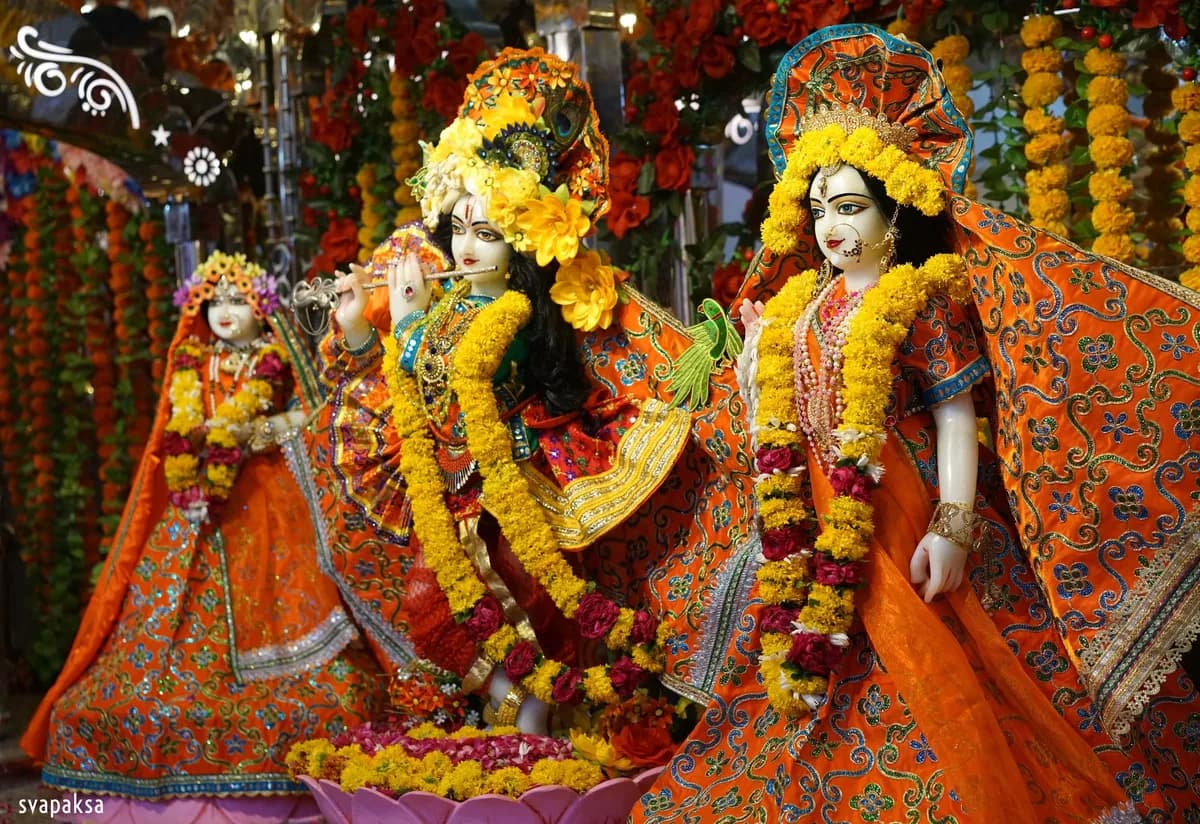
The spring Rāsa festival, or Vāsantī-rāsa, takes place in the month of Mādhava. After Vāsantī-rāsa, Kṛṣṇa manifests the pastime of holī, throwing colors.
Kṛṣṇa thought, “During this time of holī, the sakhās, Myself, and all the Vrajavāsīs smear ourselves with the foot dust of the Vraja-devīs. We also bathe ourselves with the water that has bathed the Vraja-devīs’ feet. We splash this water on each other. The Vraja-devīs’ service tendency and love is unparalleled. Everything about the Vraja-devīs is special. But I cannot avail Myself of their love. How can this be made possible? I must serve and practice. I will also train Myself.”
Therefore, Kṛṣṇa came and prayed to the sakhīs. He told them, “Please give Me a chance to serve. I will also practice and undergo training. Everyone worships and serves Me. They offer everything to Me and I accept whatever they have to offer. I do so for their happiness. However, I have no chance to serve Myself. Please teach the process of how to serve. Please help Me attain the service of Śrīmatī Rādhikā.”
The sakhīs became surprised listening to Kṛṣṇa’s entreaty. They t hought, “Which mood has entered Kṛṣṇa’s heart? After the holi-līlā and vāsantī-līlā, He has changed. Before, He was a crooked cheater. But now He has become very simple and sweet, polite and humble. He repeatedly tells us, ‘Please give Me a chance to serve Śrīmatī Rādhārānī.’”
The sakhīs asked Kṛṣṇa, “How will You serve Her?”
“I will comb Her long hair. I will decorate Her hair with many flowers. In this way, Her mercy will shower on Me.”
Before, Kṛṣṇa had thought to Himself, “Everyone serves Śrīmatī Rādhārānī; but I never served Her. I never practiced serving Her in My life. I am worshipable to the entire world, but I didn’t serve Śrīmatī Rādhārānī. Only if I was given the chance to comb Rādhārānī’s hair, I would feel My life successful.” Kṛṣṇa felt He never learned how to serve. Therefore, He went to Śṛṅgāra-vaṭa and proclaimed, “I will observe a vrata for one month. I will be trained and I will learn how to serve.”
What was Kṛṣṇa’s service? He would collect many flowers and make garlands. He would comb Rādhārānī’s hair and decorate Her with the many flowers He had collected. He would also paint Rādhārānī’s hands, and perform many other services. Thus Kṛṣṇa became expert in many arts of service.
Rādhārānī is mahābhāva-svarūpiṇī; She is Kṛṣṇa’s svarūpa-śakti. You must not think of Her as an ordinary lady or goddess.
mahā-bhāva-svarūpā tvaṁ kṛṣṇa-priyā-varīyasi prema-bhakti-prade devi rādhike tvāṁ namāmy aham
[O Śrīmatī Rādhārānī, You are the exalted form of mahābhāva, therefore You are the most dear to Kṛṣṇa. O Goddess, You alone are able to bestow pure love for the Supreme Lord; therefore I offer my humble obeisances unto You.]
Kṛṣṇa underwent extensive training learning how to serve Rādhārānī. The devotees eternally pray under the guidance of Kṛṣṇa, “When will I also serve Śrīmatī Rādhārānī? When will I get a continuous chance and service tendency.”
To achieve this, Keśava took up this vrata. On another side, Vajranābha, Uddhava, Nārada, and the rest of the devotees began their vrata on the banks of Govardhana. They started their worship. Their worship was similar to how Gopāla Bhaṭṭa Gosvāmī worshiped the Śālagrāma-śilā. Gopāla Bhaṭṭa Gosvāmī would apply sandalwood paste and offer Tulasī leaves to Śālagrāma-śilā. On the full moon of the month of Vaiśākha, the Śālagrāma manifested as Rādhā-ramaṇa. Similarly, Keśavadeva manifested Himself after Vajranābha and Uddhava had worshiped Him throughout this month.
On this day, devotees should worship Keśavadeva with clay pots full of water and many delicious drinks. The ṛṣis only worship Śālagrāma-śilā with Tulasī leaves and Gaṅgā water.
Śrī Hari is very pleased by such service. Śrī Hari states, “I will not accept anything unless it is offered with Tulasī.”
Therefore, Mahāprabhu said, “Oh Raghunātha! You need only worship Kṛṣṇa with Tulasī leaves.”
dui-dike dui-patra madhye komala mañjarī ei-mata aṣṭa-mañjarī dibe śraddhā kari
Caitanya-caritāmṛta, Antya 6.297
[With faith and love, you should offer eight soft Tulasī mañjarīs, each with two Tulasī leaves, one on each side of each flower.]
Mahāprabhu gave a Govardhana-śilā to Raghunātha. He told him to worship Girirāja with eight Tulasī mañjarīs and water from a pitcher. Mahāprabhu then arranged for Svarūpa Dāmodara to give khajja (a special sweet fried in ghee, also known as ‘Jagannātha tongue’) for Girirāja to Raghunātha dāsa Gosvāmī. Thus, Raghunātha dāsa Gosvāmī could offer khajja to Girirāja. Mahāprabhu instructed Dāsa Gosvāmī to honor all others without expecting respect from anyone in return, and to always serve Rādhā-Kṛṣṇa in his mind, in Vraja. Mānasī-sevā is especially important in our sampradāya. But how can you know how to do mānasī-sevā if you don’t practically serve as well? Mānasī-sevā is not very easy. After trying to do mānasī-sevā for some time, you may think, “This is all speculation.” Therefore, vigraha-sevā is one of the five most prominent limbs of devotion. By properly doing vigraha-sevā, you will be able to naturally enter mānasī-sevā.
After giving dīkṣā and harināma, Śrī Guru gives Deity service to the initiated devotees. He tells them, “You should worship the Deity; then you will get a relationship with the Lord.”
Raghunātha dāsa Gosvāmī would worship Girirāja-Govardhana everyday. How would Mahāprabhu worship Girirāja? Mahāprabhu would bathe Girirāja with His tears and place Girirāja on His head or chest.
As Kali-yuga progresses, the holy rivers like Gaṅgā and Yamunā will gradually decline and disappear, and most of Śrī Tulasī, Śālagrāma, śāstras, Vaiṣṇavas, and the Bhāgavatam will disappear. Before, every household would worship Śālagrāma. They would blow on the conch early in the morning and, ringing the bell, they would worship Śālagrāma. They would sprinkle caranāmṛta on themselves and distribute it to others as well. They would diligently offer bhoga and partake of the prasāda. And they would do ārati in the evening. But now, Śālagrāma is rarely seen.
The people of Kali-yuga are very strange. They will create many problems when someone worships Tulasī-devī or Śālagrāma-śilā. My Guru Mahārāja spoke of an incident:
A brāhmaṇa father told his son, “I am going to officiate a fire sacrifice. I will return after some days, so you should worship Śālagrāma in my place.”
“All right. But how should I worship?”
“Offer Tulasī leaves, sandalwood paste, and the water of the Gaṅgā. Nothing else is required.”
A jamun tree stood near the temple that bore many juicy berries. On looking at them, the son thought, “These berries look so succulent and sweet. But how can I collect them?”
The boy then took Śālagrāma and threw Him at the tree branches. Many berries fell to the ground. He threw the Śālagrāma at the tree many times and collected as many berries as he could.
“This Śālagrāma is very good,” he exclaimed. “My father told me to worship Śālagrāma, but He is more useful this way. The Śālagrāma is my good friend! I can eat so many berries now.”
The boy then threw the Śālagrāma at the tree again, but to his dismay, the Śālagrāma did not fall back to the ground as before and he couldn’t find the Śālagrāma. The boy grew anxious and thought, “My father will beat me if he doesn’t see the Śālagrāma. What should I do?”
He took a black jamun berry and put it on the altar. He smeared sandalwood paste on it and offered Tulasī leaves to it. The father came the next day and asked his son, “Where is Śālagrāma?”
“It is right here father.”
The father had a close look and realized that the Śālagrāma was a black jamun berry.
“This Śālagrāma is rotten!”
“What can I do father?”
“What happened?”
“The Śālagrāma became rotten from all the sandal paste and water. This is not my fault.”
The brāhmaṇa strongly chastised his son for using Śālagrāma for his own enjoyment. Nowadays, the majority of caste family priests worship Ṭhākurajī for their own sense enjoyment and family maintenance.
We should try to understand the meaning of the word ‘Śālagrāma.’ You should seriously and carefully worship Śālagrāma. You will then realize how truthful this worship is in this very life. You will have this realization. You should worship Śālagrāma with respect. You must never think that the Śālagrāma is a piece of a stone. Similarly, you must never think that Tulasī is an ordinary plant.
There are various forms of Tulasī but two forms are prominent—Kṛṣṇa Tulasī and Rādhā Tulasī. Kṛṣṇa Himself has appeared in this world in this form to help all the souls have a permanent relationship with Him.
[Excerpted from the Bhakta Bandhav Publication "Holy Dust of Vraja"]