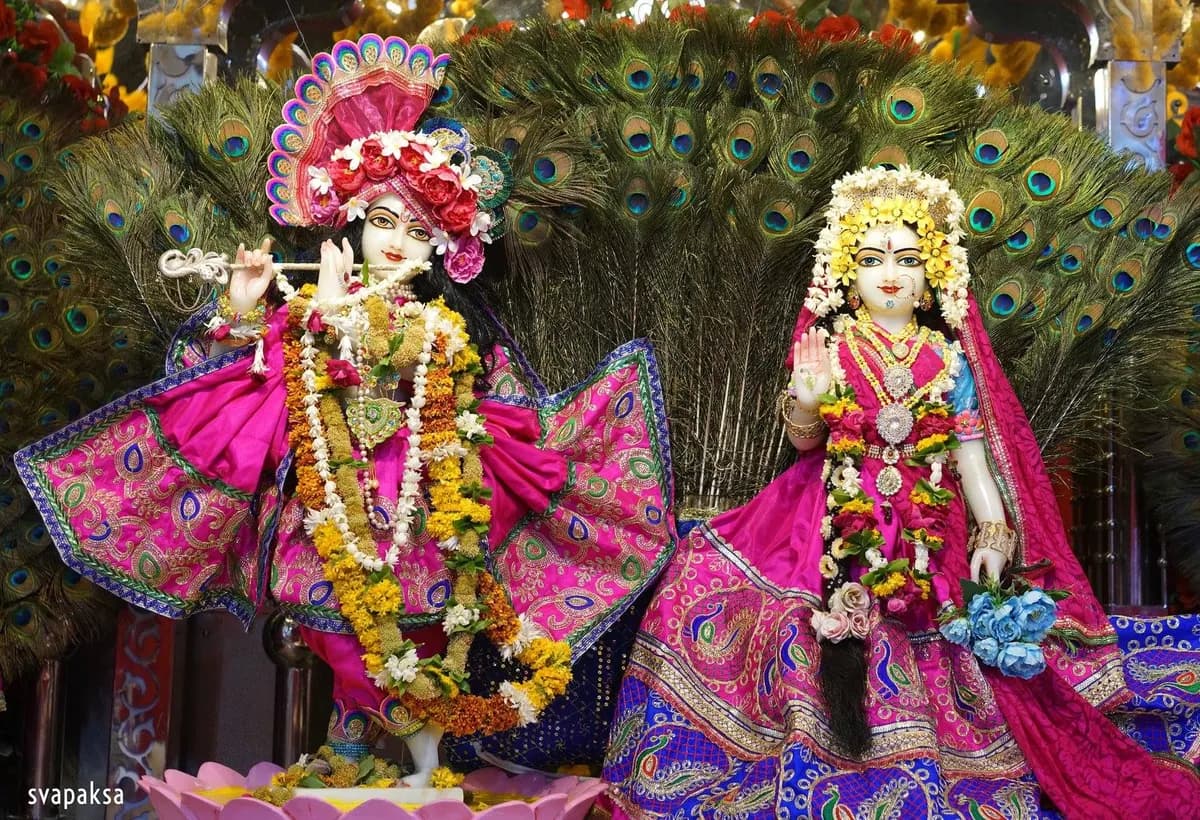
śrī-rādhāyāḥ praṇaya-mahimā kīdṛśo vānayaivā- svādyo yenādbhuta-madhurimā kīdṛśo vā madīyaḥ saukhyaṁ cāsyā mad-anubhavataḥ kīdṛśaṁ veti lobhāt tad-bhāvāḍhyaḥ samajani śacī-garbha-sindhau harīnduḥ Śrī Caitanya-caritāmṛta, Ādi-līlā 1.6
“How great is the love of Śrī Rādhā? What is the nature of My sweetness which She alone relishes? What special kind of happiness does She experience upon tasting that sweetness?” Deeply desiring to realize these three things, Kṛṣṇa took birth from the womb of Śrī Śacīmātā like the moon appearing from the ocean.
Kṛṣṇa is enchanted by Rādhārānī's love, so He put Himself in a position to find the answers to these questions and became Gaurāṅga Mahāprabhu. The Gosvāmīs and our Guru-varga, who are coming in Mahāprabhu's line, sing the glories of Rādhārānī. By their mercy we can have a glimpse of Her prema and understand Vraja-dhāma, otherwise we can only speculate uselessly. We are most fortunate that Prabodhānanda Sarasvatīpāda is giving us a small glimpse of Śrīmatī Rādhārānī’s glories here in Rādhā-rasa-sudhā-nidhi. He does this on the desire of Mahāprabhu, but only qualified people can receive and taste this nectar. Conditioned souls have many conditions, many selfish desires that go through their minds day and night. Most of them do not desire to drink the divine nectar of Rādhā-rasa-sudhā-nidhi. Mahāprabhu instructed the Gosvāmīs to distribute rādhā-rasa and to consider a method to awaken respect and make this rasa accessible to the baddha-jīvas. The jīvas waste time going here and there, following karma, jñāna, yoga, vaidhi-mārga, and fail to properly utilize their special possession that is called anurāga—attraction or love. All souls have love in varied gradations of purity. This love is inseparable from the soul itself, but when we misuse this love by offering it to other conditioned souls, because our desire for love in return cannot be fully satisfied, we become angry and depressed. This anurāga is meant to be offered to Kṛṣṇa. Those who are anurāgīs sometimes have māna, or transcendental jealous anger. This is not actual anger, or the anger that we know. When their love becomes so overwhelming, they get this contrary mood, or prema-vivarta, and it develops as māna. We find a perverted reflection of this māna in the material world, but it is not beneficial for anyone. People in this world mostly offer their love to their own body and to those they think can provide them with bodily enjoyment. Relationships of this nature, however, are relationships of lust, not love. The love of this material world is but a perverted reflection of real love. When we practice sādhana, we can gradually taste real love. We can bring back our love that has been spread to inappropriate places and give it all to Kṛṣṇa. That love will then increase more and more. Mahāprabhu gave this love and these teachings to our Gauḍīya-ācāryas. The Gosvāmīs collected this love and accepted the service of distributing it to everyone. A jīva who sincerely hears Mahāprabhu’s message will give up trying to acquire something by his own labor and practice. They will realize that all they must do is bring back their love and offer it to Kṛṣṇa. This is a very simple process, but it is also difficult. In order to properly align our love we must cut relationship with the people and things of this world. But we lack the power to do this. This is only made possible by mercy. We may think, “I will take my love from this place and give it to Kṛṣṇa,” but in truth, by our own effort, we cannot do this. Therefore, we must pray to Kṛṣṇa, who manifests in this world in the form of His Deity. Kṛṣṇa also manifests here as His own dear associates, so an intelligent person will deeply pray to Guru and Vaiṣṇavas. In the company of Guru and Vaiṣṇavas, we must serve Ṭhākurajī. This is the process of redirecting our love toward Kṛṣṇa. Under the guidance of those who possess pure love for Kṛṣṇa, we should cook for the Deities and decorate them. We should offer them flowers and other prescribed paraphernalia. If we just offer these services without emotion or meditation, we will one day realize that God has no shortage of anything and does not need these articles. He does not need gold, pearls, diamonds, cloth, or anything that we have to give, but if we really have love we will naturally want to offer everything to our beloved. That love, and that which is offered with it, is what He will accept. We therefore pray to Guru and Vaiṣṇavas for a drop of their love as we serve Ṭhākurajī. Those who have love for Guru and Vaiṣṇavas and Ṭhākurajī will bring many nice things to use in their service. If they do not have love they will give useless or cheap things—things that are rejected by others. Even people who are seen as charitable in this world only mostly distribute things that are not such good quality. Also, they are mostly only giving in charity for their own name and fame. People and different governments send ships of cloth and other things from the West to India for helping the poor, but those things are not so nice. They send items that are discarded by companies or defective. They even collect clothes that were worn by people who are now dead and send those things to India, announcing that they are very kind and great donors. People think they are charitable but if they do not give with love then what they are giving is completely valueless. How can we learn to do everything with love? We provide very nice things for our children or for ourselves, but when giving to others we try to cheat as much as possible. How can we use everything for God? We must serve God as if He is our own family member or in the same way that we care for ourselves. Then we can gradually develop pure love and realize that He is even dearer than our own soul. Mahāprabhu teaches how to properly use one’s anurāga for Kṛṣṇa and His service. This, however, we cannot achieve through sādhana. We cannot change our nature by sādhana. Understand this carefully. This is why Mahāprabhu sends His anurāgī followers. He says to them, “You have love for Kṛṣṇa. Therefore, go help others and share this love with them.” A person may cook something very tasty for Ṭhākurajī but he may also be greedy to eat it. He hides some for himself and his friends and offers what remains. If anyone takes from his personal share, he becomes angry. He is very far from thinking, “I will share this with Rūpa Mañjarī, Rati Mañjarī, Vilāsa Mañjarī, Kastūrī Mañjarī, Ramaṇa Mañjarī, Rasa Mañjarī, and Nīlā Mañjarī.” Why? He has no spiritual relationship with them. He does not think, “I will also give this to Śrīdāma, Sudāma, Dāma, Vasudāma, Kiṅkiṇī, Arjuna, Pippali, and Kṛṣṇa’s other sakhās.” This aside, they do not even think, “I will share with the devotees here around me.” They will hide something only for those who they consider their servants or assistants in sense-gratification. If someone comes a little late they will say, “There is nothing left! Why did you come late?” They will not give from their private stash. Where is their love? If their own lover comes, they will give so much. One time, Prabhupāda Sarasvatī Ṭhākura, who would stand on the second floor of the temple to watch who would come to take prasāda, distribute prasāda, clean, and so forth, observed some sannyāsīs as they served out prasāda. Something caught his attention. He came down and saw that the sannyāsīs, who normally never distributed prasāda, were carefully serving many ‘chief guests,’ wealthy and influential people who were met in the course of the sannyāsīs’ preaching and who were favorable to them. Prabhupāda later said to them, “Where is your relation? Do you come to distribute prasāda every day? Why have you come today only? You have come to take care of your own followers. Do you have relation with these businessmen, or Vaiṣṇavas? Why are you specially giving them sweets, yogurt, curd, and fried things? You are giving this to them, but if a bhakta you don’t know comes here by God’s desire and without invitation will you serve him nicely? You will say to them, ‘You should clean the temple. Have you given a donation? Why have you come here?’ You think that this property is yours, that everything is yours, and that you are the controller.’ ” People say externally that everything is for God, but really they consider everything to be their own property. If their own followers come, they will spend their time and energy and even give up sleep or rest for a time. They will do anything to assist that person who provides them with their material needs and desires. Prabhupāda said, “Even if an ordinary person comes, one should serve him kṛṣṇa-praśāda with affection and respect. This is a right owned by everyone. Because you divide your love in so many places, you have nothing left with which you can serve and feel genuine affection for others.” The goal of our life is to develop prema, pure love. How can we get pure love by doing sādhana? We must have connection to those who have this love. That is the only way. That is our sādhana. That is our spiritual practice. The Gosvāmīs distributed the prasāda of Mahāprabhu’s teachings. Mahāprabhu Himself also distributed prasāda. After kīrtana, He would always distribute prasāda. During Ratha-yātrā, He would arrange so much prasādam for the bhaktas. When Lord Jagannātha’s chariot reached Guṇḍīcā Mandira in the evening time, Mahāprabhu rested at Āi-ṭoṭā. Devotees like Vāṇīnātha, Gopinātha, Sārvabhauma Paṇḍita, and Kāśī-miśra brought fruit, chickpeas, khājā, and many other different kinds of sweets. Mahāprabhu told them, “Give this prasāda to all the bhaktas. Let everyone sit together and have mahā-prasāda.” The Lord then distributed the prasāda with His own hand. Kīrtanīyāra pariśrama jāni gaurarāya—Lord Gauracandra knows that the devotees become tired by enthusiastically doing kīrtana. As the Lord was distributing this prasāda, Svarūpa Dāmodara said to Him, “O Lord, please sit and accept prasāda Yourself.” Mahāprabhu replied, “No, I will distribute.” Finally, the Lord sat down, but He continued to instruct the devotees who were distributing:prabhu kahe—more deha’ lāphrā-vyañjane piṭhā-pānā, amṛta-guṭikā deha’ bhakta-gaṇe Caitanya-caritāmṛta, Madhya-līlā 12.167
Mahāprabhu said, “Give Me simple lāphrā (mixed vegetables), but give all the devotees piṭhā-pānā (fried cakes soaked in thick sweet milk), sweet rice, and the sweet called amṛta-guṭikā.”
The Lord Himself thus showed how to respect the bhaktas. The devotees’ hearts have so much love. They have a pure nature and love for Kṛṣṇa. When you serve them, then their loving nature will gradually come within your own character. Bahu janma kare yadi śravaṇa kīrtana, tabu ta’ na pāya kṛṣṇa-pade prema-dhana—even if you do śravaṇa and kīrtana for millions of lives, still, by that you cannot achieve Kṛṣṇa. Your nature will never change unless you learn to serve the devotees and make relationship with the anurāgī-bhaktas. You must develop love not just for the bhaktas but for service. You must have eagerness to serve. Serve while praying for the mercy of the bhaktas. Now, while serving, we think, “I am so great. I am so high and superior. I am giving charity.” We don’t think, “I am a beggar, petitioning these exalted souls for just a drop of their mercy—a drop of their anurāga.” Sometimes, people give a donation and then announce, “I have given this donation. I have done a great service! I am so senior. I am the maintainer of everyone here.” But how can anurāga be achieved if this is their attitude? They will only fill themselves up with garbage and will never be able to change. Mahāprabhu said (Caitanya-caritāmṛta, Ādi-līlā 3.20-21), “Āpani ācari’ bhakti śikhāimu sabāre, āpane nā kaile dharma śikhāna nā jāya—by My own behavior, I will teach how to properly follow dharma. If I do not show this by My own behavior then no one will learn how to properly carry out devotional service.” Mahāprabhu did service Himself, and showed others how to do so as well. On one hand, this love is easy and simple, but at the same time, we must actually properly engage ourselves in order to receive or taste it. Prabodhānanda Sarasvatī is in Vṛndāvana, at Kāliya-hrada. From there he gives this rādha-rasa-suddhā to everyone who is ready to take it. If we take this rasa then our nature will naturally become exalted. However, śāstra states, “Chāḍiyā vaiṣṇava-sevā nistāra pāyeche kebā—no one can be delivered without doing vaiṣṇava-sevā.” If we give up the service of Vaiṣṇavas we will only receive bitterness and disturbance. Without serving Vaiṣṇavas, anurāga will never come into our hearts.