Bilvamaṅgala’s Samādhi-yoga
In South India, in a brāhmaṇa family that followed in the line of the Viṣṇusvāmī sampradāya, there was a sādhaka called Bilvamaṅgala. He had faith in the teachings of his sampradāya and was nicely following all its rules and regulations, but one day, on the bank of the river, he heard someone sing a song that described the glories of God. He was mesmerized by the song, and when he discovered that the singer was a prostitute, he became so attached to that lady that he forgot everything else in the world.When his father died, Bilvamaṅgala was given the responsibility to perform his father’s śrāddha ceremony, but instead of honoring his respected family members and guests, he took all the prasādam that was to be served to them and ran to the house of that prostitute. As he was making his way to see her, a big storm developed. Rain was pouring from the sky and the river flooded, but Bilvamaṅgala did not care. He tried to swim across the river, but the current was dangerously strong and threatened to drown him. With fixed determination however, he somehow managed to cross that river, and when he finally arrived at the house of the prostitute, he fainted and fell to the ground.
The prostitute, having heard a sound near her door, came outside and found the senseless Bilvamaṅgala. After bringing him inside and giving him some dry cloth to wear, he regained consciousness. The prostitute then asked, “Why are you so attached to my body? Why are you not attached to God and His pure representatives? My whole life, my faith has been in God only. I want you to have the same faith in God as I do. You should not be attached to me. This is not good for you.” In this way, she gave strong instructions and advice to Bilvamaṅgala, and at the end she said, “If you do not give up your attachment to my physical body, I will no longer allow you to come here.”
Affected by her powerful words, Bilvamaṅgala left. Inspired from within, he arrived at the āśrama of a sannyāsī called Somagiri and took shelter there. He accepted Somagiri as his guru and received dīkṣā from him. His guru instructed him to stay in the āśrama, together with the other brahmacārīs and sannyāsīs, but Bilvamaṅgala could not stop thinking of Śrī Vṛndāvana-dhāma and of God Himself. One day, without taking the permission of his guru, he left the āśrama and set off towards Vraja.
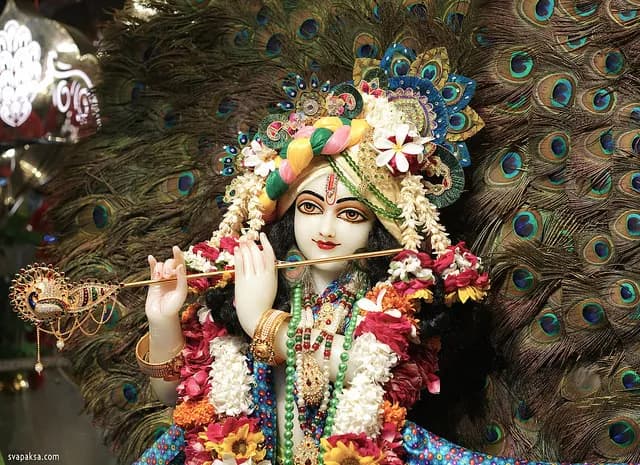
On the way, however, he again became attracted to a lady. Remembering his gurudeva’s advice, he prayed to God, “Why do I, again and again, become attached to these physical bodies? My material body and senses keep disturbing me, time and again.” He decided to no longer follow his mind, and thus he pierced out both his eyes. He then entered into samādhi-yoga and came to Vṛndāvana. There he met Śrī Nanda-nandana Kṛṣṇa, Yaśodā-nandana Kṛṣṇa, Gopī-jana-vallabha Kṛṣṇa, and all the Vrajavāsīs. He was now singing, playing, and dancing with Kṛṣna, who was very pleased with Bilvamaṅgala’s sweet songs.
Why did Kṛṣṇa become so attached to these songs of Bilvamaṅgala? Do His sakhās and sakhīs not sing a billion times more beautiful than him? There is only one reason: Bilvamaṅgala completely rejected his material body. He even gave up his attachment to his subtle body and mind, and then entered into samādhi, into the eternal world, where he started searching only for Śrī Kṛṣṇa. This type of sādhana is very serious. Not everybody can act like this, but for one who can, entering into samādhi is very easy. He will be able to cross over māyā, enter into the eternal Vraja-dhāma, and meet with the Vrajavāsīs and Sarveśvāra Lord Śrī Hari, Goloka-viharī, Nanda-nandana Śrī Kṛṣṇa.
Kṛṣṇa gave Bilvamaṅgala the name ‘Līlā-śuka’ because His līlā-śakti had entered into Bilvamaṅgala’s heart. Bilvamaṅgala was now connected to all the eternal vraja-līlā, and every day, he would compose new songs, describing different pastimes. Kṛṣṇa would listen and try to remember them. For this, He wrote everything down in a book and kept that written collection close to Him at all times. The gopīs noticed this and asked, “What is that book that You are reading from every day? Why do You carry it with You everywhere? Can we have a look?” Kṛṣṇa refused and said, “No, I will not give it to you.” The gopīs replied, “We know you have a flute that is very near and dear to you, because that flute is able to steal our heart. Does this book also have such a power? What is going on here?”
One day, by hook or crook, the gopīs got ahold of the book. When they looked inside, they saw Bilvamaṅgala’s beautiful glorifications of Kṛṣṇa and the Vrajadevīs. “How does he know all these things?” they wondered in surprise. “Who is this person? Where are all these marvelous songs coming from?” They searched for Bilvamaṅgala, and when they finally found him, they exclaimed, “But he is blind! He has no eyes!”
Kṛṣṇa replied, “Yes. He gave up his eyes for Me. He gave up his desire to look at ordinary and mundane things. Now, he only meets with Me and looks at Me with his eternal, spiritual eyes. Because of this, My līlā-śakti gave him entrance into Vṛndāvana. He is Līlā-śuka, and he is describing all of our wonderful pastimes. He is my karṇāmṛta (nectar for the ears).”
The gopīs then concluded, “Oh, then the name of this book must be Śrī Kṛṣṇa-karṇāmṛta!”
Śrī Caitanya Mahāprabhu Himself rediscovered this book, Śrī Kṛṣṇa-karṇāmṛta, on His journey to South India. He had it copied and then brought it back with him to Purī. Another book Mahāprabhu brought back was Śrī Brahma-saṁhitā. This is a collection of prayers in glorification of Śrī Kṛṣṇa that was composed by Lord Brahmā after he had witnessed Śrī Kṛṣṇa’s eternal pastimes in his samādhi-yoga.
So Mahāprahbu found, copied, and brought back these two books from South India. He gave them to all the Gauḍīyas and ordered everybody to make a copy for themselves of both. These prayers are like necklaces for the Gauḍīya Vaiṣṇavas. If we want to connect with the spiritual world, we will have to follow and accept the process and teachings of that world. The more we do, the more we will become pure and clean, and the more we will rise above māyā. Then we will have no more tension. This is called samādhi-bhāśā. This is what Mahāprabhu came to teach. He came to give us this spiritual wealth. So we should stay close to Śrī Gurupāda-padma at his samādhi center. Then it will be very easy to get this connection to the spiritual world.
Excerpted from the Bhakta Bandhav Publication “Śrī Guru-darśana As It Is”, Chapter 9
[CC-by-NDNC Bhakta Bandhav]