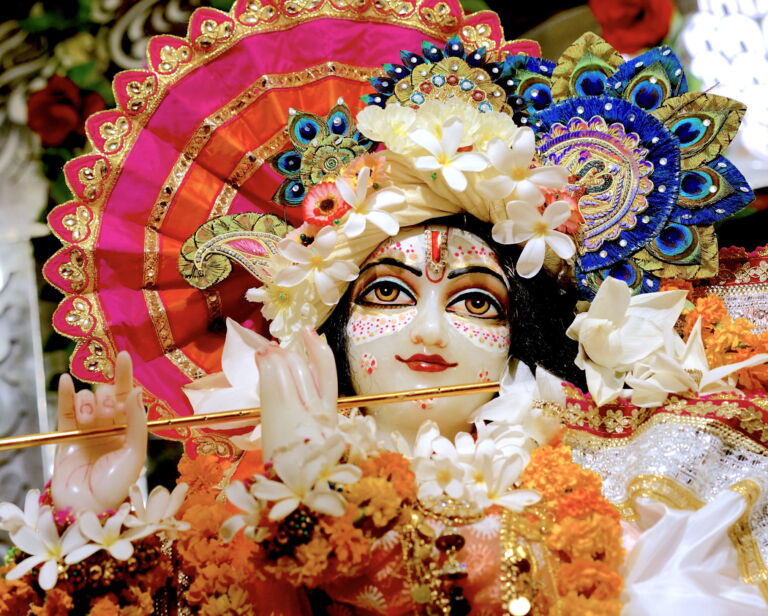
The History of Lord Jagannātha’s Snāna-yātrā
Excerpts from: The History of Lord Jagannātha’s Snāna-yātrā – Śrī Jagannātha Mahā-bhāva-prakāśa – Śrī Śrīmad Gour Govinda Mahārāja
Today is Snāna-pūrṇimā, the auspicious full moon day of Lord Jagannātha’s snāna-yātrā, bathing ceremony. Jagannātha takes a public bath today. You may have seen in Jagannātha Purī, how on this day Lord Jagannātha, Baladeva, and Subhadrā-devī are bathed publically. Why are They bathed in public on this day? What is the occasion? Does anyone know?
Devotee: It is Lord Jagannātha’s appearance day.
Śrī Śrīmad Gour Govinda Swami: Yes. Today is the appearance day of Lord Jagannātha. Jagannātha is Kṛṣṇa, but Kṛṣṇa appeared on the eight day of the dark fortnight, Kṛṣṇāṣṭami, in the month of Bhādra, so how is it that today is the appearance of Jagannātha? That is another question.
Devotee: It is the appearance day of Kṛṣṇa’s manifestation as Jagannātha.
Śrī Śrīmad Gour Govinda Swami: Yes. Jagannātha manifested on this day. Jagannātha, Baladeva, and Subhadrā appeared in Their forms today, as three logs of wood. This is mentioned in the Skanda Purāṇa. Therefore, on this day, They are given a public bath. After the bathing festival, Lord Jagannātha retires from public darśana and is repaired. Fifteen days later, He gives darśana in His freshly painted and young appearance, known as nava-yauvana veśa, during the cart festival (Ratha-yātrā). Thus, Ratha-yātrā will take place fifteen days from today.
*****
𝐖𝐡𝐲 𝐚𝐫𝐞 𝐓𝐡𝐞𝐲 𝐢𝐧 𝐭𝐡𝐢𝐬 𝐅𝐨𝐫𝐦?
Jagannātha is Kṛṣṇa. Why have Jagannātha, Balarāma, and Their sister Subhadrā assumed these forms with big, big dilated eyes, and Their hands and legs shrunken? Why is that? Does anyone know why They are in this mahā-bhāva form? What is it? Why is it mahā-bhāva?
Devotee: Jagannātha is Kṛṣṇa feeling separation from Rādhārāṇī.
Śrī Śrīmad Gour Govinda Swami: Kṛṣṇa feels separation. What about Balarāma and Subhadrā? (devotees laugh) Why have They also assumed that form?
Devotees: We were hearing a story.
Śrī Śrīmad Gour Govinda Swami: What story?
Devotee: A story that is told in Vṛndāvana.
Śrī Śrīmad Gour Govinda Swami: Āre bābā! Why is Jagannātha carved like that? That is what you should understand, why this form of Jagannātha manifested.
Devotee: It is an unfinished form of the Lord.
Śrī Śrīmad Gour Govinda Swami: Why is it unfinished? Why did He appear in that form?
Devotee: Because the king [Mahārāja Indradyumna] promised that…
Śrī Śrīmad Gour Govinda Swami: Āre, that is not the reason. (Devotees laugh) Everything takes place by the will of the Lord, so why does the Lord appear in that form? It is not that the Deities are not finished because of the king’s promise. That is an external reason, bhaiya. You should understand what the real reason is.
𝐊𝐫̣𝐬̣𝐧̣𝐚’𝐬 𝐇𝐞𝐚𝐫𝐭 𝐢𝐬 𝐢𝐧 𝐕𝐫𝐚𝐣𝐚𝐛𝐡𝐮̄𝐦𝐢
Kṛṣṇa left Vrajabhūmi for Mathurā, and then went to Dvārakā, where He married more than sixteen thousand wives. They all served Him very nicely, but still Kṛṣṇa was not happy. He was there physically, but with His mind and heart, He was always with the damsels of Vrajabhūmi, especially Rādhārāṇī, as well as His father Nanda and mother Yaśodā, and the cowherd boys, because they were all very dear to Him. Sometimes while Kṛṣṇa was asleep, He would deliriously call out, “Rādhe, Rādhe, Rādhe! Gopī, Gopī, Gopī!” His queens would think, “What is this? We are taking so much care of Kṛṣṇa. Why is our most beloved husband thinking like this? He is uttering these names, “Rādhe! Gopī!” like a delirious madman. Who are they?
𝐇𝐢𝐬 𝐐𝐮𝐞𝐞𝐧𝐬’ 𝐋𝐨𝐯𝐞 𝐢𝐬 𝐌𝐢𝐱𝐞𝐝 𝐰𝐢𝐭𝐡 𝐉𝐧̃𝐚̄𝐧𝐚 𝐚𝐧𝐝 𝐀𝐢𝐬́𝐯𝐚𝐫𝐲𝐚
His queens do not understand this, and they have no access to Vrajabhūmi because they are aiśvarya-mayī, full of opulence. Vraja-līlā is mādhurya-mayī-līlā, very sweet transcendental līlās, where there is no question of aiśvarya, opulence. Aiśvarya is covered with mādhurya in Vrajabhūmi, whereas in Mathurā and Dvārakā, mādhurya is covered with aiśvarya. Therefore, the queens in Dvārakā – Rukmiṇī, Satyabhāma, Jāmbavatī, and Kṛṣṇa’s other wives – have no access there. They are aiśvarya-mayī, while the damsels of Vrajabhūmi, of whom Rādhārāṇī is the chief, are all mādhurya-mayī. Their love is not mixed with jñāna and aiśvarya, it is pure love, whereas the love of the queens in Dvārakā is mixed with jñāna and aiśvarya, and therefore is not pure. When love is mixed with jñāna and aiśvarya, then that love becomes shrunken, prīti-saṅkucita.
𝐕𝐫𝐚𝐣𝐚-𝐥𝐢̄𝐥𝐚̄ 𝐢𝐬 𝐈𝐧𝐭𝐨𝐱𝐢𝐜𝐚𝐭𝐢𝐧𝐠
Wanting to know the reason why Kṛṣṇa was sometimes uttering, “Rādhe, Rādhe! Gopī, Gopī!” the queens went to Rohiṇī Mātā and asked, “Mother, please tell us why Kṛṣṇa is always acting like this? We are taking care of Him so nicely.”
Mother Rohiṇī replied, “Oh, vraja-līlā is such a sweet mādhurya-mayī-līlā. It is nectarean and intoxicating. How can I describe it? It is such an attractive līlā, that if I speak about it, even Kṛṣṇa and Balarāma will be attracted.”
“Please tell us about it. We have no access to it, and we are not able to go there, but at least we can hear about it. We cannot take part in the rāsa dance, we are also deprived of that.” In this way they requested Mother Rohiṇī to speak. Rohiṇī agreed and said, “All right.”
When all of Kṛṣṇa’s wives were assembled in a big hall, Mother Rohiṇī began, “I will tell you the story, but there is one condition. I have already told you that this līlā is so attractive that Kṛṣṇa and Balarāma will also be attracted. If they come here, everything will be ruined and I will not be able to speak anymore, so someone should stand at the door and keep guard. If that person sees Kṛṣṇa and Balarāma coming, then she has to indicate to me to stop speaking.” They were all interested in hearing Mother Rohiṇī speak, but who would guard the door? They requested Subhadrā-devī, “Please Subhadrā, can You go and guard the door?” Subhadrā agreed and went to the doorway. She stretched Her arms out and blocked the entrance.
Mother Rohiṇī began narrating the intoxicating līlās. Everyone was listening with concentrated attention. Even Subhadrā, while standing guard at the door, was listening to vraja-līlā kāhāṇī and became ecstatic. Her hands and legs retracted into Her body, and Her eyes dilated.
In the meantime, Kṛṣṇa and Balarāma came to the door, but Subhadrā, who was already intoxicated, was not able to give any indication to Rohiṇī to stop speaking. With Kṛṣṇa on one side and Balarāma on the other side of Subhadrā, They listened to Rohiṇī speaking, “Oh, Vraja-līlā, it is so sweet!” Then, the two of Them also became ecstatic. Their hands and legs shrunk into Their bodies, Their eyes became dilated, and in this way, the three forms of Jagannātha, Baladeva, and Subhadrā stood there, stunned, in the doorway.
𝐍𝐚̄𝐫𝐚𝐝𝐚’𝐬 𝐑𝐞𝐪𝐮𝐞𝐬𝐭
Śrī Nārada Muni from a distance saw these three ecstatic forms, mahā-bhāva-prakāśa, of Jagannātha, Baladeva, and Subhadrā. As Nārada approached Them though, those ecstatic forms vanished and Their natural appearance came back. Nārada said, “I saw these forms! I already saw them! I desire that these forms appear again and be worshiped.” Nārada was referring to Jagannātha, Baladeva, and Subhadrā in that ecstatic form, and this was his request.
𝐀𝐜𝐮𝐭𝐞 𝐏𝐚𝐧𝐠𝐬 𝐨𝐟 𝐒𝐞𝐩𝐚𝐫𝐚𝐭𝐢𝐨𝐧
Kṛṣṇa was always thinking of Rādhārāṇī, and He was feeling acute pangs of separation from Her and the gopīs in Vrajabhūmi. Similarly, in Vrajabhūmi, Rādhārāṇī and the gopīs were all feeling acute pangs of separation from Kṛṣṇa. Sometimes Kṛṣṇa fainted and became unconscious. In Vrajabhūmi, the same thing would happen to Rādhārāṇī. She would faint and become unconscious. Kṛṣṇa would faint and become unconscious because He was feeling acute pangs of separation from Rādhā and Rādhārāṇī would faint because She was feeling acute pangs of separation from Kṛṣṇa.
𝐇𝐨𝐰 𝐭𝐨 𝐁𝐫𝐢𝐧𝐠 𝐊𝐫̣𝐬̣𝐧̣𝐚’𝐬 𝐂𝐨𝐧𝐬𝐜𝐢𝐨𝐮𝐬𝐧𝐞𝐬𝐬 𝐁𝐚𝐜𝐤?
One day it happened that Kṛṣṇa fainted and fell unconscious. He remained unconscious. What was to be done? By providence, Nārada Muni and Uddhava came there. Nārada and Uddhava are both very dear to Kṛṣṇa, and they are all-knowing personalities. They could understand that Kṛṣṇa fainted because He was thinking of Rādhārāṇī and feeling acute pangs of separation from Her.
Kṛṣṇa is līlā-puruṣottama, so this is just one of the wonderful mysterious līlās that He was about to manifest. Still, they were both worried about how to bring Kṛṣṇa’s consciousness back. In the meantime, Balarāma arrived, and along with Nārada and Uddhava discussed how they could bring Kṛṣṇa back to consciousness. They agreed to have Nārada Muni sing and play his vīṇā, and that He would regain His consciousness on hearing vraja-līlā.
Nārada said, “I will do this, but there is one danger.”
“What is that?” they asked.
“As soon as Kṛṣṇa regained His consciousness and wakes up, He will get up and start running to Vrajabhūmi. We should let Dāruka, Kṛṣṇa’s charioteer, know this. Tell him that Kṛṣṇa will certainly start running as soon as He wakes up, so he should have the chariot ready.”
Uddhava thought very deeply and said, “You are right, but from what I understand, the vraja-gopīs, especially Rādhārāṇī, are feeling acute pangs of separation from Kṛṣṇa, and their condition now in Vrajabhūmi is very grave. They are all in a dying condition and they are very, very weak. If Kṛṣṇa goes there and sees them in that condition, I don’t think He will be able to tolerate it. The condition there will be so precarious that I am worried we will not be able to get Kṛṣṇa back here.”
Nārada said, “O Uddhava, you are Kṛṣṇa’s messenger, dūta. Kṛṣṇa sent you to Vrajabhūmi, carrying His message of love. Therefore, I think that you should go ahead to Vrajabhūmi and inform all the Vrajavāsīs that Kṛṣṇa is coming from Dvārakā, that He has just started His journey, and will reach Vrajabhūmi soon.”
Hearing this, Uddhava became morose and said, “Nāradajī, whatever you say I accept, because you are a most elevated person. I have no objection, but I do have one apprehension.”
“What is that?”
“You might already know that when Kṛṣṇa sent me from Mathurā to bring His message of love to the Vrajavāsīs, I went to Vrajabhūmi and stayed there for three months. I went to console them, but what consolation was I able to give them? The Vrajavāsīs were feeling acute pangs of separation from Kṛṣṇa and were always crying for Him. If someone is crying, his friends will come and ask, ‘Why are you crying?’ He may tell them, ‘Oh, my wife died.’ We may console him and say, ‘That is natural, your wife died. Everything in the material world is temporary, so why are you crying and lamenting?’ However, what consolation was I able to give the Vrajavāsīs? How could I tell them, ‘Don’t cry for Kṛṣṇa’? That would have been a great aparādha, offence, on my part.
Our relationship with Kṛṣṇa is perfect, loving, and eternal. It is not a temporary or material relationship. When a material relationship breaks down, we can offer solace, but what consolation could I give the Vrajavāsīs? How could I say, ‘Don’t cry’? Rather, my heart told me to tell them, ‘Cry more! Cry more! Cry more!’ ”
This is what Mahāprabhu taught. If you want to cry, cry for Kṛṣṇa. In this mood, Mahāprabhu was crying for Kṛṣṇa. He was in rādhā-bhāva, feeling acute pangs of separation from Kṛṣṇa.
Uddhave continued, “So I could not do anything. I said, ‘All right, all right. I am going back. I will tell Kṛṣṇa everything and request Him to go to Vraja immediately.’ I gave them my word, but Kṛṣṇa has not yet returned there. If I go there again and tell them that Kṛṣṇa is coming, they will not believe me; rather, they will call me a liar! ‘You told us you would send Kṛṣṇa immediately. Kṛṣṇa never came, and now you are saying again that He will come?’ They will chastise me and call me bad names. So how can I go?”
𝐁𝐚𝐥𝐚𝐫𝐚̄𝐦𝐚’𝐬 𝐇𝐞𝐚𝐫𝐭 𝐁𝐫𝐨𝐤𝐞
Nārada and Uddhava then asked Balarāma, who had been listening to everything. “Balarāma Prabhu, why don’t You go to Vraja?” On hearing their request, Balarāma’s heart broke. He replied, “Nāradajī, you see, I would not have waited this long to go to Vraja, but think about this: Your Prabhu Kṛṣṇa only says that He will go, but He does not go. When I noticed that Kṛṣṇa was not going to Vraja, I went there Myself.”
Balarāma said, “I went to give consolation to the Vrajavāsīs. I also stayed there for some time and told them, ‘Please don’t lament. Have patience, Kṛṣṇa will come, He is coming.’ But they are like fish out of water. Kṛṣṇa is their life, and their life has gone away. Now they are all feeling immense separation from Him. They are in such a bad state that they are dying. I could see clearly that without the presence of Kṛṣṇa, their condition would not improve.
“Only Kṛṣṇa’s presence will bring life back to the Vrajavāsīs, otherwise there is no hope. I especially went to Mother Yaśodā, touched her feet and said, ‘Mother, please don’t lament. I am going back to Dvārakā. I will request Kṛṣṇa to come back immediately.’ I told them the same thing you did. I asked Kṛṣṇa to go immediately back to Vrajabhūmi many times, and He would say, ‘Yes, I will go,’ but He never went.
“Previously, whatever I told Kṛṣṇa to do, He would do right away, but this request He still has not acted on until now. He keeps saying, ‘Yes, I’ll go.’ So how can I go back again? What shall I tell Mother Yaśodā? How can I show My face to Mother Yaśodā? What will she think of Me? Tell me.”
Saying this, Balarāma started crying, as He felt so deeply for the Vrajavāsīs that His heart broke.
𝐒𝐮𝐛𝐡𝐚𝐝𝐫𝐚̄ 𝐖𝐢𝐥𝐥 𝐆𝐨 𝐭𝐨 𝐕𝐫𝐚𝐣𝐚𝐛𝐡𝐮̄𝐦𝐢
While they were having this discussion, Subhadrā-devī appeared and said, “Do not take too much trouble, I will go to Vrajabhūmi. I am a woman, nāri api, so I will be able to pacify Mother Yaśodā, sit on her lap and wipe the tears from her eyes with My sārī. I will tell her, ‘O Mother, Kṛṣṇa is coming. We have made arrangements for Kṛṣṇa’s arrival. We have come ahead. Kṛṣṇa will be late, but He is coming along the road with many kings. There are many ladies and gentlemen who have decorated the gates to welcome Kṛṣṇa. I have come ahead to inform you.’ I’ll tell her that He will be late, but that He will come. ‘I came ahead to give you this message. Have patience, don’t cry, don’t be upset, and don’t be in so much anxiety.’
Then I will go to the gopīs and tell them, ‘Kṛṣṇa is coming, He will be here soon. You should know that male persons are a little crooked, but us women, we are very simple.’ Hearing this from a woman, My sisters will put faith in My words. ‘So, now engage yourselves in giving a nice welcome to Kṛṣṇa, by arranging a big festival.’ I will try to organise for them to engage themselves in this way, so that they will stop crying and give up lamenting.”
When Subhadrā finished speaking, Nārada, Uddhava, and Balarāma agreed, “Yes, this is a very good proposal.”
Baladeva Prabhu has so much love and affection for Vrajabhūmi. After thinking deeply, Balarāma said, “Why should Subhadrā go alone? I will go with Her.” Thus, two more chariots were prepared: one for Balarāma and one for Subhadrā. That is why, during Ratha-yātrā, Baladeva’s chariot moves first, then Subhadrā’s chariot, and Jagannātha’s chariot is the last to leave.
Balarāma said, “I will go with My sister Subhadrā.” The three chariots were decorated very nicely. Uddhava and Nārada said, “You two, brother and sister, Baladeva and Subhadrā, should both already go. We will make arrangements to send Kṛṣṇa after You leave. We make that promise to You.
𝐊𝐫̣𝐬̣𝐧̣𝐚 𝐃𝐫𝐚𝐧𝐤 𝐭𝐡𝐞 𝐌𝐞𝐥𝐥𝐨𝐰 𝐨𝐟 𝐑𝐚̄𝐝𝐡𝐚̄-𝐩𝐫𝐞𝐦𝐚
Balarāma and Subhadrā then climbed onto Their chariots. As the wheels of Their chariots rolled forward, Nārada Muni started to sing vraja-līlā, prema-līlā, mādhurya-līlā kīrtana with his vinā-tantra. As soon as that kīrtana entered Kṛṣṇa’s ears, He immediagely regained His consciousness, jumped up and stood there, with His body curved in three places – tri-bhaṅga-bhaṅgi. He said, “Hey! Where is My flute? Who took My flute?” Kṛṣṇa has no flute in Mathurā and Dvārakā. He only has a flute in Vrajabhūmi, and only in Vrajabhūmi is Kṛṣṇa tri-bhaṅga-bhaṅgi, curved in three places. Kṛṣṇa is not like that in Mathurā or Dvārakā.
“Where is My flute? Where is My mohana-muralī? Who took it? This must be the work of the gopīs.” While saying this, “O Gopīs! O Rādhe!” Kṛṣṇa became mad, and started running. He ran and ran. Kṛṣṇa is always thinking of Vrajabhūmi, the gopīs, and Rādhārāṇī, but He had forgotten that He was in Dvārakā. Therefore, He was asking, “Where is My flute? The gopīs must have stolen it!”
Then He looked and saw Uddhava and asked, “Hey Uddhava! Why are you here in Vrajabhūmi?” Then He saw Nārada. “Āre! Nārada? Why are you here in Vrajabhūmi? Kṛṣṇa had completely forgotten that He was in Dvārakā. “Why are you both here?” Then Uddhava and Nārada told Him: “Our Lord, please go to Vraja. We have already prepared Your ratha, chariot. Please come and sit down.”
Kṛṣṇa is always thinking of Rādhārāṇī. He drank the mellow of rādhā-prema, rādhā-prema-rasa, so He appeared like a mad man, as if He intoxicated with liquor. Both Nārada and Uddhava helped this mātāla, mad man, Kṛṣṇa, into the ratha. He was so mad and kepts repeating, “O Rādhe! Rādhe!” In this condition, He sat in the ratha. Then Nārada and Uddhava told Dāruka, the charioteer, to drive the ratha as fast as he could toward Vrajabhūmi.
𝐌𝐚𝐡𝐚̄-𝐛𝐡𝐚̄𝐯𝐚-𝐩𝐫𝐚𝐤𝐚𝐬́𝐚
In the meantime, Subhadrā and Baladeva had already reached Vrajabhūmi on Their chariots, and Kṛṣṇa’s ratha was following Them. This is Ratha-yātrā. Just by thinking of Vrajabhūmi, Balarāma became ecstatic. His hands and legs shrunk, and His eyes dilated. That is mahā-bhāva-prakāśa, where His internal mood is externally visible. The internal mood, that bhāva, visibly changes the external form because in the Lord there is no difference between deha [the body] and dehī [the embodied soul]. For a conditioned soul, deha and dehī are different, but Balarāma’s deha and dehī are not different; what is inside also manifests externally.
So Balarāma manifested this ecstatic mahā-bhāva form, with His eyes dilated and His hands and legs shrunken. Subhadrā was in that same condition and displayed the same symptoms. Thus, She was not able to go to Mother Yaśodā, because of Her ecstatic state. While thinking of Vrajabhūmi, They developed that bhāva. This vraja-bhāva, vrajara-mādhurīma, the sweetness of Vrajabhūmi, is vast, like an ocean, and Balarāma and Subhadrā were drowning in that ocean of mādhurya. This bhāva is known as mahā-bhāva-prakāśa.
𝐑𝐚̄𝐝𝐡𝐚̄𝐫𝐚̄𝐧̣𝐢̄ 𝐈𝐬 𝐢𝐧 𝐚 𝐃𝐲𝐢𝐧𝐠 𝐂𝐨𝐧𝐝𝐢𝐭𝐢𝐨𝐧
What then is Rādhārāṇī’s condition? She is in a dying condition. There was a doubt whether She was still alive or had already died. All the inhabitants of Vrajabhūmi were worried. Rādhārāṇī was almost dead. All Her sakhīs, especially Her intimate aṣṭa-sakhīs, surrounded Her, not knowing what to do. “Oh, our dearest sakhī is in this condition.” Hanging their heads, the aṣṭa-sakhīs were sitting as if their lives had left them. They were also in a dying condition, especially Lalitā and Viśākhā, Rādhārāṇī’s most intimate companions. They were only just holding on to their lives, while patiently chanting kṛṣṇa-nāma-kīrtana into Rādhārāṇī’s ears: “hare kṛṣṇa hare kṛṣṇa, kṛṣṇa kṛṣṇa hare hare, hare rāma hare rāma, rāma rāma hare hare.” Sometimes they would hold a piece of cotton under Rādhā’s nose to see whether She was still breathing. She was breathing very, very slowly, such was Her condition. Rādhārāṇī was lying in Her kuñja, Nidhuvana-kuñja, with Her head in Lalitā-sakhī’s hands.
*****
𝐀 𝐋𝐨𝐠 𝐨𝐟 𝐖𝐨𝐨𝐝 𝐅𝐥𝐨𝐚𝐭𝐢𝐧𝐠 𝐢𝐧 𝐭𝐡𝐞 𝐎𝐜𝐞𝐚𝐧 𝐨𝐟 𝐑𝐚̄𝐝𝐡𝐚̄-𝐛𝐡𝐚̄𝐯𝐚
At that moment, Kṛṣṇa’s chariot reached Vrajabhūmi. As soon as Kṛṣṇa arrived in Vraja, He jumped down from His chariot. Yogamāya was manifesting another līlā. As if by providential arrangement, Kṛṣṇa appeared there in Nidhuvana, where Rādhārāṇī was lying in such a pitiable condition. Kṛṣṇa ran to Her, and from His mouth the words were coming, “Rādhe! Rādhe! Dehi-pada-pallavam udāram – O Rādhe! O Rādhe! Please give Me Your lotus feet. I want to put them on My head.” Kṛṣṇa was shouting in that way. Such a wonderful līlā manifested.
Kṛṣṇa, feeling the acute pangs of separation from Rādhārāṇī, became completely ecstatic. His arms and legs contracted into His body and He became like a tortoise. This is the form of Jagannātha. With big dilated eyes, He was gazing at Rādhārāṇī, who was lying there in the kuñja as if dead. Seeing Her condition, He lost His consciousness and fell to the ground. In that form, He is feeling intense pangs of separation from Rādhā. That is the form of Jagannātha, rādhā-bhāva sindhure bhāsamāna, as if He is a log of wood, floating in the ocean of rādhā-bhāva.
𝐔𝐧𝐢𝐨𝐧 𝐀𝐟𝐭𝐞𝐫 𝐒𝐞𝐩𝐚𝐫𝐚𝐭𝐢𝐨𝐧 𝐢𝐧 𝐍𝐢𝐝𝐡𝐮𝐯𝐚𝐧𝐚-𝐤𝐮𝐧̃𝐣𝐚
The wind was blowing over the transcendental body of Kṛṣṇa. When that wind touched the body of Rādhārāṇī, who was just about to die, it acted like a soothing balm. Rādhārāṇī’s life returned immediately. In a very sweet voice, Śrīmatī Lalitā whispered in Rādhārāṇī’s ear, “Kṛṣṇa has come.” When She heard this, Rādhārāṇī gradually opened Her eyes to see Her prāṇa-vallabha, most beloved, Kṛṣṇa. This was the medicine by which She regained Her life and got up. She forgot everything. The pangs of separation She had felt completely disappeared.
Kṛṣṇa was still unconscious in this tortoise-like form. Seeing Kṛṣṇa in this condition, Śrīmatī Rādhikā told Her priya-sakhī, Viśākhā, “Please, help Kṛṣṇa.” Viśākhā knows what medicine to apply. In a very sweet voice, she started to chant, “rādhe, rādhe, rādhe,” in Kṛṣṇa’s ears. Hearing this, Kṛṣṇa regained His consciousness and opened His eyes. Kṛṣṇa looked at Rādhārāṇī and Rādhārāṇī looked at Śyāmasundara Kṛṣṇa, in eye-to-eye union. Then, everyone forgot their previous condition. Where is Dvārakā? Where are Kṛṣṇa’s pangs of separation? And where is Śrīmatī Rādhārāṇī’s viraha? All of these were now gone. This is the union of Rādhā and Kṛṣṇa in Nidhuvana-kuñja.
Nidhuvana-kuñja is where niśa-līlā, the night pastimes of Rādhā and Kṛṣṇa, take place. So the sakhīs arranged a nice bed for Rādhā and Kṛṣṇa to spend the night together. When the brahma-muhūrta came, a cuckoo bird produced a very sweet sound, “cooh! cooh!” indicating that dawn had come. “Wake up! Rādhā and Kṛṣṇa, get up!” The Divine Couple awoke. Kṛṣṇa was standing in His Śyāmasundara tri-bhaṅga form, bent in three places. He was dressed in a yellow dhoti and had a peacock feather in His hair. Kṛṣṇa was playing sweet sounds on His flute, and on His left side was Rādhārāṇī, dressed in a blue sārī. Lalitā-sundarī was offering pañca-pradīpa ārati. Viśākhā was singing nice kīrtana of the union of Rādhā and Kṛṣṇa, yugala-mahimā kīrtana. Some other sakhīs were playing mṛdāṅga, some karatāla, and others were playing the vīṇā while maṅgala-ārati was going on. It was such a beautiful, nectarean union after Their separation. Kṛṣṇa cast a glance at Rādhārāṇī and Rādhārāṇī drank the sweet honey coming from the lotus-like face of Kṛṣṇa through Her eyes.
Then, both of Them sat down on an effulgent jewelled throne, dīvyaratna-siṁhāsana. Viśākhā started kīrtana. All the narma-sakhīs came and joined her. All their pangs of separation were gone. Now there is milana (union) after viraha (separation). After the union, there will again be viraha. Union after viraha, and again viraha after union. This is such a nice wonderful mādhurya-mayī līlā in Vrajabhūmi.
Kṛṣṇa is a very crooked person. Kṛṣṇa was looking at the lotus-like face of Rādhārāṇī. He was casting a glance in a crooked way, whereby He was shooting madana, Cupid’s arrow, to pierce the heart of Rādhārāṇī. At the same time, Kṛṣṇa relishes the madhu, honey, emanating from the lotus-like face of Rādhā. There is honey in a lotus flower. While Rādhā and Kṛṣṇa were both sitting on a transcendental golden throne, divya-śrīngaṣana, Kṛṣṇa said, “O Rādhe! In tattva there is no separation between Yourself and Myself. Where is separation? There is no separation. In order to show Your vamya-bhāva, leftist mood, and raise it to the highest level, I create such līlā, such separation. You are always with Me, and I am always with You, because Your love for Me is pure love. Rādhe, Your love for Me is like an unlimited ocean and I want to drown in that ocean and enter into the core of Your heart. In order to reach that deep ocean and to drown in it, I have assumed the form of Jagannātha. In this form, I will eternally stay in Śrī-kṣetra.”
𝐑𝐚̄𝐝𝐡𝐚̄-𝐯𝐢𝐫𝐚𝐡𝐚-𝐯𝐢𝐝𝐡𝐮𝐫𝐚 𝐚𝐧𝐝 𝐊𝐫̣𝐬̣𝐧̣𝐚-𝐯𝐢𝐫𝐚𝐡𝐚-𝐯𝐢𝐝𝐡𝐮𝐫𝐚
This is Jagannātha-vigraha: rādhā-viraha-vidhura, Kṛṣṇa feeling intense separation from Rādhā. In the form of a log of wood, He is floating in the ocean of rādhā-bhāva, wich is in the heart of Rādhārāṇī. “In order to do that, I remain in Jagannātha Purī Dhāma, Nīlācala-kṣetra, in this tortoise-like form, with big eyes and My hands and legs shrunken.”
That is the form of Jagannātha, rādhā-viraha-vidhura-rūpa, feeling pangs of separation from Rādhā, Kṛṣṇa becoming so ecstatic in mahā-bhāva and drowning in the rādhā-prema-sāgara.
Kṛṣṇa also told Rādhā, “Assuming Your sentiment and complexion, I will also stay in that Purī-kṣetra in the form of Śrī Kṛṣṇa Caitanya.” Whereas Jagannātha is Kṛṣṇa feeling pangs of separation from Rādhā (rādhā-viraha-vidhura), Lord Caitanya is Kṛṣṇa feeling acute pangs of separation from Kṛṣṇa (kṛṣṇa-viraha-vidhura). Rādhā-viraha-vidhura and kṛṣṇa-viraha-vidhura are both there in Purī. Why did Mahāprabhu go there after taking sannyāsa? Mahāprabhu is in rādhā-bhāva. He is always crying for Kṛṣṇa. He is in the same mood as Rādhārāṇī, suffering great feelings of separation from Kṛṣṇa in rādhā-bhāva.
𝐕𝐢𝐩𝐫𝐚𝐥𝐚𝐦𝐛𝐡𝐚-𝐤𝐬̣𝐞𝐭𝐫𝐚
Jagannātha is crying for Rādhā, and Mahāprabhu is crying for Kṛṣṇa in Jagannātha Purī-kṣetra. When They meet each other there, They see, “O My prāṇa-vallabha.” Jagannātha showed His Śyāmasundara form to Caitanya Mahāprabhu because He [Mahāprabhu] is in rādhā-bhāva. Jagannātha is rādhā-viraha-vidhura and Caitanya is kṛṣṇa-viraha-vidhura. Both viraha-vidhuras are there. Therefore, Jagannātha-kṣetra is vipralambha-kṣetra, because of that mood of feeling pangs of separation. Kṛṣṇa said, “I will appear there in the form of Jagannātha, feeling pangs of separation from Rādhā, and I will also be there in the form of Mahāprabhu and accept Your mood, O Rādhārāṇī, with Your complexion, feeling pangs of separation from Kṛṣṇa. I will take My brother Balarāma and sister Subhadrā with Me, because They helped Me in this meeting in Vrajabhūmi. Therefore, I will appear in this form with My brother Balarāma and My sister Subhadrā.
On this Day They Appear in the Form of Three Logs
Do you understand now why Kṛṣṇa manifests this form as Jagannātha? On this day, Jagannātha, Baladeva, and Subhadrā appeared in the form of three logs, floating in the ocean of rādhā-prema. Today is that day, Snāna-yātrā, the day Lord Jagannātha appeared and that is why there is a public bathing ceremony.
An evening lecture by Śrī Śrīmad Gour Govinda Mahārāja,
given on the 23rd June 1994, in Towaco, USA.
© Tattva-vicara Publications