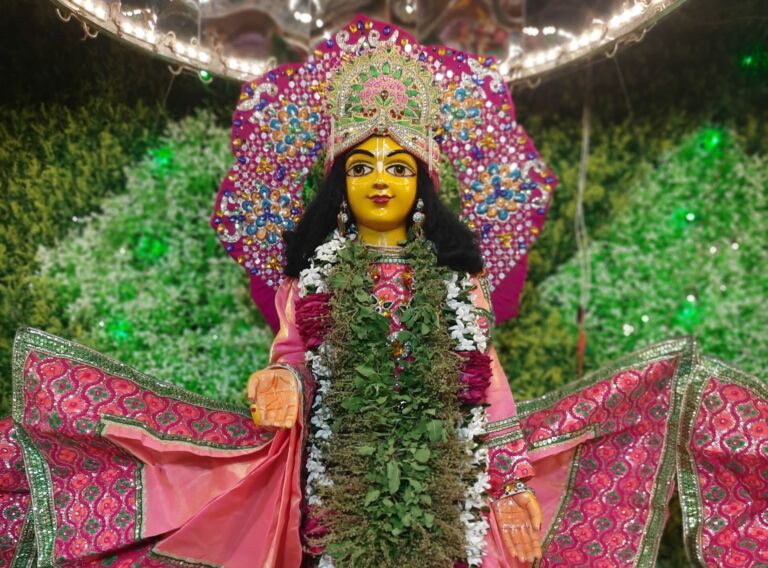
Rādhā-dāsyam
Kṛṣṇa Himself followed this Keśava-vrata to develop relationship with the Vraja-devīs. He thought, “I am Viṣṇu, I am Nārāyaṇa, Nṛsiṁha, Rāma, Kalki. I am the all-pervasive Supreme Lord. I am Dvārakādhīśa and Mathurādhīśa, but I am distant from the Vrajavāsīs. How can I always be with them?”
Bhagavān is very restless. As Rāma, He ran away from His loving father, and as Vāmana, He left Kaśyapa and Aditi. He now wondered, “How can I stay permanently in Vraja-maṇḍala?” For this purpose, Kṛṣṇa started this vrata. Keśava wants to be accepted into the group of the Vraja-devīs. “How will they accept Me? I will learn how to serve then this will be possible.”
Śrīla Rūpa Gosvāmī, who is praying to Keśava, mentions how Keśavadeva is in Vraja-maṇḍala with the Vraja-devīs. He fills the Vraja-devīs with delight. But that Keśavadeva wants to learn something from them. Therefore, He accepts training from Viśākhā-devī for one month. Viśākhā-devī can give knowledge how to serve as well as the tendency to serve.
In Mahāprabhu’s līlā, Viśākhā-devī, in the form of Rāmānanda Rāya, became the constant companion of Mahāprabhu after He took sannyāsa. Mahāprabhu learned from him and then taught the jīvas.
Śrīla Rūpa Gosvāmī Prabhu explains how Kṛṣṇa went to Viśākhā-devī at Śṛṅgāra-vaṭa, on the bank of the Yamunā, desiring to learn the skill of dressing and decorating Śrīmatī Rādhārānī’s hair and divine body. Śrī Keśava is Parabrahma, Parameśvara. All demigods worship Him. All the Vraja-devīs serve Him. But just see, the worshipful is now the worshiper.
Śrīla Śukadeva Gosvāmī said:
anayārādhito nūnaṁ
bhagavān harir īśvaraḥ
yan no vihāya govindaḥ
prīto yām anayad rahaḥ
Śrīmad-Bhāgavatam 10.30.28
[Certainly this particular gopī has perfectly worshiped the all-powerful Personality of Godhead, Govinda, since He was so pleased with Her that He abandoned the rest of us and brought Her to a secluded place.]
Hari Himself worships Śrīmatī Rādhikā.
Śiva Ṭhākura said:
ārādhanānāṁ sarveṣāṁ viṣṇor ārādhanaṁ param
tasmāt parataraṁ devi tadīyānāṁ samarcanam
Padma Purāṇa 6.253.176
[Of all types of worship, worship of Lord Viṣṇu is best, but even better than the worship of Lord Viṣṇu, is the worship of His devotees.]
What is the highest ārādhana? Who has the most exalted position? Kṛṣṇa Himself worships the Vraja-devīs, especially Śrīmatī Rādhikā. Kṛṣṇa took training Himself, and then taught everyone this ārādhana. Viśākhā-devī administered Keśava’s training. Therefore, this vrata, which is followed in the month of Vaiśākha, is called Keśava-vrata, and it is performed under the guidance of Bhagavatī Paurṇamāsī and Vṛndā-devī.
Parama-gurudeva wrote prayers of unprecedented depth and insight to that Kṛṣṇa who is not worshiped by Śrīmatī Rādhārānī, but who is the worshiper of Śrīmatī Rādhārānī. The Gauḍīyas wish to see Kṛṣṇa serving Śrīmatī Rādhārānī. Kṛṣṇa should worship Rādhārānī. Kṛṣṇa should always think of Her. This is the mood in the Gauḍīya line.
At the time of Vāsantī-rāsa, near Imli-tāla, Rādhārānī saw that Kṛṣṇa was with Her, but all the gopīs were also with Him. They were dancing with Him, holding His hand, playing and singing with Him, and all were very happy. Śrīmatījī thought, “Oh, Kṛṣṇa is treating these gopīs as equal to Me?” She left that place, and as soon as She left, Kṛṣṇa stopped everything.
In his songs, Bhaktivinoda Ṭhākura sings how on the bank of the Yamunā, within the groves of Vṛndāvana, Kṛṣṇa is present with hundreds of crores of gopīs. Although this great number of gopīs is there, Kṛṣṇa is restless without Śrīmatī Rādhārānī. When Śrīmatījī left, Kṛṣṇa went and sat under the tamarind tree at Imli-tāla, where He played His flute.
śata-koṭi gopī mādhava-mana,
rākhite nārilo kori jatana
[Millions of lovely cowherd damsels are unable to keep Mādhava’s attention, although endeavoring very hard to do so.]
veṇu-gīte dāke rādhikā-nāma,
eso eso rādhe! ḍakoye śyāma
[The flute song calls the name of Rādhikā, and Śrī Śyāmasundara petitions Her, “Come here, come here, Rādhā!”]
With His flute song, Kṛṣṇa does kīrtana of Rādhārānī’s holy name. Thinking deeply of Śrīmatī Rādhārānī, He lost His own color and nature. His kīrtana soon changed to “Kṛṣṇa, Kṛṣṇa, Kṛṣṇa.” Completely absorbed in the moods of Śrīmatī Rādhārānī, He forgot His own identity and in the mood of Rādhārānī began chanting His own name. We worship this Gaurahari.
The sakhīs came to see what Kṛṣṇa was doing. He was senseless, in a mysterious state of absorption. Not receiving the darśana of Rādhārānī, Kṛṣṇa’s situation became very serious. Śyāmā, Lalitā, and Viśākhā searched for Rādhārānī. Śrīmatī had gone to Māna-sarovara, on the other side of the Yamunā, and flooded that area with Her tears. The sakhīs and mañjarīs came and prayed at Her lotus feet. They offered many beautiful prayers to try and pacify Her. They called Kṛṣṇa to try and cool Her māna. Kṛṣṇa chanted the thousand and eight names of Rādhārānī. He prayed, did tapasyā, and was waiting for Her with great pain in His heart.
Śrīmatī wondered, “Who is chanting My name in this dense forest?” Viśākhā and the other sakhīs told Her, “A botu–brahmacārī is determined to have Your mercy. He has been doing austerity for a very long time, but You are not giving Your darśana.”
“Who is He?” Śrīmatī asked. “Where has He come from?”
“He says He has been chanting Your names lifetime after lifetime and that He has undeviating desire for Your mercy alone—He does not look toward any other devī. He only wants Your blessings.”
“What kind of blessings does He want?”
“All He wants is that You be pleased with Him and give Him some service. If He lacks the adhikāra for service, He only asks that You bless Him by kindly glancing upon Him and saying that You are happy with Him. This will satisfy Him. Without this, He will suffer, cry, and do strong tapa. The intensity of His austerity will disturb the planets up to Brahma-loka. It will cross even Brahma-loka and reach Vaikuṇṭha. Even crossing Vaikuṇṭha, it will affect Vṛndāvana. It will burn everything. Everything will be destroyed. This botu-brahmacārī’s austerity is very strong. Will You not give Him mercy?”
Śrīmatī said, “I will examine to see who He is.” She was led to the place where the botu–brahmacārī was doing austerities. Śrīmatī saw that He was very young, nine or ten. He sat atop a lush patch of grass in a peaceful kuñja. His eyes were closed and He chanted Her names. Rādhārānī stood and listened. The boy was chanting very sweet names, each new and more sweet than the previous one, such as:
caru-gorocana-gaurī
garutmata-nibhambara
vicitra-paṭṭa-camarī
caru-venī-śikha-ruciḥ
Stava-māla, Vṛndāvaneśvari-nāmāṣṭottara-śata-nāma-stotra
[Whose beautiful complexion is fair as gorocanā, whose garments are splendid as sapphires, and whose beautiful braided hair is crowned with colorful flowers.]
padmendu-jaitra-vaktra-sri-
niruddha-mura-mardana
cakorika-camatkari-
hari-hari-vilocana
[Whose beautiful face, which has already conquered both the lotus and the moon, holds Kṛṣṇa as its prisoner, and whose eyes enchant Hari and fill the cakora birds with wonder.]
Rūpa Mañjarī and all the mañjarīs were surprised and delighted to hear Śrīmatī’s names chanted by this botu–brahmacārī. Śrīmatī went closer. She took a flower in Her hand and said to the brahmacārī, “I am pleased with You. May You be satisfied. You shall have no problems in Your life. You have done strong austerity, but where You have come from, I do not know. I do not know Your identity. I do not know what You want. But because You are praying to Me so sweetly, I give You My blessings.”
Kṛṣṇa said, “I am just a small cowherd boy. I do not know anything. I like a respected resident of this Vraja-maṇḍala, but that person has rejected Me. I have met with many people, but they are not like that person. I am ready to do anything for that person. If You are pleased with Me, then please give Me the blessing that You will never be angry with Me; not just in this life, but for millions of lives. Can You make this promise to Me? Your pleasure is My pleasure.”
Śrīmatī smiled. How tricky were the words of this botu–brahmacārī. People do austerity for their own benefit, but this boy only wants that I be pleased. She said to Viśākhā, “There are dreadlocks in this boy’s heart. Dreadlocks cannot be combed out straight. I cannot give the blessing this boy is asking for.”
She turned to leave, but the botu–brahmacārī cried and chanted Her names even louder. The area of Māna-sarovara became hot like the inside of a volcano. First, it had become hot from Rādhārānī’s māna, and now it was heated by Kṛṣṇa’s austerity.
Śrīmatī Rādhikā said, “Viśākhā, I cannot stay here any longer.”
“How can You go?” Viśākhā-devī asked. “Look at this forest. It is as if on fire. Everything will be destroyed by this brahmacārī’s austerity. His austerity is so strong because He only chants Your names and desires Your mercy.”
“Did You not hear Him?” Śrīmatī said. “He does not want My mercy but My happiness. He wants that I be pleased and never disturbed with Him. He wants Me to never reject Him. What is this matter? Who is He? Why does He not tell Me His identity? Where did He come from? How long has He been doing this austerity? He does not explain Himself. Why does He want Me to be happy?”
Then, very politely, Lalitā and Viśākhā explained, “This boy went to Imli-tāla. He sometimes sat, stood on one leg, and sometimes even stood on one toe under the tamarind tree, and all the while He only chanted Your names. Why not be pleased with Him?”
“No,” said Śrīmatī. “I keep no relation with cheaters and the followers of cheaters. I shall not give this cheater even one drop of My favor.”
“In what way is He cheating?” Viśākhā-devī asked. “Look at Him; He is tamal-śyāma. Look into His completely clean heart. If You look just once, You will be pleased. You have not had a close look at Him. Just see His long eyes and curly hair. Attracted by His fragrance, bumblebees have come to rest on His curling locks. Will You not look at Him? How long will He perform such austerity with tears running down His face? Gaṅgā and Yamunā seem to flow from each of His eyes. Do You not see these streams of tears? He has done so much austerity to please You.”
“Alright,” said Śrīmatī. “I will arrange for His happiness, but not My happiness. I do not like the nature of His prayer. If He does not ask for My happiness, and instead asks for His own, then I will help Him.”
In response to this, the botu-brahmacārī replied, “Yes, I will tell You what will make Me happy. If You are never disturbed with Me, if You never reject Me, if You never send Me distant from You, if I may continuously chant Your holy names and serve You, if You accept Me as Your small disciple and teach Me how to serve You, then I will be very pleased and happy.”
“A disciple surrenders himself,” Viśākhā-devī said. “And a disciple offers praṇāma. Will You not offer praṇāma to whom You have surrendered?”
smara-garala-khaṇḍanaṁ
mama śirasi maṇḍanaṁ
dehi pada-pallavam-udāraṁ
Gīta-govinda 10.8
[I bow My head to You and pray that You put Your lotus feet on My head so that the disease of separation in My heart be cured. Please give Me the fortune of placing those feet on My head.]
Viśākhā-devī then said, “Offer praṇāma to Your guru. Then You will receive Her blessings.”
The botu–brahmacārī then offered sāṣṭāṅga praṇāma to Śrīmatī Rādhārānī and prayed, “Rādhe, now please give Your blessings and mercy. You have promised to never reject whoever takes shelter of You. Now, please bless Me.”
Śrīmatī Rādhārānī said, “Tathāstu.” Kṛṣṇa then begged something from Her. “And now, Rādhe, please give Me Your māna.”
This Māna-sarovara līlā is very deep. From that day, if Śrīmatī was ever in māna, Her sakhīs would remind Her, “He is Your disciple. He is Your student. How can You neglect Him? Do You remember Your promise?” At these times, Rādhārānī would smile, forget, and forgive.
Śrī Kṛṣṇa taught this and Mahāprabhu did as well. This is the way of the Gauḍīya paramparā. Lord Keśava performed this vrata, as does Śrī Caitanya Mahāprabhu. Mahāprabhu took sannyāsa at the age of 24 and continuously chanted the sannyāsa–gopī–mantra. Do you know what the sannyāsa–mantra is? It is the mantra chanted by those who wish to be a follower of the gopīs. Caitanya Mahāprabhu, who is Kṛṣṇa Himself, chanted this mantra day and night. Kṛṣṇa does austerity for Rādhārānī’s mercy and Her direct service.
vraja-gopī-bhāva, haibe sva-bhāva, anā bhāva na rahibe
Gīta-mālā
[I shall take birth in Vṛṣabhānu Mahārāja’s town and will marry in the nearby village of Yāvaṭa. My disposition and nature will be that of a cowherd maiden, and no other.]
āmi to rādhikā-pakṣa pātī sadā, kabhu nāhi heri tā’ke
Gīta-mālā
[I will know that Rādhā’s pleasure is Kṛṣṇa’s only source of joy. Therefore I will never desire to abandon Her lotus feet to meet Him. I am always in Rādhikā’s party and I never even glance at those who have left Her group.]
This is the prayer of Keśava-vrata. This is the line of the Gauḍīyas.
Śrīmatī Rādhārānī never does any vrata, but Kṛṣṇa does vrata. Keśava chants these names of Rādhikā. The living entities are His part and parcels. Therefore, if He, Keśava, does this vrata, then all the jīvas will follow His example. They will also take up this vrata and attain spiritual realization. All our Gosvāmīs have written about the glories of Śrīmatī Rādhārānī and of service to Her lotus feet. And this has been taught by our Gauḍīya Guru-varga. We take shelter of them and of Keśavadeva Himself, and pray to be able to follow His example of prayer and service.
[Excerpted from the Bhakta Bandhav Publication “Holy Dust of Vraja”]