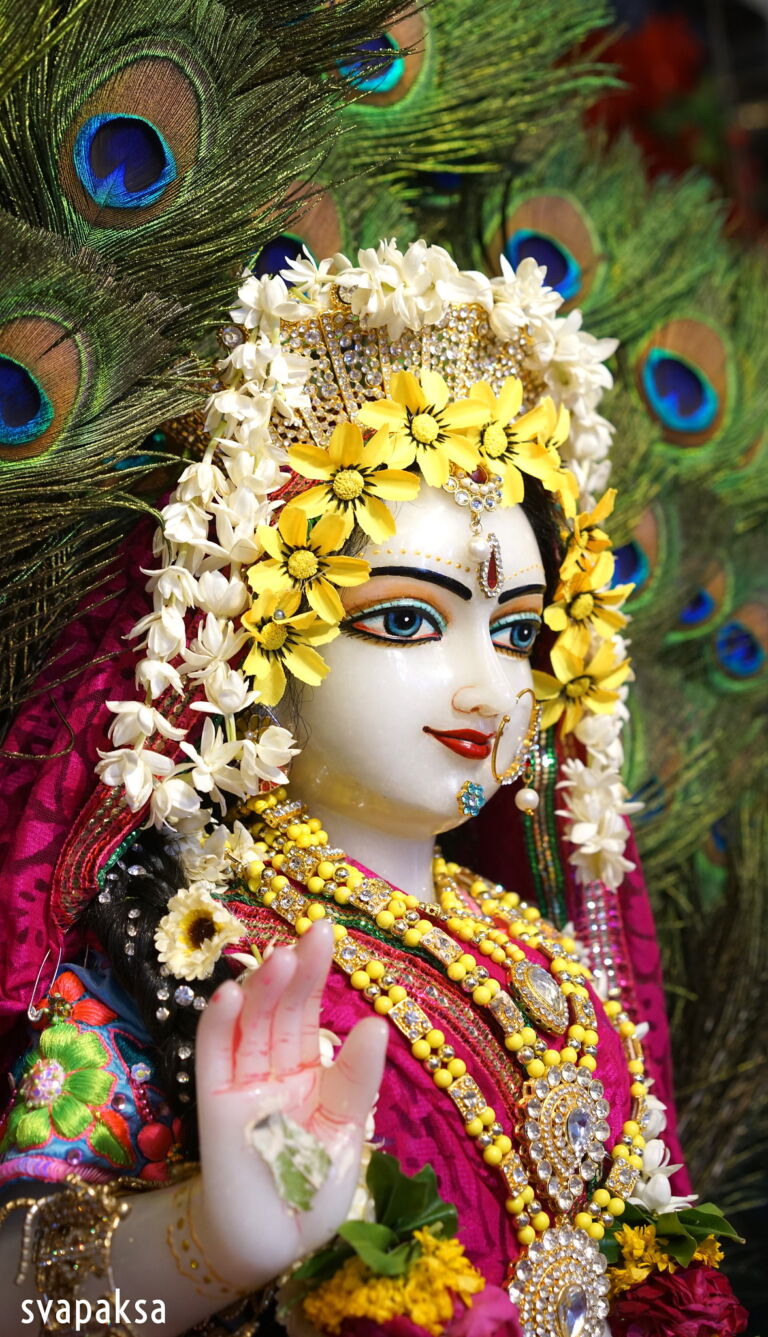
Kṛṣṇa’s Love
The Padma-purāṇa, Skandha-purāṇa, and other Purāṇas extensively describe the glories and specialties of Keśava-vrata. The jīvas take birth in this world and have to experience their prārabdha and aprārabdha-karma, which they have collected since millions of lives. After taking birth in this world, they meet many other living entities. As a result, their balance of karma invariably increases. The jīvas don’t know how to purify themselves and establish a relationship with Bhagavān. Therefore, the śāstras advise, “In this month, you should water Tulasī-devī and placing Śālagrāma-śilā or Govardhana-śilā on an altar, you should shower them with water everyday.”
What is the result of having drops of water trickle down on the Śālagrāma-śilā or on Tulasī-devī? Our karma from millions of lives will be washed away. Although Kṛṣṇa, Rāmacandra, and many other incarnations appeared, we never bathed Them with water and we never served Them. We only shower and clean our own body with great diligence.
The caranāmṛta of Kṛṣṇa is Bhagavatī Gaṅgā herself. Although we bathe in the Gaṅgā everyday, how can we bathe our soul? One should do abhiṣeka of Keśavadeva and Tulasī-devī. Thus, when we take their caranāmṛta, our insurmountable prārabdha-karma resulting from previous lives will completely be destroyed. We will be thoroughly cleansed by this abhiṣeka.
The sun, moon, and all the other planets bear witness to your karma. Yama Mahārāja is also well acquainted with your balance of karma. But there is only one process to sever this bond of karma. Although we do abhiṣeka of the Deity everyday, it is especially beneficial to bathe Śālagrāma in this month.
The ṛṣis would go to the banks of a holy river early in the morning. They would go to the Mandākinī, Gaṅgā, Yamunā, Sarasvatī, Godāvarī, Kāverī, Narmada, and Sindhu, and bathe there. They would go especially where these holy rivers form a confluence. That place where three holy rivers meet together is called Triveṇī, where five holy rivers meet together is called Pañcaveṇī, and where seven holy rivers meet and merge together is called Saptaveṇī. The ṛṣis would worship and pray to Keśavadeva for one month in these places.
Śrīla Rūpa Gosvāmī Prabhu worshiped Keśavadeva in Vṛndāvana. He composed the Keśavāṣṭakam. Who is Keśava? He is the Supreme Lord, who performs human-like pastimes as an cowherd boy residing in Vraja-maṇḍala.
How is the abhiṣeka of Kṛṣṇa done during the summer? Is there any need for Kṛṣṇa to bathe in a pond or under a waterfall? There is no need. Gaṅgā-devī does abhiṣeka of Keśava-Kṛṣṇa from the sky as rain from the heavens.
Seeing this, Kṛṣṇa’s sakhās say, “How kind Devarāja Indra is. He is cooling everyone with his rain.”
Kṛṣṇa replies, “No. This is not Indra’s mercy, rather this is the fruit of serving the cows, coming in the dynasty of Mother Surabhi. This is her blessing. Even Pṛthivī-devī is very happy. Why? Everyone is serving and taking care of the cows.”
Keśavadeva and all the demigods, like the sun and the moon, are pleased with a devotee who has a desire for unconditional service.
Kṛṣṇa told His sakhās, “Girirāja-Govardhana is very happy with us. Therefore, this is his rainfall. The clouds form in the sky and are pushed by the winds into the high peaks of Govardhana, causing them to burst and shower rain.” All the sakhās would serve the cows with Kṛṣṇa.
Everyone in Vraja-maṇḍala takes care of the cows, but in this material world no one likes to serve the cows. People like to disturb the animals and kill them rather than serving them. No one is compassionate. They only serve animals to suit their selfish purposes; no one serves with love. Śrī Caitanya Mahāprabhu nourishes and takes care of all the living entities by prema, therefore He is called Viśvambhara. Kṛṣṇa Himself takes care of everyone in Vraja-dhāma. Keśavadeva serves and helps any soul that comes to Vraja-dhāma. He brings everyone nearby and makes an intimate friendship with them. He takes care of everyone from morning to evening. He never neglects or is angry with anyone.
Yaśodā Mātā told Kṛṣṇa, “When You return from the forest, many monkeys follow You back and they come and disturb You. You cannot sleep because of them. Why do You feed these monkeys? Many peacocks fly and sit on the roof. They start calling out to You even before the sun rises. You cannot take rest because of these birds and animals.”
Kṛṣṇa replied, “Mother, everyone here is your child. So, if you have love for Me, then it is necessary to have love for all your other children as well. I share the love you have for Me with everyone else.”
How magnanimous Keśavadeva is!
Śrī Kṛṣṇa Caitanya Mahāprabhu sang:
Rāma! Rāghava! Rāma! Rāghava! Rāma! Rāghava! rakṣa mām
Kṛṣṇa! Keśava! Kṛṣṇa! Keśava! Kṛṣṇa! Keśava! pāhi mām
Caitanya-caritāmṛta, Madhya 6.97
Rāma is Rāghava. His heart is most magnanimous. Kṛṣṇa is Keśava; He serves and takes care of everyone.
Seeing that Mother Yaśoda was not very eager to support the animals, Kṛṣṇa told His mother, “Mother, what is the matter? I will distribute whatever food you give Me. I will distribute My butter and rotis to everyone.”
Hearing Kṛṣṇa’s words, Mother Yaśodā became very shy. She replied to Kṛṣṇa, “The peacocks and other animals eat grains. They eat the fruits, leaves, and roots they find in the forest. Why should You share Your food with everyone?”
Kṛṣṇa replied, “Mother, My sakhās have hands and legs. They can feed themselves. But these animals don’t have hands. They are always tired because of flying and moving here and there searching for food. Where can they find water, fruits, or grains?”
Kṛṣṇa continued, “Mother, you should distribute your motherly affection to everyone. If you don’t give this love—then who will? No one takes care of these birds and animals. Mother, everyone has ample milk products. There are so many sweets, laddus, and grains. Won’t you give any of them away?”
By listening to Kṛṣṇa’s caring words, the ocean of love within Yaśodā’s heart swells all the more.
This is the nature of Keśava’s vrata. He serves all the living entities. He never neglects or rejects anyone who comes near Him. Keśavadeva is taking care of souls in 84 lakhs species, giving them a chance to come to Him. But now, in the human form, if they do not serve Keśava, then they waste their chance and fall back to animal life.
No one takes care of this world and its inhabitants. No one has any kindness or love. Everyone steals everything away from us and kick us away. They are very selfish; they don’t think about our wellbeing. But Kṛṣṇa never kicks anyone away. He is so magnanimous.
Śrīla Gurudeva has explained how Kṛṣṇa would take care of the trees, plants, creepers, grasses, and everyone else.
Kṛṣṇa said, “Vṛnde, your garden is very green. It is sweet, like your heart. You use your body, mind, and everything else in the service of Vṛndāvana. You have love for Vṛndāvana.”
Vṛndā-devī replied, “Kṛṣṇa, everyone has come here only for You! I serve and take care of everyone here because You will be pleased. I take care of the trees who offer many juicy fruits to You as their gift.
I also serve the animals, for they have a very sweet relationship with You. Everyone is inclined to Your service. Even the animals do not steal the fruits; except for Your prasāda, they don’t eat anything else. How will You ever be happy if Your followers are not served and helped?”
Therefore, if anyone offers himself to Keśavadeva, then Vṛndā-devī, Lalitā, Viśākhā, and everyone else will seriously take care of such a sādhaka.
In gaura-līlā we see that deer, bears, snakes, tigers, lions, elephants, and all the animals came and danced with Mahāprabhu. In kṛṣṇa-līlā even demons came to Vraja-maṇḍala. They came as a crane, donkey, calf, serpent, and in various other forms. However, Kṛṣṇa never rejected or kicked any of these demons away. He removed all their anarthas, and gave them pure vraja-bhakti and a chance to serve. This has all been described by Śrīla Sanātana Gosvāmī.
Śrīla Rūpa Gosvāmī has explained the glories of Śrī Keśavadeva in his Śrī Keśavāṣṭakam.
Śrīla Jayadeva Gosvāmī has written extensively about the glories of Śrī Keśava.
Jayadeva Gosvāmī would worship Rādhā Mādhava everyday with Padmāvatī-devī. He would pray and compose poetry glorifying Śrī Rādhā and Kṛṣṇa:
rādhe kṛṣṇa govinda gopāla nanda-dulāla
yaśodā-dulāla jaya jaya deva hare
śrita-kamalā-kuca-maṇḍala dhṛta-kuṇḍala (e)
kalita-lalita-vana-mālā jaya jaya deva hare
Maṅgala-gītam
O You who take shelter of the round breasts of Kamala, O You whose ears are decorated with earrings and who wears an enchanting garland of forest flowers, O Deva, O Hari, may You be triumphant!
He would write and sing many such prayers. He would then bathe in the Gaṅgā and return.
Once, Śrīla Jayadeva Gosvāmī saw something astonishing in his trance. He saw the Supreme Lord Himself, Śrī Kṛṣṇa, bowing down and placing His head at the lotus feet of Śrīmatī Rādhikā. He thought, “How can I write this:
smara-garala-khaṇḍanaṁ
mama śirasi maṇḍanaṁ
dehi pada-pallavam-udāraṁ
Gīta-govinda 10.8
O My beloved, Cupid’s powerful poison is devastating me. Please be merciful to Me and place upon My head the cooling, tender petals of Your lotus feet.
Jayadeva Kavi tried to write this but could not. Lord Parabrahma will offer praṇāma to Śrīmatī Rādhārānī’s lotus feet? How is this possible? He could not write this.
Jayadeva Gosvāmī said to his wife, “Padma, I am troubled. I will now go to the Gaṅgā, bathe, and chant mantras. Please put away my book and pen. I will be back to take prasādam, and will write after that if some realization comes to me.”
He gave his book to Padma and took the path to the Gaṅgā, which was a few kilometers away from their āśrama. Only five minutes later, Padma saw her husband returning. He came to her and said, “Padma, Padma, please give me my book and pen.” She gave them.
“I will write something now,” he said, and then sat down and wrote.
“Will you take prasādam now?” Padma asked.
“Yes. Please bring prasādam.”
Padma fed him. When he finished eating, he lay down to rest and Padma massaged his feet. She then went to take the remaining prasādam.
Padma had half-finished prasādam when she heard the voice of her husband from outside the house, “O Padma, I am back.”
“Where are you coming from?” Padma asked, confused.
“Why, the Gaṅgā.”
“What are you saying?” said Padma. “You already came, took prasādam, and took rest. I am now taking your remnants. How could you possibly be just coming back from the Gaṅgā?”
“No, I am very disturbed. I am wondering how to write what I am feeling. I bathed in the Gaṅgā and prayed there for a long time, but found no solution. How can I write that Parabrahma Kṛṣṇa offers praṇāma to Śrīmatī Rādhārānī’s lotus feet and prays to Her. It is very difficult for me to write this.”
“What are you talking about?” said Padma. “You just came to me asking for your book and pen, and that you would write something immediately. I gave you your book and pen and you wrote something. You gave me back your book and pen and then took prasādam. This is what I saw. Now I am taking prasādam. I only do this after you.”
Jayadeva Gosvāmī said, “Bring me the book.” Padma did so. Both of them saw written there the verse that Jayadeva Gosvāmī was hesitating to write:
smara-garala-khaṇḍanaṁ
mama śirasi maṇḍanaṁ
dehi pada-pallavam-udāraṁ
Gīta-govinda 10.8
Kṛṣṇa expressed to His beloved, “Oh! You who are so kind, I am proud and hard like a rock. I never offer praṇāma to anyone. You are the greatest. Now I bow My head to You and pray that You put Your lotus feet on My head. How can My heart be clean? No one’s heart can be purified unless they offer praṇāma to Your lotus feet. Please give Me the fortune of having those feet on My head.”
Kṛṣṇa Himself, disguised as Jayadeva Gosvāmī, wrote this. Jayadeva Gosvāmī looked at Padma and, weeping, said, “You are extremely fortunate. Śrī Kṛṣṇa has come and written what I could not.” He touched the book to his head and held it to his chest. “Kṛṣṇa wrote this verse personally to prove that it is absolutely true. O Padma, how lucky you are! He ate from your hand directly. He ate and rested here. Now, please give me some of your remnants, which are also Kṛṣṇa’s direct remnants.”
In this way, Kṛṣṇa showed the glory of Śrīmatī Rādhikā.
Jayadeva Gosvāmī lived in the kingdom of the Bengali king, Mahārāja Lakṣmaṇa Sena. Once, a group of dacoits became very envious of him because he was the king’s guru. They thought, “Jayadeva Gosvāmī has much wealth but he doesn’t give anything to anybody,” so they conspired to kill him. One day, when Jayadeva Gosvāmī was returning from bathing in the Gaṅgā, the dacoits mutilated his body and threw him in a well. Yet, miraculously Jayadeva Gosvāmī continued singing Kṛṣṇa’s glories, “Jaya jaya deva hare.”
The king prayed to Rādhā-Mādhava and started to look for Jayadeva Gosvāmī. Searching and searching, the King found Jayadeva inside the well, his limbs severed. After taking Jayadeva Gosvāmī out of the well, the King and Padmāvatī bathed him with the water of the Gaṅgā. By the mercy of Gaṅgā-devī, Jayadeva Gosvāmī’s body was rejuvaneted.
After this incident, Jagannātha came to Jayadeva Gosvāmī in a dream and told him, “Now you should come to Me in Purī.”
When Jayadeva Gosvāmī was in Purī, he would sing, dance, and pray in front of Jagannātha.
Śrī Gīta-govinda manifested during this time of Keśava-vrata. In the Gīta-govinda, Jayadeva Gosvāmī sings:
rati-sukha-sāre gatam abhisāre madana-manohara-veśam
na kuru nitambini gamana-vilambanam anusara taṁ hṛdayeśam
dhīra-samīre yamunā-tīre vasati vane vana-mali
pīna payodhara parisara mardana cañcala karayugaśālī
Vanamālī-Kṛṣṇa is in Vṛndāvana in the summer. Everything becomes dry from the heat. The gopīs are disturbed because they cannot meet with Kṛṣṇa. Before, the forest was green, but now there are no lush green kuñjas where they can secretly meet with Kṛṣṇa. How can the gopīs go and serve Kṛṣṇa now? Seeing the situation Kṛṣṇa arranged to give them a good opportunity to serve. Kṛṣṇa manifest Himself as a forest-god so everyone could come and serve Him. The gopīs would daily bring sandalwood-paste, Tulasī, and many cold drinks. They would come to the bank of Govardhana to serve Kṛṣṇa who had now appeared as a forest-god (vana-devata).
We should endeavor to cultivate Mahāprabhu’s moods and follow the desire of the Guru-varga, especially the moods of Rūpa Gosvāmī, as he has given in his Śrī Keśavāṣṭakam. This is the best offering to Keśavadeva during this month of Keśava-vrata. Our heart will then be cleansed and the soul will be showered with many blessings and mercy. What blessings? The soul will attain svarūpa-siddhi, its transcendental form, and we will no longer be attached to anything mundane in this world.
[Excerpted from the Bhakta Bandhav Publication “Holy Dust of Vraja”]