Samādhis of Contemporary Vaiṣṇavas in Vraja-maṇḍala
After the disappearance of Śrīla Prabhupāda Sarasvatī Ṭhākura,
many of his prominent disciples came to Vraja and took shelter
in the villages of the Vrajadevīs, like Kāmāī Karelhā, Pāvanasarovara,
Bihāravana, Cīra Ghāṭa, and many other places. These
niṣkiñcana-akiñcana sādhus did their bhajana there, and would
maintain themselves by accepting madhukarī (alms) from the
local Vrajavāsīs.
In Kāmāī Karelhā, Nimāī dāsa Bābājī Mahārāja would chant
three lakh of harināma daily and would then accept a little
madhukarī. He was respected by all the Vrajavāsīs. Just before
he left this world, he visited all the Gauḍīya Maṭhas in Vraja. His
sevaka, a vrajavāsī boy called Rāma Kṛṣṇa dāsa Bābājī, would
carry him to the temples. Bābājī Mahārāja met with all the
Vaiṣṇavas and then returned to Kāmāī Karelhā, where he entered
nitya-līlā upon arriving. The Vrajavāsīs respectfully placed Bābājī
Mahārāja in samādhi. By Bābājī Mahārāja’s inspiration, the devotees
there continue to perform nāma-saṅkīrtana, nagara-parikramā
(village parikramā), and to discuss the glories of the Vrajadevīs,
up to this day.
Later, another disciple of Śrīla Prabhupāda Sarasvatī Ṭhākura
came to that village. His name was Śrīla Bhakti Ṛṣi Ācārya
Mahārāja. After his departure from this world, he was also given
samādhi there.
Dīna-bandhu dāsa Bābājī Mahārāja did his bhajana at Pāvanasarovara,
close to the bhajana kuṭīra of Śrīla Sanātana Gosvāmī. On
the disappearance day of Śrīla Prabhupāda Sarasvatī Ṭhākura, he
went on Govardhana parikramā. In the evening, after completing
his parikramā, he took prasādam at his Gurudeva’s temple, Śrī Rādhā-
Kuñjabihārī Gauḍīya Maṭha, and then returned to Nandagrāma by
bus. When he arrived, all the Vrajavāsīs anxiously asked him where
he had been. They carried him from the bus to his bhajana kuṭīra.
On the way, while passing by Nanda-bhavana, Bābājī Mahārāja
offered pranāma to Nanda Mahārāja, Yaśodā-mātā, and Kṛṣṇa
and Balarāma. Bābābjī Mahārāja was remembering how, at that
time, Kṛṣṇa returns home from go-cāraṇa, or cow grazing. He
offered praṇāma to all and then departed to the eternal world.
All the Vrajavāsīs took him to Pāvana-sarovara. They called the
prominent and exalted Vaiṣṇavas of Vraja and together, they
placed him in samādhi there.
Akiñcana Kṛṣṇadāsa Bābājī Mahārāja did his bhajana by
continuously chanting harināma and traveling everywhere. Six
months of the year he would stay in Vraja-maṇḍala, and the other
six months in Gaura-maṇḍala. Sometimes he would visit all the
Gauḍīya Maṭhas and the appearance place of Śrīla Prabhupāda
Sarasvatī Ṭhākura in Śrī Kṣetra-dhāma. He was ajāta-śatru, he
had no enemies. He was everybody’s friend and was respected by
all. He entered nitya-līlā in Pāvana-sarovara, where the guru-varga
placed him in samādhi. He is still present there now, continuing to
chant harināma and serve his gurupāda-padma and the guruvarga.
This place is continuously overflowing with harināma-rasa.
It will never be dry.
Svāmī Haridāsa
There are many bona fide devotees present in Vraja-dhāma.
They perpetually pray to the vraja-raj, the dust of Vraja, and
never leave this Vraja-bhūmi. Svāmī Haridāsa, for example, was
doing his bhajana in Nidhuvana. One day, a very rich person came
for his darśana. As a gift, he gave Svāmī Haridāsa a bottle of very
expensive, nice-smelling perfume. Svāmī Haridāsa looked at the
bottle, opened it, and then threw all the perfume in the dust of
Nidhuvana. That rich man became very angry and disturbed.
“Oh, that was Mughal perfume! Kings and emperors are using
this kind of scent, but Bābājī has no idea of its value! Why did I
give this perfume to Bābājī! He just threw it all in the dust…” But
that person could not understand. He had no eyes to see the real,
eternal reality.
Still disturbed, that man then went to the Bankī-bihārī temple.
When he entered, he noticed to his great surprise that the whole
temple smelled like the perfume that Haridāsa had just thrown
into the dust. The walls, cloth, air, floor, everything smelled like
that perfume, and all the people present within the temple were
intoxicated with that smell. How amazing was that fragrance!
And Bihārījī also – His clothes, body, and everything – smelled like
that perfume. The rich man then went back to the place where
Svāmī Haridāsa had thrown the perfume into the sand, but there
that wonderful perfume smell had completely disappeared. He
thought, “How is this possible? This perfume is so strong that the
smell lasts for a month. But although Bābājī threw the oil here
just a few hours ago, there is not even the slightest bit of scent
from it remaining.”
The man approached the two main sevakas of Svāmī Haridāsa,
called Tānsena and Baiju-bāvara. Bāvara means ‘mad person.’
He was given that name because when he sings, Bankī-bihārījī
Himself comes running there, like a madman. So the rich man
asked this Baiju-bāvara, “Is your guru-mahārāja really a bona
fide mahā-bhāgavata?” The sevakas inquired why he was asking
this question, and the man explained what had happened. He
concluded by stating, “Today I have realized that Svāmī Haridāsa
must for sure be a siddha-mahāpuruṣa.”
That Svāmī Haridāsa is all the time serving Bihārījī, and
Bihārījī is always with him. But how can ordinary people
understand this? When Haridāsa sings, the whole of Vṛndāvana
is dancing. The trees, creepers, animals – all are feeling happy
and pleased. And when he stops singing, Bihārījī becomes very
sad. Therefore, Tānsena and Baiju-bāvara, Svāmī Haridāsa’s
sevakas, continuously sing everywhere in Vraja-maṇḍala, and
in Nidhuvana, Bihārījī is dancing every night with his sakhīs and
mañjarīs to their singing.
Once, there was a professional singer at the court of the
Muslim king in Delhi. The singer requested the king, “I want that
no one in your country should be allowed to sing without my
permission. If they independently sing, they should be hung and
killed. If anyone desires, he can come here and I will test him.
If he sings better than me, then he may be allowed to sing. But
really, I am the greatest singer of all.”
Previously, the king had heard that there was an expert
singer in Vṛndāvana, called Svāmī Haridāsa. He invited Haridāsa
to come Delhi, to test his singing, but Haridāsa had no desire
to leave Vraja. He therefore sent his two sevakas, Tānsena and
Baiju-bāvara. When the two arrived at the royal court, they
asked the king, “You want to test us, but who will judge whose
singing is better? You? Or your court singer? Who will decide? We
desire to do this test in the forest, and let the forest animals be
the judge.”
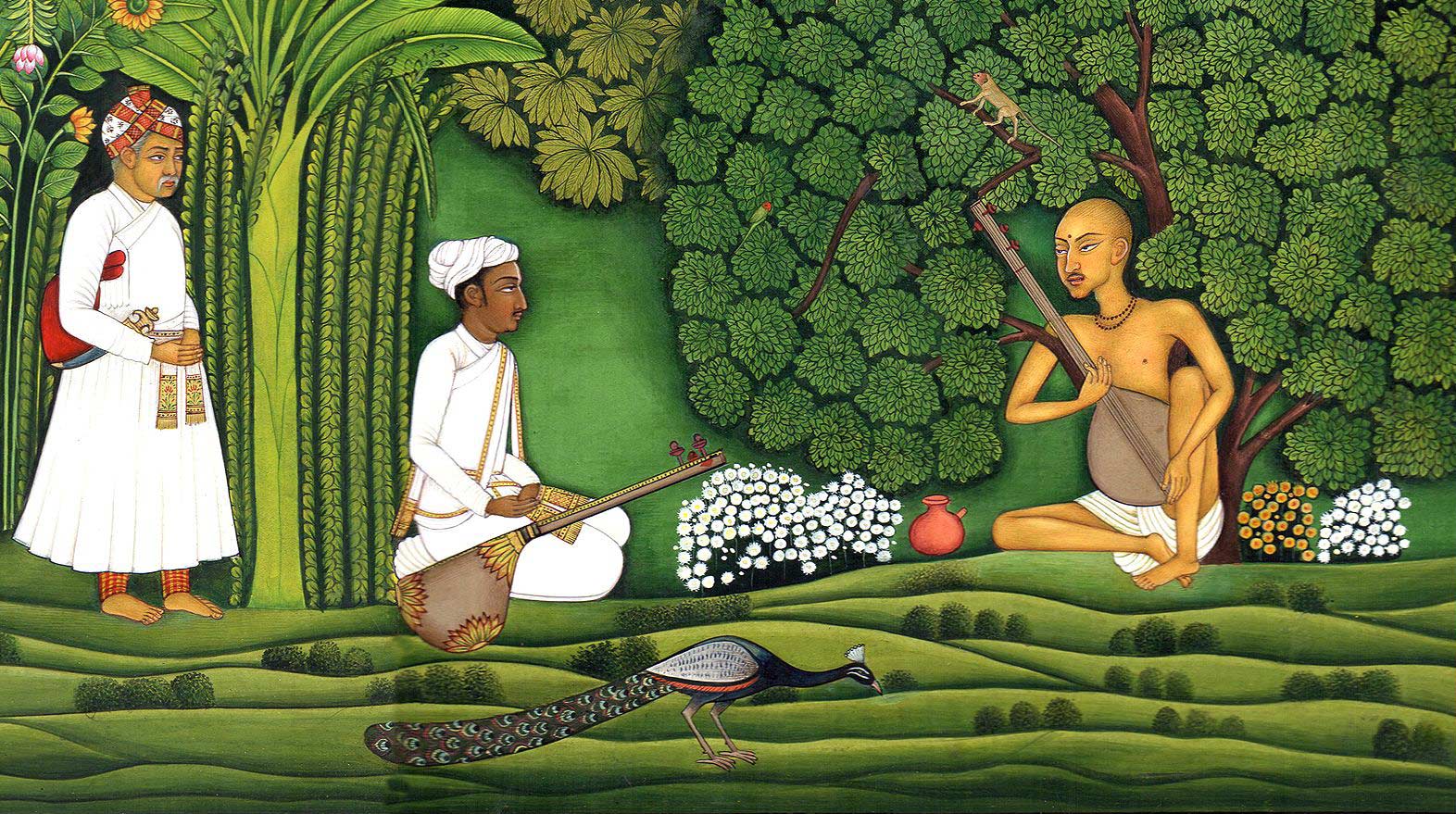
The King, the court singer, Tānsena, Baiju-bāvara, and a few
more people then went into a deep forest. Tānsena was asked to
sing first. When he started his song, accompanying himself on his
guitar, all the forest animals gathered there. Tigers, lions, deer,
jackals, and even elephants and zebras came. They all peacefully
listened to the song and started crying in happiness. Tānsena put
tilaka on all the animals and placed a garland around their neck,
and when he stopped singing, they all ran back into the forest.
Tānsena then told the king, “Now your court singer should sing,
and by doing so, he should again call all the animals here and take
off the flower garlands that I put around their neck.” The court
singer said, “How can that be possible?!” He started singing and
singing, but no animals came. Even birds and mosquitos were not
present there. The court singer said, “This is an impossible task.
These animals must have gathered here earlier only by chance.”
But when Tānsena started a new song, all the animals returned,
and very easily he could take off the flower garlands. By this, the
king and his followers understood the spiritual power of both
Tānsena and his guru, Svāmī Haridāsa.
Tānsena and the Muslim King Visit Svāmī Haridāsa The king then desired to directly meet with Svāmī Haridāsa and hear him sing. But there was a problem: Svāmī Haridāsa
only sings for the pleasure of his worshipful Lord, Baṅkī-bihārījī,
and for no one else’s. When the king arrived in Vṛndāvana,
Svāmī Haridāsa said, “Oh, has this muslim king now come here to
create problems for us?”
To resolve the situation, Tānsena took his sitar and started
singing, but he sang off-tune and out of rhythm. His gurudeva,
Svāmī Haridāsa, chastised him, saying, “Is this how I taught you to
sing?” He took Tānsena’s sitar and started to sing himself. At that
time, a big cloud appeared in the sky and it started raining. The
demigods came and offered flower petals, while the Gandharvas
were dancing. Bihārījī also came and danced there. All the flower
trees started to bloom and drop honey, and everybody present
was crying in separation. When the king saw this scenery, he
became astonished and understood that God is really present in
this world with his devotees.
When that Svāmī Haridāsa left this world, his transcendental
body was placed in samādhi in Bihārījī’s nikuñja-vana, Nidhuvana.
There, he is continuously serving Bihārījī, and at the time of
rāsa-līlā, he sings his songs under the guidance of Lalitā-sakhī for
the pleasure of Bihārījī.
We should never think of the samādhi centers of the guruvarga
as ordinary graveyards. They are not like pyramids,
holding mummies. If a mahā-bhāgavata spiritual master is
present somewhere, then all his spiritual wealth will be present
there too. By visiting the samādhi of Svāmī Haridāsa with respect,
faith, and heartfelt love, we can obtain his mercy. Svāmī Haridāsa
himself will come to give us his blessings and all kinds of help for
our eternal benefit. This place is called a center of eternal Goloka
Vṛndāvana in this world.
[CC-by-NDNC Bhakta Bandhav]