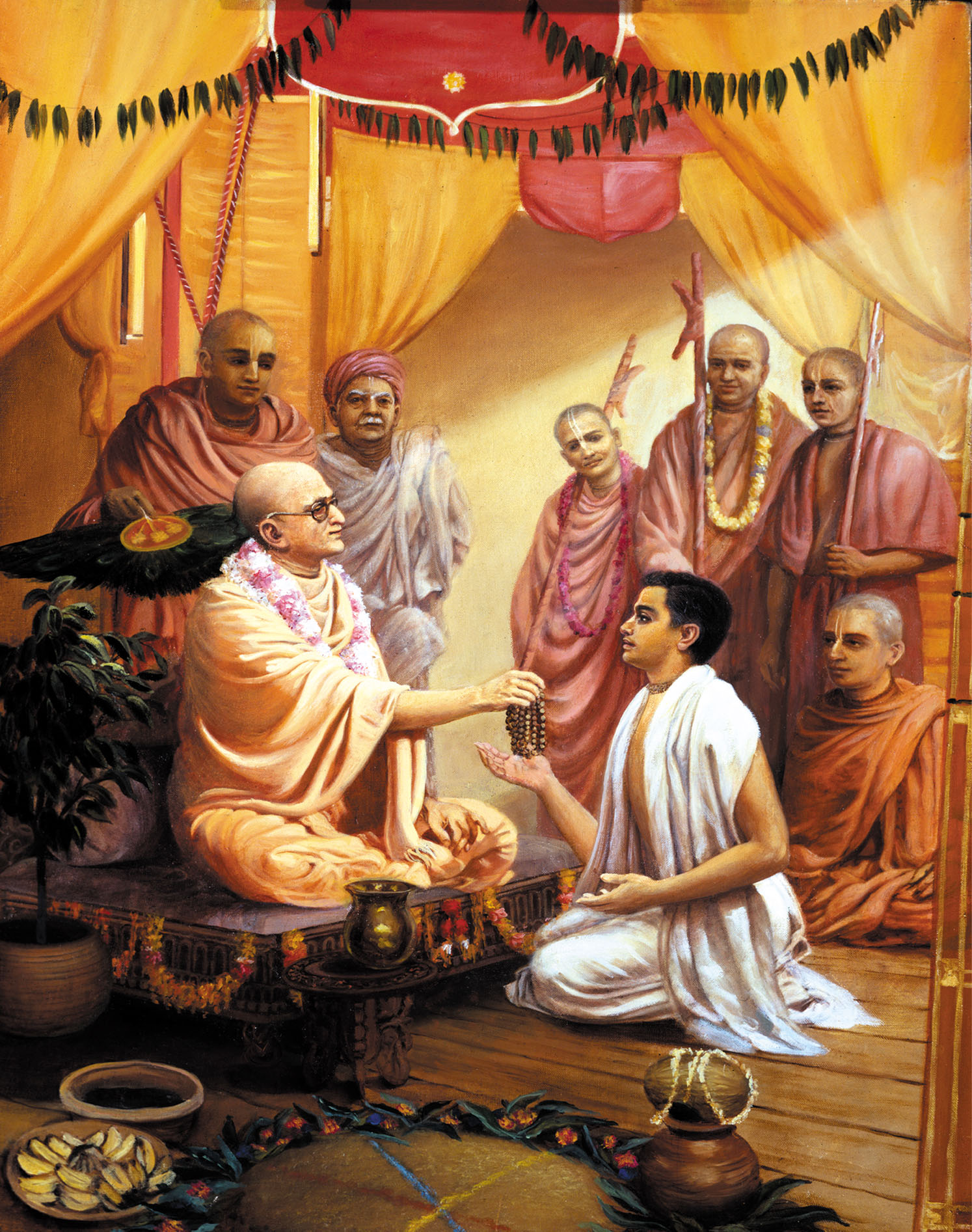
The Sadhu’s Blessing
Curse and Boon
Once, a sadhu came to a village where the villagers served the sadhu very attentively. The sadhu stayed the night, and all came to hear his hari-katha and to serve him. The next morning, the sadhu left and cursed the village to be destroyed. He went to the next village where people threw stones and sand at the sadhu, but the sadhu did not complain and went to lie down under a tree.
The entire night people disturbed the sadhu by lighting his place on fire, and throwing stones and tridents in order to kill him. In the early morning, the sadhu was leaving the village when everybody came and chased him away. The sadhu became very happy and gave them a boon, “Your village will have great opulence. Everybody will be rich and reside in five and ten story buildings surrounded by beautiful gardens. God’s blessings will come to you.”
The people from the first and second village came together and asked the sadhu, “Baba, why is it that you cursed the village of the people who served you and blessed the village of the people who disturbed you?”
The sadhu said, “These villagers served me, and therefore I destroyed their village so that they can go and help others in this world. And to these bad villagers who only desire to enjoy, I gave good facilities so that they will not go out of their village and disturb anyone.”
Krsna protects His bhaktas from opulence, respect, name, and fame. And in order to keep away those bad people who fight and disturb others, he gives them opulence. By following the footsteps of the Vaisnavas and developing humility and tolerance, then we can progress in this path. But if the sadhaka cannot tolerate the chastisement, insults, or even slaps from others, then he will find it very difficult to advance.
Are You Ready for Diksa?
One time, a disciple went to his guru and requested for diksa. The guru said, “Yes, I will give you diksa, but first go and bathe in the Ganga.”
At the ghata of the Ganga was a sweeper lady who had previously been instructed by the guru to wait there for this man and to throw dirt at him after he bathed and to then run away to avoid getting beaten by him. The disciple came to the Ganga, bathed, combed his hair, applied tilaka, and dressed in fresh clothes. Just as he was ready to go before his Gurudeva, the sweeper lady threw dirt at him from a distance.
The disciple became very angry and shouted, “I am about to get diksa from my Gurudeva, and you made me dirty again, you useless, tamasika sweeper lady. How can I go like this?” He had no other choice then to take bath again and after that he finally stood in front of his Gurudeva. But the guru said, “Unfortunately, the auspicious time for your diksa came to an end. I will give you diksa on the same day next year.”
One entire year passed, and on the same day, at the same time, the disciple again went to bathe in the Ganga. The guru called the sweeper lady and ordered her, “Collect all the ashes from the kitchen and the cow dung from the cowshed and when the man arrives from taking a bath in the Ganga, shower him with the whole bucket. Once you are done you should quickly run away. Do not worry, I will protect you.”
The disciple arrived nicely prepared, with new shiny white clothes on, and carrying a flower garland for his Gurudeva in his hands. The lady then threw all the contents of the bucket at him, ran away, and hid at a distance to watch the reaction of the man. The man yelled at the lady, “Stupid lady! Last year you were disturbing me, and after I waited an entire year, you again want to ruin my diksa. That’s enough! After taking diksa, I will break you into pieces.” The lady just smiled at him. The disciple again went to bathe in the Ganga and when he returned, the guru said, “You are too late. You have to wait for another year.”
When this day again came after one year, the man was prepared and aware. He hired many guards who were there to protect him from all sides. One of the sweeper lady’s duties was to collect all the stool from the toilet and dump it outside. At that time, there were no toilets like what we have nowadays. There was a toilet some distance away from the house and all the stool went inside a hole, which had to be emptied from time to time.
The guru instructed the sweeper lady, “Instead of dumping the stool, mix it with water and keep it in a cask on the roof of the entrance gate. Hide there with this and when my disciple arrives, dump all of it on his head. You do not have to run and hide yourself. Do not worry; I will watch what he does.”
The lady did as instructed by her Gurudeva. Protected by his guards, the man thought he was safe. But they had not checked on top of the entrance, and as he walked under the gate, the lady showered him with the pot of stool and urine, which covered his whole body and cloth and even went inside his mouth and nose.
This time, the man was not disturbed. He stood there humbly and offered pranama to the sweeper lady, saying, “I accept you as my instructing guru.” At that moment, his guru appeared before him and said, “Now you are ready for diksa. There is no need to bathe again. Now you are truly clean. I will give you the mantra right now.”
This is taror-api-sahisnuna, and when someone has this mood, amanina manadena will naturally result. We should understand that it is due to our own karma that we have to suffer the bad results of our karma, so we should not blame others for this. Guru is very strong, and Bhagavan is even stronger. But if you are a little tolerant, then soon you will see the great result from this tolerance.
There is another story regarding trnad-api-sunicena that I heard from Srila Gurudeva.
Only by Doing This You will be Able to Chant the Holy Name Continuously
There was a dacoit who was detested by common men. After many years of stealing and disturbing others, in his later years, he approached a famous and respected guru for diksa. The guru said, “I will give you diksa, but there is one condition. Everyday, you should sit from morning till evening in front of the temple’s gate as a gatekeeper. You should shave your head, put tilaka on your body, and keep a mala in your hand. If you do not get disturbed by whatever the people offer to you, then I will give you diksa-mantras.”
The disciple followed the order of his Gurudeva, but many people who came to the temple used to insult him. They said, “Look at this dacoit. He is like a cat that lost all her teeth, and since she is now unable to eat mice and snakes, she became a Vaisnavi.”
Other people compared him to a mullah who does not go to the mosque anymore due to old age, and considers himself a Kazi. They said, “Oh, before he was a dacoit, and now he pretends to be a sadhu.” Hearing all these insults from the people, the disciple approached his guru and said, “O Gurudeva, I can’t tolerate this anymore. This is not possible.” But the guru insisted that he continue his service as the gatekeeper.
Daily for six months, he tolerated the people abusing him and even throwing garbage at him. He went again before his guru and said, “Gurudeva, I would rather die than continue to sit at the gate.” But the guru said, “Your time as a gatekeeper is almost over. You only have to do this service for a few more days.”
Reluctantly, the man again took up his post at the gate the next day, but this time everything was different. The people glorified him and his Gurudeva. “Oh this guru is like a touchstone! He changed his disciple from a dacoit into a real sadhu! Everybody always abuses and insults him, but he stays calm. This guru is really a sad-guru.” People now offered respect and presented flower garlands, fruits, and donations to the man.
In the evening, the disciple went before his Gurudeva who inquired from him about his day as the gatekeeper. The disciple answered, “O Gurudeva, today I am very happy because everybody is now giving me so much respect.”
“This is much worse for you,” the guru said. “Never accept anything independently. Anything the people offer to you, you should bring to me. This is not for you. Do not think that after serving for six months you are now worthy of respect and worship.”
People have a lot of sins and pious activities from their past. Do not think that simply by going to the dhama your past karma will vanish. By chanting krsna-nama, the sinful reactions to your karma disappear, but Krsna keeps some remnant there, to help you further advance in your bhajana.
Both your sins and pious activities will remain present with you. And if people torment and insult you, then they steal away your anarthas, false ego, and all your sins and offenses. People come to the Vaisnavas and take a share of other people’s anarthas, sins, and offenses by criticizing them. On the other hand, if somebody offers respect to the Vaisnavas, then he collects sukrti.
The guru told his disciple, “For six months all the people stole your anarthas and purified you. Now you have some sukrti, but if you accept the offerings of these people and think that you can bless them, then they will take all your bhakti-sukrti, and all will be lost.”
To avoid this, the Guru-varga offers everything to Lord Krsna. They never keep anything for themselves.
The guru instructed his disciple, “You should continue being the gatekeeper for another six months, but you should offer everything that comes to me and I will offer to Bhagavan. Then you will be protected from the effects of the honor of others.” Six months later, he was trnad-api-sunicena and amanina manadena as the result; he offered respect to everyone without expecting their respects in return. Then kirtaniyah sada harih, one is able to chant the holy name continuously.
If one thinks himself to be a great scholar or acarya, and does not offer respect to others, then kirtaniyah sada harih is not possible. Only when the sadhaka is trnad-api-sunicena, taror-api-sahisnuna, and amanina manadena, is it possible to perform kirtaniyah sada harih.